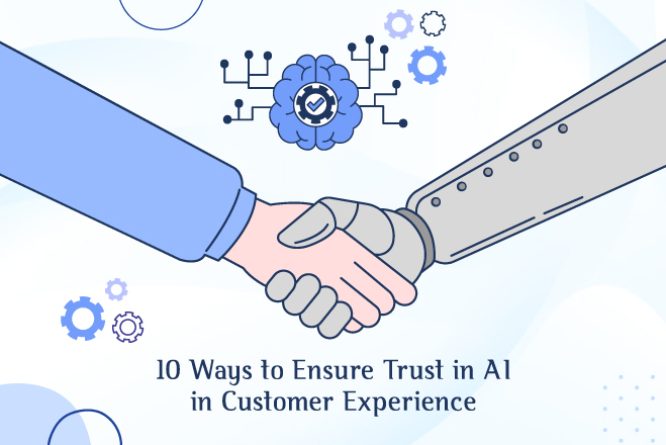
Artificial intelligence (AI) is revolutionizing the way businesses engage with customers. For B2B leaders and other business executives in the U.S., adopting AI in customer experience is no longer optional. It is essential. AI enables companies to deliver faster, more personalized, and efficient services. It helps in making it easier to meet growing customer expectations.
However, trust remains a crucial factor. Customers expect transparency, privacy, and respect in how AI handles their information and queries. Without trust, even the most advanced AI can alienate customers.
This blog explores 10 proven ways to build and maintain trust in AI in customer experience. It also explains the role of AI in customer support and how businesses can utilize it to enhance their customer service while maintaining a human touch.
What is Customer Experience?
Customer experience (CX) encompasses every interaction a customer has with a company, encompassing all touchpoints and interactions. It spans the entire customer journey, from the first discovery to purchase and ongoing support. In B2B environments, CX is critical because the relationships tend to be long-term and involve complex solutions.
CX encompasses all points of customer support, including contact, phone calls, emails, live chats, and social media. Effective CX management ensures consistency and satisfaction across these channels.
“By 2029, agentic AI will autonomously resolve 80% of common customer service issues without human intervention, leading to a 30% reduction in operational costs.” - Gartner
Many businesses adopt customer support outsourcing to meet increasing demand while maintaining quality. Outsourcing allows companies to leverage specialized teams and advanced technologies, including AI, to deliver a seamless customer experience.
What is the Role of AI in Customer Experience?
AI in customer experience refers to the use of AI technologies to improve customer interactions. This includes generative AI, chatbots, predictive analytics, and automated workflows. AI tools can analyze real-time data, predict customer behavior, and offer personalized solutions.
By applying AI, companies can reduce response times, enhance accuracy, and tailor interactions to each customer's needs. AI-powered platforms can handle repetitive tasks, freeing human agents to focus on complex issues. This balance leads to improved overall customer service experiences.
A survey shows 87% of customer service leaders say conversational AI boosts productivity, 80% view it as essential, and 72% expect it to increase revenue and profitability. 65% of support agents report that AI tools improve their productivity
Customers today expect companies to use innovative technology to enhance their experience. But they also want the usage of AI to be ethical and responsible. Transparency and control are key to earning their trust.
10 Ways to Ensure Trust in AI in Customer Experience
1. Be Transparent about AI Usage
Transparency is the foundation of trust when deploying AI in customer experience. Customers have the right to know when they are interacting with an AI system rather than a human. Communicate this at the start of any chat, call, or interaction. This honesty builds credibility.
Additionally, explain how AI works behind the scenes to improve service. For example, you might share that AI analyzes data to provide faster answers or helps route queries to the correct department.
Avoid trying to make AI appear human, as this can backfire and reduce trust. Customers appreciate when companies are upfront about the role of AI and its capabilities. According to Zendesk, 64% of customers are willing to engage with AI if they know what to expect.
By being transparent, you help customers feel respected and in control. Many businesses incorporate this openness into their AI-driven customer support strategies to create a positive experience.
2. Ensure Data Security and Privacy
Trust is impossible without protecting customer data. AI systems often handle sensitive information, making security a top priority. Businesses must comply with regulations such as GDPR and CCPA, which outline the guidelines for collecting, storing, and processing personal data.
Using strong encryption, secure servers, and limited access protocols protects data from breaches. Inform customers about your privacy policies and data usage practices to reassure them of your commitment to their privacy.
Many companies partner with top customer support outsourcing companies in the US, which are known for their high standards in data security. This reduces risk and builds customer confidence.
Customers expect brands to be responsible stewards of their information. Mishandling data not only damages trust but can also lead to costly legal issues and damage to the brand. Protecting privacy should be an integral part of every AI implementation.
3. Combine AI with Human Agents
AI excels at handling routine queries, but customers still value the empathy and judgment only humans can provide. For complex issues or emotional situations, human intervention is crucial.
Using a hybrid approach, where AI manages basic requests and humans handle exceptions, ensures better service. Customers know they can escalate problems to a real person whenever needed, which boosts their trust.
This model allows companies to scale efficiently without sacrificing quality. Human agents supported by AI can focus on tasks that require creativity, empathy, and problem-solving.
AI alone cannot replicate the nuance of human conversation. The best CX blends AI technology with human care to create seamless and personalized customer journeys. Many firms offering customer support outsourcing follow this balanced approach.
4. Respect Personalization Boundaries
AI can enhance personalized customer experiences by analyzing past interactions and customer behavior. Personalization enables the delivery of relevant recommendations and timely responses, ultimately improving customer satisfaction.
However, companies must respect privacy and avoid making customers feel over-monitored or uncomfortable. Use AI to offer value, not to intrude.
Consent is key. Customers should be aware of what data is collected and how it will be used. Overly aggressive targeting or invasive personalization can erode trust and push customers away.
When done correctly, AI-driven personalization makes interactions smoother and more meaningful. This ability to personalize interactions effectively is a core benefit of integrating AI in customer experience CX.
5. Train AI with Ethical and Inclusive Data
AI’s effectiveness depends heavily on the quality of the data it learns from. Biased or incomplete datasets can produce unfair or inaccurate outcomes, damaging customer trust.
Businesses must ensure that training data reflects diverse populations and is free from discriminatory elements. Inclusive datasets enable AI to understand diverse languages, cultures, and customer needs.
Regular audits of AI models are crucial for identifying and rectifying biases or errors. Ethical AI practices improve fairness, transparency, and overall reliability.
By building AI systems on solid, ethical foundations, companies can enhance the customer experience across all customer segments and maintain a positive brand image. With the implementation of AI in customer support, companies can experience multiple benefits of outsourcing customer support.
6. Regularly Monitor AI Output
AI should not be “set and forget.” Ongoing monitoring and evaluation are crucial for maintaining quality and trustworthiness.
Track key metrics, including resolution rates, response times, and customer satisfaction scores. Be aware of patterns where AI may misinterpret queries or provide subpar answers.
Gathering feedback from customers and frontline teams helps identify areas for improvement. Use this information to retrain AI models and improve workflows.
Continuous evaluation ensures AI supports rather than harms the customer experience. Companies that closely monitor AI performance tend to achieve better results and stronger trust.
7. Set Limits on AI's Scope
Define clear boundaries for what AI can and cannot do. For example, AI may excel at answering FAQs but may not be well-suited for handling disputes or sensitive topics.
Setting expectations with customers about AI’s role prevents frustration and confusion. Always provide an option to speak with a live representative.
Limiting AI’s scope also reduces the risk of errors in critical situations, ensuring the quality of customer service experiences remains high.
Many organizations that follow current customer support trends in 2025 emphasize clear AI limits to maintain customer trust.
8. Teach AI Emotional Intelligence
Though AI does not experience emotions, it can be programmed to recognize emotional cues in text or speech. Sentiment analysis enables AI to detect emotions such as frustration, urgency, or satisfaction.
Responding with appropriate tone and empathy. Using polite language or offering to escalate helps build rapport with customers.
Emotionally aware AI enhances the customer experience, particularly in high-stress or sensitive situations. It creates a perception of understanding even without human involvement.
This soft skill is becoming increasingly important as customers expect more than transactional interactions; they want to feel heard and valued.
9. Test with Real Customers before Scaling
Pilot testing AI with real customers before a full rollout uncovers potential issues early. This phase helps businesses observe how AI interacts in real-world scenarios.
Feedback from testers can reveal gaps in understanding, usability challenges, or unexpected sources of frustration. Adjustments made during testing improve the final experience.
Staged rollouts build internal and external confidence. They allow gradual training for human agents working alongside AI tools.
Many successful companies and customer support outsourcing providers rely on pilot phases to refine AI systems before wider deployment.
10. Align AI with your Brand Values
Your AI should reflect your company’s tone, style, and values. If your brand is known for warmth, professionalism, or speed, your AI must embody those qualities.
Consistency across channels builds familiarity and trust. Customers are more comfortable interacting with AI that “sounds” like your brand.
This includes not just language but also how AI handles issues and treats customers. AI is an extension of your brand identity and should uphold your standards.
Aligning AI with your brand ensures customers receive a cohesive experience, strengthening loyalty and trust over time.
Considering Outsourcing? See How Much You Can Save Compared to In-House Hiring- Introducing Outsourcing Cost Calculator
Role of AI in Customer Support
AI is playing an increasingly critical role in modern customer support outsourcing. It has revolutionized how companies manage customer interactions, streamline workflows, and deliver service.
One of the primary advantages of AI in customer support is its ability to handle large volumes of requests efficiently. AI-powered chatbots and virtual assistants can answer common questions 24/7, providing instant responses without wait times. This not only reduces operational costs but also enhances customer satisfaction by promptly addressing their needs and concerns.
AI tools also analyze real-time data to predict issues before they escalate. For example, AI can monitor social media sentiment or call patterns to identify rising complaints. As a result, it allows teams to intervene proactively.
Moreover, AI enhances support by personalizing responses. By using past interactions and customer data, AI systems tailor messages and recommendations to individual preferences. Improving the overall customer experience.
Despite automation, human intervention remains essential. AI complements human agents by freeing them from repetitive tasks. It allows them to focus on complex or sensitive issues that require empathy and judgment.
The integration of AI in customer support also enables businesses to scale their service capabilities without compromising quality. Many companies outsource these AI-augmented support teams to experts, enabling them to meet the increasing expectations of their customers efficiently.
In summary, AI in customer support is not about replacing humans—it is about empowering them, improving efficiency, and enhancing personalized service, all of which contribute to building trust and long-term customer relationships.
Conclusion
AI is reshaping customer experience, offering speed, personalization, and efficiency. But trust is key. Without it, AI can become a barrier instead of a bridge.
By following these 10 strategies alongside transparency, data security, ethical AI, human collaboration, and brand alignment, one can ensure trust in AI in customer experience. Businesses can ensure that their AI-powered CX feels trustworthy and valuable.
For B2B leaders, establishing this trust is crucial for achieving lasting success. Utilize AI as a tool to enhance your team's capabilities and optimize the entire customer journey.
Stay informed and adapt to evolving customer support and AI trends in 2025 to keep your AI practices current and reliable.
If you want to experience the best AI-driven customer support outsourcing services, then BolsterBiz is the right place for you.
Schedule a Free Consultation today
FAQs about AI in Customer Experience
1. What is trust important when using AI in customer experience?
Trust ensures customers feel safe sharing their data and interacting with AI systems. Without trust, customers may avoid AI-powered channels, which can lead to reduced efficiency and satisfaction.
2. How can AI personalize customer interactions responsibly?
By using consented customer data and applying AI to tailor communications based on real-time behavior, while respecting privacy and avoiding intrusive targeting.
3. What is generative AI's role in customer service?
Generative AI helps create personalized replies, summaries, and content, speeding up responses and supporting human agents.
4. Can AI detect customer emotions?
Yes, through sentiment analysis, AI can recognize tone and urgency, allowing it to respond empathetically or escalate to humans when needed.
5. Will AI replace human customer service agents?
No. AI handles repetitive tasks, while human agents manage complex, emotional, or nuanced issues. Both work together to improve customer experience.