In today’s fast-paced digital economy, the B2B SaaS industry is evolving at an unprecedented rate. With shifting buyer behaviors, AI integration, rising security demands, and the push for operational efficiency, staying ahead is no longer optional—SaaS businesses must survive and scale.
As we step into 2025, business leaders are no longer just exploring tools—they’re investing in smarter, leaner, and real-time SaaS solutions that align with customer needs and compliance. But what exactly should you be paying attention to?
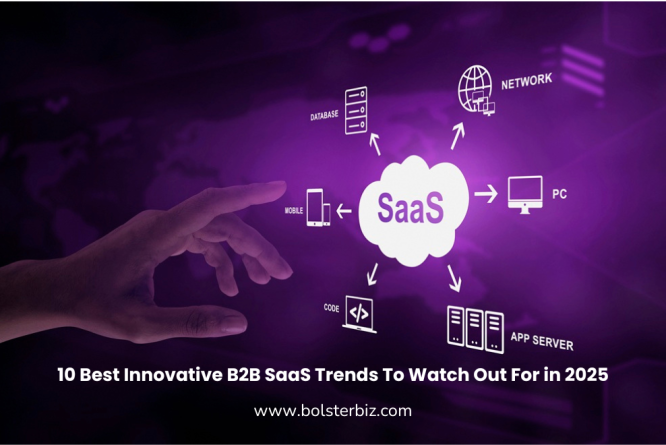
This guide uncovers the 10 most innovative B2B SaaS trends shaping the future of software. From AI-powered platforms to vertical SaaS solutions, these trends are redefining how companies operate, grow revenue, and enhance the user experience.
If you’re a founder, C-level executive, or decision-maker in the SaaS space, now is the time to act. Adopting these trends and knowing when to outsource functions like customer support, internet research, or IT staff augmentation can be the edge your business needs.
Let’s explore what’s next for B2B SaaS in 2025 and how your company can lead the charge.
Top 10 Game-Changing B2B SaaS Trends in 2025 Every Leader Must Know
The SaaS industry is experiencing rapid growth. And that is also a sign of making your teams focus even more on customers’ needs. But that is only possible when you know the trending SaaS innovations coming your way. Let’s take a look at the B2B SaaS trends in 2025 one by one.
1. Hyper-Personalized SaaS Experiences through AI-Powered Intelligence
The rise of AI-powered personalization is transforming how SaaS platforms connect with business users. In 2025, B2B SaaS companies are doubling down on delivering tailored solutions based on user behavior, industry needs, and real-time data.
Gone are the days of one-size-fits-all SaaS applications. Businesses expect platforms that adapt automatically, whether it’s dashboards that update based on usage patterns or automation tools that adjust messaging in real-time, and expect personalization.
According to Twilio Segment, 69% of customers are more likely to purchase from brands that offer personalized experiences. For SaaS, this directly impacts customer retention and revenue growth.
With predictive analytics, platforms now recommend actions, automate workflows, and even forecast churn. This enhances user experience, reduces friction, and fosters deeper engagement.
To stay competitive, many SaaS leaders are choosing to outsource customer support and backend processes. This enables internal teams to focus on developing more innovative, more adaptable products.
2. Rise of Vertical SaaS for Industry-Specific Solutions
Vertical SaaS is gaining momentum in 2025 as companies seek niche tools tailored to their industry’s specific needs. Unlike horizontal SaaS, which serves broad functions, vertical SaaS is tailored to particular sectors, such as healthcare, legal, construction, and finance.
This trend is powerful among mid-size enterprises and startups seeking agility and accuracy. Vertical SaaS solutions understand sector-specific pain points.
For example, a legal tech SaaS tool may automate compliance tracking, while a real estate SaaS solution streamlines property management. Customization enhances operational efficiency, boosts adoption, and improves customer satisfaction.
It also supports faster onboarding and simplifies integrations. SaaS businesses targeting these markets gain loyalty by deeply understanding industry workflows.
To focus on their core software development, many of these companies utilize IT staff augmentation or internet research services to expand product features or market reach quickly.
3. ESG and Sustainability Becoming Core to SaaS Strategy
Environmental, Social, and Governance (ESG) initiatives are no longer just buzzwords; they are a fundamental part of corporate strategy. Investors and customers alike are evaluating SaaS companies based on their sustainability metrics and ethical practices.
A report predicts that by 2026, 75% of B2B buyers will require ESG data and verification from their SaaS vendors .
SaaS companies are responding by integrating carbon footprint trackers, transparent data centers, and diversity-focused HR features into their SaaS tools. They are also publishing ESG impact reports as part of their core offering.
This shift isn’t just good for branding. It improves trust, attracts funding, and aligns with customer expectations.
To meet these growing expectations while managing costs, forward-thinking companies are adopting cost-effective outsourcing models for non-core tasks, such as customer support outsourcing or digital marketing.
4. Low-Code and No-Code Platforms Fueling Innovation
In 2025, low-code and no-code development tools are reshaping how companies build and scale products. These platforms allow users to develop apps and workflows with minimal coding, accelerating software development across organizations.
For B2B SaaS providers, this trend offers significant flexibility. Teams can prototype fast, launch MVPs quicker, and iterate based on customer feedback.
According to Forrester, predicts a projection of the combined low-code and digital process automation market approaching $50 billion by 2028. The demand is rising among both startups and enterprises looking for agile, scalable, and cost-effective solutions.
It’s also empowering marketing, operations, and customer success teams to launch internal tools without waiting on dev cycles.
For support, many companies pair low-code teams with outsourced internet research partners who feed market intelligence and competitor analysis to keep the product roadmap aligned with demand.
5. Cybersecurity and Compliance as Differentiators
Security and compliance are more than operational checkboxes—they’re key brand differentiators. As cyber threats become more sophisticated, customers are scrutinizing how SaaS platforms store, manage, and protect data.
IBM reports that the average cost of a data breach in the U.S. reached $9.48 million in 2023, the highest globally. The pressure is on for B2B SaaS firms to embed security at every layer.
From SOC 2 and GDPR compliance to zero-trust frameworks and continuous vulnerability testing, 2025 will see an industry-wide shift from reactive to proactive security.
Automated compliance workflows and built-in audit trails are becoming core features of SaaS solutions. This not only reduces risk but also boosts buyer confidence.
Many SaaS companies are outsourcing their compliance documentation, policy management, or monitoring functions to reduce internal load and maintain operational efficiency.
6. AI-powered Predictive Analytics for Smarter Decision-Making
Predictive analytics powered by AI is quickly becoming a must-have feature in modern SaaS offerings. Businesses want more than static dashboards—they need foresight.
In 2025, AI-powered models will help forecast customer churn, optimize pricing, and identify anomalies across datasets. This empowers B2B clients to make informed decisions based on future possibilities rather than past performance.
McKinsey estimates that predictive analytics can improve business performance by up to 20%. It also improves customer retention, enhances upsell/cross-sell strategies, and unlocks better ROI.
From sales platforms to project management tools, predictive features are being embedded across verticals.
To support these developments, many SaaS companies rely on data analytics outsourcing partners who bring in domain-specific data science capabilities without the burden of building in-house teams.
7. Real-Time Collaboration as a Standard, not a Feature
As remote and hybrid work continues, real-time collaboration is no longer a premium feature—it’s expected. SaaS platforms that enable seamless, synchronous teamwork across locations are dominating the market.
Tools like Notion, ClickUp, and Monday.com are setting the standard. In 2025, expect even more platforms to introduce embedded video, whiteboarding, and live editing to meet team needs.
The trend isn’t limited to communication. Sales tools, design platforms, and even CRMs are integrating real-time collaboration to boost team agility.
This evolution supports faster decisions, stronger alignment, and better project outcomes. It’s especially impactful for teams using project management tools to coordinate across departments or time zones.
To keep pace, SaaS companies are outsourcing parts of their infrastructure and development to focus internal energy on collaboration features that drive adoption.
8. API-First Integrations and Modular SaaS Architectures
Customers today demand flexibility. That’s why API-first architectures are one of the top B2B SaaS trends to watch in 2025. Instead of building monolithic systems, SaaS firms are shifting to modular, plug-and-play approaches.
API-first design allows third-party developers and clients to easily integrate tools into their workflows. It also enables faster scaling, easier feature rollouts, and broader market adoption.
This trend is helping SaaS providers reach more customers without reworking the core product. It also reduces downtime and support tickets.
Many of these architectures are supported by backend teams or outsourced software development partners who specialize in scalable infrastructure design.
9. Outsourcing as a Strategic Growth Lever
A trend that often goes unspoken but is crucial for scaling is strategic outsourcing. In 2025, more SaaS companies are recognizing the value of outsourcing non-core functions, such as customer support, digital marketing, IT staff augmentation, and internet research.
Why? Because it helps companies focus on core innovation while maintaining quality across the board. Outsourcing is no longer about cost-cutting alone—it’s about speed, flexibility, and access to global talent.
According to Deloitte, 70% of technology companies cite scalability and access to expertise as their top reasons for outsourcing.
For C-level executives, it’s a way to meet aggressive goals without burning out internal teams. The key is partnering with providers who align with your goals and understand the SaaS lifecycle.
10. The Rise of Embedded SaaS in Other Platforms
In 2025, we’re seeing SaaS go stealth. Instead of being standalone platforms, many solutions are now embedded inside other tools or workflows. Think payroll integrations in HR software or analytics modules inside eCommerce dashboards.
This trend reduces tool fatigue, improves user experience, and delivers more value in context. It also unlocks new distribution channels and revenue streams for SaaS providers.
As demand grows, more SaaS companies will need to design for embedded use cases—offering SDKs, white-label versions, or API toolkits.
Supporting these efforts often requires the development of niche teams and internet research to analyze where and how these integrations bring the most value.
Conclusion
The future of B2B SaaS trends in 2025 is clear: innovation must be agile, secure, and centered around user value. Whether through AI-powered tools, industry-specific platforms, or scalable collaboration features, SaaS companies must evolve to stay competitive.
Just as important is knowing when to build and when to partner. Innovative outsourcing, encompassing functions such as customer support, digital marketing, IT staff augmentation, and data analytics, can provide the flexibility necessary to innovate more quickly and grow stronger.
For SaaS leaders ready to lead the next wave, the opportunity is massive. Embrace these trends, invest in strategic partnerships, and let 2025 be the year your SaaS business scales with purpose.
FAQs about Top B2B SaaS Trends in 2025
1. What are the most significant B2B SaaS trends in 2025?
Key trends include the integration of AI and machine learning, the rise of vertical SaaS solutions, the adoption of low-code/no-code platforms, enhanced data security measures, product-led growth strategies, API-first development, and the emergence of micro-SaaS businesses.
2. How is AI transforming the SaaS industry?
AI enhances personalization, automates routine tasks, and provides predictive analytics, leading to improved user experiences and operational efficiency.
3. Why is vertical SaaS gaining popularity?
Vertical SaaS offers industry-specific solutions, ensuring better compliance, customized features, and addressing unique business needs effectively.
4. What role do low-code/no-code platforms play in SaaS development?
These platforms enable faster application development by allowing non-developers to build applications, reducing development time and costs.
5. How can businesses prepare for these emerging trends?
Businesses should invest in AI technologies, explore vertical SaaS solutions tailored to their industry, adopt low-code/no-code platforms for agility, prioritize data security, and focus on product-led growth strategies.