[wpsummarize]Customer service is where brands quietly win or lose. Most companies don’t realize they're losing customers until it's too late. There’s rarely a dramatic exit. No angry email. No final warning.
The customer just stops logging in. Stops responding. Stops renewing.
And when leaders finally look into it, the product isn’t the problem. Pricing isn’t either. The issue usually lies within the service experience. Slow replies. Disconnected conversations. Support that feels scripted when the situation clearly isn’t.
This is exactly why customer service trends deserve serious attention as we head into 2026.
Customer service is no longer a backend function. It has moved into the spotlight. Buyers now judge brands not just on what they sell, but on how they respond when something goes wrong. And something always goes wrong eventually.
But over the course of time, customer expectations have changed.
Customers want help that feels immediate, relevant, and human. They expect companies to remember past interactions, understand context, and respond without friction. When that doesn’t happen, frustration builds fast.
For leadership teams, this creates pressure. Costs are rising. Volumes are unpredictable. Talent is harder to retain. Meanwhile, customer patience is shrinking.
This is where understanding modern customer service trends becomes essential. Not as a theory. But as a practical guide for how service actually needs to operate in the real world.
| Key Takeaways |
|
Many companies are discovering that redesigning service delivery, including the smart use of customer support outsourcing, is essential. It is no longer optional. It’s becoming part of how resilient businesses are built.
Before diving deeper, it helps to ground this shift in structured service models like business process outsourcing, which has quietly evolved over the last decade.
Now, let's explore the ten customer service trends in 2026 that Businesses in the US should know. But first, let's learn some basics.
What do we Really Mean by Customer Service Trends?
A customer service trend is not a fancy new tool or buzzword.
It’s a visible shift in how customers behave and what they expect during moments of need. These shifts force companies to rethink how support is delivered, measured, and scaled.
In 2026, customer service trends are shaped by three realities:
- Customers compare service experiences across industries, not just competitors
- Technology enables speed, but customers still want empathy
- Poor service is now a stronger churn driver than product gaps
For B2B and B2C leaders alike, service has become a retention engine. Those who adapt early tend to keep customers longer and spend less on acquisition. Also, offering top-notch customer satisfaction is one of the golden rules of customer service.
Many organizations revisit fundamentals like ways to keep your customers happy as they modernize service strategies.
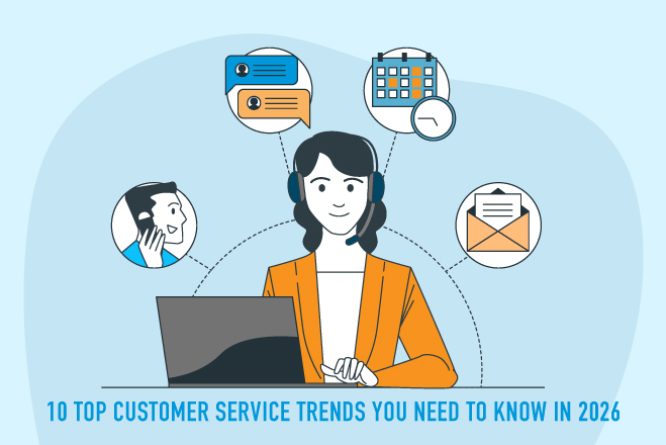
What are the 10 Top Customer Service Trends Businesses Should Know in 2026?
Customer expectations in the United States have reached a level where service quality now significantly influences purchasing decisions and long-term loyalty. Customers no longer tolerate slow responses, generic answers, or fragmented support journeys. They want help that feels informed, timely, and aligned with their context. As a result, organizations must find ways to improve customer experience not just incrementally, but structurally.
At the same time, customer service teams are being asked to do more with less. They must handle increasing ticket volumes, support more channels, and still deliver empathy and accuracy in every interaction. This is a real operational challenge—not just a technology decision. Service organizations that invest in stronger processes, clearer training, and smarter tools tend to perform better on customer satisfaction metrics and retention.
All of this aligns with broader research showing how customer expectations are shaping the competitive landscape. For example, a report suggests that nearly all consumers (around 99%) say customer service influences their buying decisions, and a significant majority consider it very important or essential.
Against this backdrop, U.S. businesses must understand where service is heading and how to align teams, tools, and strategy. Here are the 10 key customer service trends.
1. Proactive Support is a Must Have
A few years ago, proactive support felt impressive. In 2026, it’s expected.
Customers don’t want to report issues that could have been detected earlier. They expect companies to notice unusual behavior, declining usage, or repeated friction points and step in before frustration peaks.
This shift forces service teams to move away from ticket-driven thinking. Instead of waiting, teams monitor signals and act early. That might mean reaching out when a feature isn’t used correctly or flagging a recurring error pattern before it escalates.
Proactive service reduces inbound volume and improves trust. It also makes call centers far more effective, because agents spend less time firefighting and more time guiding.
2. Outsourcing Customer Support is a Strategic Game Changer
One of the customer service trends is that outsourcing used to be a cost conversation. In 2026, it’s operational.
Leadership teams are realizing that scaling internal teams endlessly is neither efficient nor sustainable. Instead, many are blending internal ownership with outsourced execution to stay flexible.
Modern outsourcing partners don’t just answer tickets. They bring trained support agents, defined processes, and performance accountability. This helps companies maintain service quality during growth spurts or seasonal spikes.
Understanding the different types of BPO allows businesses to align outsourcing with specific service goals rather than treating it as a one-size solution.
Find Out: How much you can save with outsourcing by using this free outsourcing cost calculator
3. Speed Matters, but Context Matters More
Everyone wants fast replies. But customers don’t want rushed, irrelevant answers.
In 2026, the focus shifts from raw speed to meaningful resolution. Faster replies only help when agents understand the full situation. That includes past interactions, product usage, and emotional tone.
Customers notice when they have to repeat themselves. They notice even more when agents already know the issue.
Reducing response times while preserving quality requires better routing, smarter tools, and well-trained teams. Many companies rethink delivery channels, such as phone support outsourcing, to maintain consistency.
4. AI Becomes a Silent Assistant, but not the Star
AI is everywhere now and that counts as one of the major customer service trends in 2026 in the US. But customers don’t want to feel like they’re talking to a machine.
In 2026, ai powered systems operate mostly behind the scenes. Artificial intelligence helps agents find answers faster, summarize conversations, and suggest next steps.
This improves efficiency without breaking customer trust.
AI also helps surface relevant knowledge bases during live interactions, reducing guesswork and errors.
Companies starting this journey often explore AI in customer support as a foundation rather than a replacement strategy.
5. Personalization has to feel Human or it Fails
Personalization has been overused. In reality, customers just want to feel understood.
In 2026, personalization depends on the responsible use of customer data. It’s about recognizing patterns and tailoring support based on where someone is in their customer journey, rather than over-automating messages.
Thoughtful personalization improves the overall customer service experience and strengthens loyalty. It also supports personalized interactions that don’t feel forced.
6. Omnichannel Support is finally Growing
Customers don’t think in channels. They switch from live chat to email to social media without noticing. They expect companies to follow.
In 2026, omnichannel support is less about being everywhere and more about being connected. Context must carry across touchpoints. Conversations shouldn’t reset.
Many businesses rely on specialized models like live chat outsourcing or outsource in-app support services to maintain quality without spreading internal teams thin.
7. Cost Optimization without Service Erosion
Service costs are under scrutiny. But cutting corners hurts retention.
In 2026, leaders focus on smarter cost structures rather than blunt reductions. Outsourcing, automation, and forecasting play a role here. Tools like an outsourcing cost calculator help quantify savings realistically.
Check Out: The best customer support outsourcing services tailored for your business.
A report cites PwC’s findings that companies that outsource their back-office functions can save up to 40% of their operational costs, allowing them to redirect these resources toward strategic activities such as innovation and growth.
Savings are often reinvested into training and experience design.
8. Empathy is the Differentiator
No technology replaces empathy, which is one of the trending customer service trends in 2026.
Customers still want reassurance during stressful moments. This is where human-led customer care becomes critical. AI handles volume. Humans handle nuance.
Well-supported agents build trust, especially during escalations. This balance defines mature service organizations.
9. Offshore and Nearshore Models Mature
Global service delivery is more reliable now, and US leaders must focus on it to improve the customer experience and drive success.
Companies choose between offshore vs nearshore outsourcing based on language, coverage, and compliance needs.
BPOs and outsourcing companies like BolsterBiz offer offshore outsourcing services and emphasize transparency, training, and integration rather than cost alone.
10. Feedback becomes a Continuous Loop
Collecting customer feedback is easy. Acting on it is harder. But company leaders must start working on it now and your outsourcing team can easily handle that without emptying your pockets.
In 2026, feedback loops operate in near-real-time. Leaders monitor signals, test changes, and communicate outcomes clearly.
Bain & Company reports that companies excelling in customer experience grow revenues 4–8% faster than their markets.
Feedback-driven iteration strengthens support teams and improves faster responses over time.
Conclusion
Customer Service is a long game that can be easily played with the help of outsourcing. Customer service doesn’t create headlines, but can move your business forward silently.
But it quietly shapes reputation, loyalty, and long-term growth.
In 2026, the companies that win are not the loudest. They are the most consistent. They invest in people, process, and partnerships. They understand that service is not just about fixing problems, but about preventing frustration before it begins.
Understanding customer service trends helps leaders make informed decisions instead of reactive ones. Whether it’s adopting AI carefully, redesigning workflows, or leveraging outsourcing intelligently, the goal remains the same: to deliver value.
Make customers feel supported. Make service feel effortless. And never forget that behind every ticket is a human expectation.
I hope these 10 customer service trends will give you clear picture of the customer success and CX scenario. Plus, if you wish to know how you can keep up with the evolving changes of customer support you can consult BolsterBiz for tailored 24/7 offshore customer support outsourcing services. Our multichannel and omnichannel support services will help you scale efficiently with improved CSAT scores and response times.
Book your free consultation or request a tailored team proposal today.
FAQs about Customer Service Trends in 2026
1. What are customer service trends, and why do they change?
Customer service trends reflect evolving customer expectations, technology adoption, and operational pressures. They change as customer behavior shifts and new tools reshape how support is delivered.
2. How does outsourcing fit into modern customer service strategies?
Outsourcing provides flexibility, trained talent, and scalability. When managed correctly, it strengthens service quality while controlling costs. We at BolsterBi can help you guide with the nitty-gritty and benefits of outsourcing and how our support services align with evolving customer service strategies.
3. Is AI replacing human customer support?
No. AI supports human agents by improving speed and accuracy. Empathy and complex problem-solving still require people.
4. How can businesses prepare for customer service challenges in 2026?
By investing in training, improving data usage, adopting AI responsibly, and designing service models that scale without sacrificing experience. As an outsourcing company or a BPO company, we at BolsterBiz can help US and global businesses to overcome customer service challenges. Our trained expert agents and modern CRM helps companies gain a competitive edge to reduce operational costs and improve their CX rapidly.