Business leaders in the US are under pressure to grow faster while maintaining cost control. Technology is now at the core of that growth. Every company needs modern, user-friendly web applications and digital platforms to reach customers and deliver better experiences. But building these solutions in-house can be expensive and time-consuming.
That’s where front-end development outsourcing comes in.
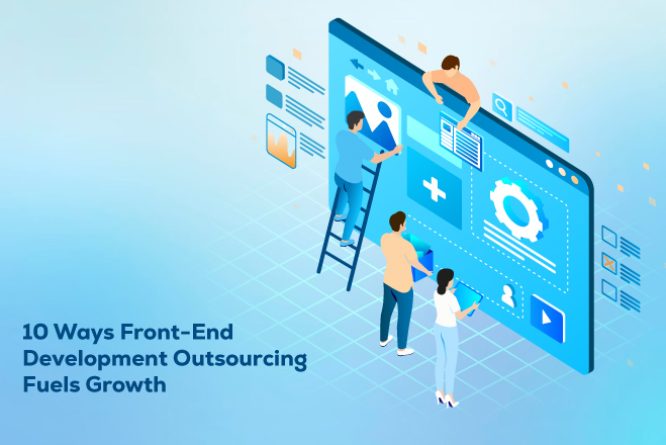
Front-end development outsourcing means hiring skilled developers or an outsourced team to handle the design and coding of your digital platforms. It allows companies to create user interfaces and experiences that are both visually appealing and high-performing, also, without the heavy burden of building a large in-house developer team.
According to a report by Statista, the global IT outsourcing market is projected to reach $588.38 billion by 2025. This demonstrates how companies worldwide view outsourcing as a practical means to scale and save. For US-based B2B leaders, it’s not only about cost. It’s about speed, talent, and focus.
In this blog, we will explore what front-end development outsourcing is, its relationship to IT staff augmentation and DevOps outsourcing, its various types, and ultimately, the 10 powerful ways it fuels business growth.
What is Front-End Development Outsourcing?
Front-end development focuses on the part of websites and applications that users interact with. It encompasses everything users see and experience, including the layout, buttons, navigation, colors, and responsiveness.
Front-end development outsourcing is when companies hire external experts to handle these tasks. Instead of managing every line of code internally, businesses rely on professionals from outsourcing firms to build and maintain the front-end layer of their applications.
This enables companies to meet project requirements more efficiently, stay competitive, and bring their vision to life with modern technologies. It’s handy for businesses that do not have a large in-house development team but need to execute development projects quickly.
What is IT Staff Augmentation?
Many companies opt for IT staff augmentation when they require skilled professionals for specific roles. In simple terms, staff augmentation refers to hiring external IT talent while maintaining in-house management control.
Unlike traditional outsourcing, where you hand over entire development projects, staff augmentation lets you expand your developer team with dedicated experts. You manage their work directly, while the outsourcing partner handles recruitment, payroll, and training.
Why is DevOps Outsourcing?
Another related concept is DevOps outsourcing. DevOps focuses on integrating development and operations to deliver software more quickly and efficiently. By outsourcing DevOps, companies gain access to skilled teams that handle automation, testing, and deployment.
This helps organizations reduce downtime, accelerate releases, and maintain a robust management system for applications. Outsourcing DevOps allows your in-house teams to focus on core activities while experts handle critical tasks behind the scenes.
6 Types of Front-End Development Outsourcing
Front-end work can be sourced through several engagement styles. The right choice depends on your roadmap, project requirements, governance needs, and budget rhythm.
1. Dedicated Team (Extended Team Model)
A dedicated team works as a long-term extension of your developer team. You get consistent capacity, stable velocity, and deep domain familiarity.
The outsourced team typically includes a tech lead, front-end engineers, a QA engineer, and a UI engineer, with optional support for UX and accessibility. You retain product ownership while the vendor handles hiring, onboarding, replacements, and a light management system for delivery.
Use this when you need sustained throughput across multiple development projects or a product line, and you want to keep architectural decisions in-house. It is ideal for complex software development where continuity matters.
2. Project-Based Outsourcing (Fixed-Outcome)
Here, you define the scope, timeline, and acceptance criteria upfront. The vendor delivers a complete front-end design system, user interfaces, components, and integration stubs against agreed milestones. This works well for a one-time launch, a microsite, or a discrete feature set.
Select this option when the scope is clear and you prefer a turnkey outcome over day-to-day management. Risks include scope creep and change friction; mitigate with robust discovery, prototype signoff, and frequent demos.
If you’re weighing staffing options, consider the benefits of IT staff augmentation.
3. Staff Augmentation (On-Demand Capacity)
You add one or more front-end engineers to your internal squad while retaining daily control. This keeps momentum high on your backlog and lets you scale down without layoffs. It’s great when you need to meet a deadline, fulfill project requirements, or require niche skills like accessibility, animations, or performance tuning.
Augmentation suits leaders who want speed without a full vendor handover. You manage the sprint plan and code reviews; the partner supplies talent, bench cover, and replacements.
4. Hybrid Model (Split Ownership)
Combine in-house product and architecture with outsourced execution. For example, keep discovery and UX with your internal squad while using a partner for component builds and test automation. You get flexibility and cost-effectiveness, while protecting your strategy.
This model excels when demand is volatile or when performance, SEO, and accessibility require specialized attention during peak periods.
5. Managed Services/Outcome-Based SLA
The partner owns a slice of the front-end lifecycle, say, design system upkeep, browser support matrices, or Core Web Vitals, under an SLA. You buy outcomes like “maintain Lighthouse scores,” “meet accessibility targets,” or “keep load time under X.”
This works if you want stable, ongoing quality without managing the mechanics. It reduces the operational load on your product leadership, allowing them to focus on core growth initiatives.
If reliability is the goal, augmentation can still complement this model; see these 5 ways IT staff augmentation helps.
6. Build-Operate-Transfer (BOT)
For larger enterprises, the partner sets up a captive developer team, runs it with mature processes, then transitions it to you after a period. You gain a pre-built team, battle-tested workflows, and a lower-risk path to establishing a center of excellence.
Use BOT when you want a long-term base of capabilities but need to start fast. It reduces ramp risk and hands you a working management system and delivery engine you can scale. You can also layer CI/CD and environment provisioning through a partner’s DevOps outsourcing offering to streamline releases.
10 Best Ways Front-End Development Outsourcing Helps Reduce Company Costs
1. Access to Specialized Talent
Finding senior front-end engineers who are familiar with modern frameworks, design systems, accessibility (WCAG), and performance is challenging. A seasoned outsourcing partner provides that mix from day one. You also gain adjacent skills, such as UI engineering, motion design, and testing.
The payoff: faster architectural decisions, fewer rewrites, and better user experience. Experienced partners bring proven patterns for routing, state management, micro-frontends, and component libraries that scale effectively. This shortens the learning curve for your internal team and raises the baseline for delivering high-quality work.
2. Faster Time-to-Market
Every delayed release compounds lost revenue and market share. With front-end development outsourcing, you add committed capacity without the delays of recruiting. You also gain proven sprint rituals, risk logs, and demo cadence that compress time.
Partners arrive with boilerplates, CI templates, and pre-built design tokens, which cut build time. This is especially valuable for multi-brand web applications where shared components accelerate delivery across development projects.
3. Cost Effectiveness without Quality Trade-Offs
Full-time hiring brings salaries, benefits, tooling, and ongoing management. Outsourcing allows you to match spending to outcomes or sprints. You pay for expertise when you need it and pause when you don’t. That’s direct cost effectiveness.
Critically, top outsourcing firms protect quality with coding standards, code review gates, and shared libraries. You get better unit coverage, visual regression tests, and automated accessibility checks, reducing post-release defects.
Need a quick lens on pricing structures? This explainer breaks down the IT staff augmentation pricing model.
4. Improved UX and Conversion
Front-end specialists live in the details that matter: layout shifts, perceived performance, keyboard navigation, and error states. They tune components to be user-friendly, visually appealing, and fast. They also link analytics to UI states, so product managers can see where friction occurs.
The result is smoother user interfaces that reduce drop-offs in critical funnels—sign-up, checkout, and self-service. Your team receives dashboards tied to UX KPIs, such as Core Web Vitals and task completion, which improve product decisions.
5. Elastic Scale for Peaks and Pivots
Roadmaps change. M&A adds new brands. Campaigns create spikes. With a partner, you can add or remove engineers in weeks, not quarters. That elasticity keeps leadership options open.
It also protects your permanent headcount while preserving delivery promises. You right-size squads to meet project requirements without burning out people or missing quarters.
If you’re choosing between vendors, this guide on how to choose the right IT staff augmentation partner will help with due diligence.
6. Focus on Core Strategy and Revenue
When a partner handles the build, your leaders can focus on core initiatives, such as category expansion, partner ecosystems, pricing experiments, and customer success. Engineers focus on architectural direction and integration logic, rather than repetitive UI assembly.
This division of labor compounds. Product marketing ships more experiments. Sales demos improve. Customer success sees fewer UI-related tickets.
7. Lower Delivery Risk through Proven Playbooks
A capable partner brings case studies, reference architectures, and risk checklists. They show how they handled accessibility debt, edge browser bugs, or i18n issues in similar development outsourcing engagements.
You benefit from a stronger management system. Clear RACI, change control, and definition of done. That structure reduces rework and makes status transparent to stakeholders.
For operating guardrails that keep teams on track, review these IT staff augmentation best practices.
8. Tooling, Automation, and DevOps Alignment
Front-end excellence accelerates when CI/CD, testing, and environments are rock solid. Good partners set up linting, unit/UI tests, preview environments, and performance budgets from day one.
They also align with platform teams, so front-end pipelines are reliable. That’s where DevOps outsourcing complements UI work. It involves fewer flaky builds and faster releases. This synergy shortens feedback loops and keeps development services humming.
9. Quality as a Habit, not a Phase
Quality is not a final gate; it’s a habit. Partners embed checklists for accessibility, localization, and visual diffs into daily work. You get enforceable standards, reusable components, and consistent design tokens.
That creates a stable platform for future features, integrations, and brand expansions. It also enhances your reputation for delivering high-quality products, which is crucial in complex B2B buying journeys.
10. Strategic Value Beyond the Launch
The best partners don’t just ship. They bring your vision to life with evolution in mind, featuring feature flags, A/B testing hooks, and observability built in. Your front-end becomes easier to iterate on and safer to change.
Over time, this compounds into faster experiments and clearer ROI on product moves. As your needs mature, you can transition from staff augmentation to a managed services SLA for ongoing maintenance and roadmap guidance.
Choose BolsterBiz for Front-End Development Outsourcing
At BolsterBiz, we understand the challenges of modern businesses. Our expertise spans IT staff augmentation, DevOps outsourcing, Front-end development outsourcing, and a wide range of development services.
We help you build user-friendly web applications, manage complex development projects, and extend your internal teams with top global talent. With years of experience and proven case studies, we ensure cost savings, faster execution, and unmatched quality.
By choosing BolsterBiz as your outsourcing partner, you not only gain access to skilled professionals but also achieve long-term scalability. Our extended teams serve as a natural extension of your organization, enabling you to meet every business challenge with confidence.
Schedule a free consultation today.
Final Thoughts
Growth today depends on digital strength. Front-end development outsourcing enables businesses to scale more quickly, deliver enhanced customer experiences, and reduce costs. From access to top talent and speed, to risk reduction and innovation, outsourcing has become a growth driver for B2B leaders.
For U.S. businesses aiming to compete globally, outsourcing is not just an option; it is a necessity. It is a strategic move. Companies that embrace it can unlock efficiency, achieve cost-effectiveness, and secure future growth.