
Customer support today is no longer a backend function or a tick box operation. It directly impacts revenue, customer retention, and brand reputation. For many leaders, the real question is not whether to invest in support, but how to do it efficiently. That is where the in-house vs outsourced customer service cost debate becomes critical.
If you are scaling operations or trying to control operational costs, this decision affects your long-term profitability.
According to a Deloitte report, companies outsource primarily to reduce costs and improve efficiency. 80% of executives are planning to maintain or increase investment in third-party outsourcing.
In this guide, we break down the real cost comparison, hidden expenses, and strategic trade-offs to help you make an informed decision.
| Key Takeaways |
|
In-house vs Outsource Customer Service Cost: What is the Real Difference?
At a high level, the difference comes down to ownership and cost structure.
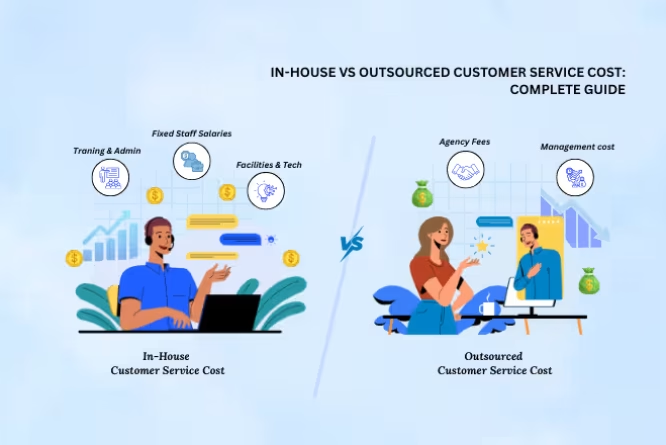
In-house customer support requires a significant investment in people, infrastructure, and ongoing management. Outsourced customer support shifts these responsibilities to outsourcing partners, often at a lower cost and greater flexibility.
However, the real difference is not just visible costs. It lies in long-term efficiency, scalability, and how well your support operations align with business growth.
In addition, if you are new to the outsourcing model, you can start by understanding what customer support is and analyzing it to make an informed decision.
What is In-house Customer Service?
In-house support means building and managing your own internal teams. They handle customer queries, refunds, and all other customer complaints. These teams work within your company’s structure, using your tools and following your processes.
You hire, train, and manage agents directly. This gives you full control over quality, communication, and customer experience.
From a strategic perspective, many companies prefer in-house teams for high-touch interactions. However, this approach comes with high operational costs and limited flexibility.
But leaders can always opt to partner with a business process outsourcing company to balance internal and external operations. Doing so helps reduce costs, improve productivity, and enhance customer satisfaction.
What is Outsourced Customer Service?
Outsourced customer support involves partnering with a third-party provider to handle support operations. This includes phone support, email, live chat, and even social media.
Integrated outsourcing services providers like BolsterBiz bring trained agents, infrastructure, and processes. You pay based on usage, volume, or dedicated time. Different outsourcing models depend on your needs:
- Offshore outsourcing for cost savings
- Nearshore for better time zone alignment
- Onshore for local expertise
Pro tip: Many companies rely on call center outsourcing to efficiently manage high call volumes without increasing internal overhead.
Detailed Cost Comparison: In-house vs Outsourced Customer Service Cost
This is where most decisions are made. When it comes to comparing in-house vs outsourced customer service costs, these are the prime differentiators:
In-house Customer Service Cost Breakdown
Building an internal support team requires significant time and money. The main cost components include:
1. Salaries and Benefits
Hiring full-time employees means fixed salaries, insurance, bonuses, and compliance costs. In the US, full-time support agents can cost $35,000 to $60,000 annually, excluding benefits.
2. Hiring and Training
Recruitment is a cost to the company that takes time and money. You also need to hire and train continuously to maintain quality. It is time-consuming and delays operations for a while until the onboarding and training process is completed.
3. Office Space and Infrastructure
We understand you have a physical office, but as your company grows and scales, you will need a bigger space to accommodate growing teams, too. Hence, office space, hardware, software licenses, and utilities add to operational costs.
4. Technology and Tools
CRM systems, helpdesk software, and analytics tools require subscriptions and maintenance. With customer expectations rising, it is imperative to have automated tools and new-age technology for fast customer service.
5. Management Overhead
Supervisors, team leads, and QA managers further increase costs. Having team leads and managers for each department makes the cost even higher, including benefits and salaries.
6. Hidden Costs
Attrition, downtime, and performance gaps often go unnoticed but impact the bottom line. As a result, you see a decline in customer satisfaction and retention since their problems remain unresolved or delayed. Thus, it is imperative to know the ways to keep your customers happy, and outsourcing can make that happen.
Outsourced Customer Support Cost Breakdown
With outsourcing you can shift most of these operational costs to the provider.
1. Flexible Pricing Models
You pay per agent, per ticket, or per hour. With BolsterBiz, you can start with just one agent and scale as you grow. The pricing starts at ust $8/hour. Outsourcing helps reduce fixed operational costs.
2. No Hiring or Training Costs
Tired of endless hiring cycles and onboarding sessions? A reputable and dedicated outsourcing partner provides trained agents, reducing onboarding time. Plus, you get to choose your team that’s trained to align with your brand from day one.
3. Reduced Infrastructure Expenses
No need to invest in office space or technology. Because investing in office rents and cubicles is a huge add-on to the company’s expenses. But with offshore outsourcing services, you can easily reduce that cost.
4. Scalability without Overhead
You can scale support teams up or down based on demand. The focus is on improving response times, maintaining quality, and creating a smooth support experience that keeps customers satisfied and engaged over time.
5. Lower Long-Term Costs
Outsourcing is often more cost-effective due to global talent and optimized processes. Leaders can cut down on operational costs by up to 70% with offshore outsourcing services. Plus, costing also depends on the type of BPO you choose. Thus, you must rule out your need to make an informed decision prior to making one.
The Hidden Costs of In-house Customer Service
When evaluating in-house vs outsourced customer service costs, one must know that hidden costs often make the biggest difference.
- Employee turnover increases hiring and training expenses
- Limited time zone coverage leads to missed opportunities
- Inefficient workflows reduce productivity
- Scaling delays impact revenue during peak periods
In addition, McKinsey & Company highlights that operational efficiency directly impacts profitability. Organizations that actively invest in operational improvements can achieve 25% higher productivity and 20% lower operating costs.
Scalability, Flexibility, and Time Zone Advantages with Outsourced Customer Service
Scaling internal teams is slow and tedious. You need to hire and train new agents, onboard them, and integrate them into workflows.
However, customer support outsourcing offers instant scalability. You can increase or decrease team size based on demand.
Time zone coverage is another major advantage. Outsourced teams can provide 24/7 support without requiring internal teams to work night shifts. And, leaders can also choose between offshore vs nearshore outsourcing to understand what benefits them better.
Positive Impact of Outsourcing on Customer Experience and Response Time
Customer experience is directly tied to response speed and support quality.
In-house teams often deliver better brand alignment. However, they may struggle to be available outside business hours.
Outsourced customer support improves response time by offering round-the-clock availability. With trained agents and structured workflows, consistency improves over time.
Many companies also outsource specific channels, such as phone support outsourcing to handle peak call volumes. In addition, leaders must also follow the golden rules of customer service to maintain quality regardless of the outsourcing model.
Does Outsourcing Enhance Technology, AI and Modern Support Operations?
Technology plays a key role in reducing operational costs. Every outsourcing provider, such as customer service and IT support companies, often invests in advanced tools, including automation and analytics. This gives them an edge over internal teams.
AI is transforming support operations by automating repetitive queries and improving efficiency.
In addition, integrating AI in customer support helps businesses scale without increasing headcount.
When Should you Choose In-house vs Outsourced Customer Service?
When comparing in-house vs outsourced customer service cost, the decision depends on your business goals. It will differ based on your line of business, the services you want to outsource to a partner, and the size of your team.
Choose in-house customer service if:
- You need complete control over customer interactions
- Your product requires deep technical knowledge
- You handle sensitive customer data
Choose outsourcing customer support service if:
- You want to reduce operational costs
- You need 24/7 support across time zones
- You want faster scalability
- You want access to trained agents without hiring delays
For a deeper understanding, you can review the pros and cons of outsourcing before making a decision.
Benefits of Hybrid Outsourcing Model: Best of Both Worlds?
Many companies today adopt a hybrid approach. They keep critical functions like sales and operations in-house while outsourcing routine, repetitive tasks like customer service.
This reduces costs while maintaining control over key customer touchpoints.
For example, businesses often outsource chat and email support using live chat outsourcing or outsource email support services, but keep marketing in-house. Similarly, app-based companies rely on outsourced in-app support services to efficiently manage user queries but handle the tech department in-house.
How to Calculate Your Outsourced Customer Support Cost
Understanding your actual cost is essential before making a decision.
Here are some major things you must consider before investing in outsourcing:
- Salaries and benefits
- Infrastructure and office space
- Technology costs
- Management overhead
- Hidden costs
To simplify this process, you can use our free outsourcing cost calculator to estimate potential cost savings. This helps you compare in-house vs outsourced customer service costs in a more structured way.
Conclusion
Choosing between in-house and outsourced customer service is not just a cost decision. It is a strategic move that impacts growth, efficiency, and customer satisfaction.
If your goal is to scale while controlling costs, outsourcing provides a clear advantage. However, the right choice depends on your business needs, customer expectations, and long-term strategy.
At BolsterBiz, we help you do more with less. Our integrated outsourcing services are designed for growing businesses that want efficiency, scalability, and real cost control.
From customer support outsourcing to digital marketing, IT staff augmentation, data analytics, and internet research services, we bring everything under one roof. No fragmented vendors. No operational chaos. Just streamlined execution.
If you are exploring the real cost difference and want clarity before making a move, this is the right time to act.
Schedule a free consultation with our team to understand your pricing, explore cost-saving opportunities, and build a support model that fits your business.
FAQs about In-house vs Outsourced Customer Service Cost
1. How much does outsourced customer service cost?
Outsourced customer service costs typically range from $8 to $25 per hour for offshore teams and $25 to $60 per hour for onshore providers. The final cost depends on factors such as support channels, complexity, and service-level requirements. Compared to in-house teams, this model reduces fixed expenses and offers more predictable pricing.
2. Is outsourced customer support cheaper than in-house?
Yes, outsourced customer support is generally more cost-effective than in-house operations. It eliminates expenses related to salaries and benefits, office space, hiring, and training. As a result, businesses achieve significant cost savings while maintaining service quality through trained agents.
3. What factors affect outsourced customer service cost?
Several factors influence in-house vs outsourced customer service cost, including support volume, time zone coverage, language requirements, and channel complexity, such as phone, chat, or email. In addition, pricing varies based on whether you choose offshore, nearshore, or onshore outsourcing partners.
4. What are the hidden costs of in-house customer support?
In-house support often includes hidden costs such as employee turnover, ongoing training, management overhead, and productivity loss. These costs increase over time, making the overall cost comparison less favorable than outsourced customer support.
5. How can outsourcing reduce customer service costs long-term?
Outsourcing reduces long-term costs by converting fixed expenses into variable pricing models. Businesses save on infrastructure, hiring, and operational costs while gaining scalability. Hence, companies can optimize support operations without making a significant investment in internal teams.


