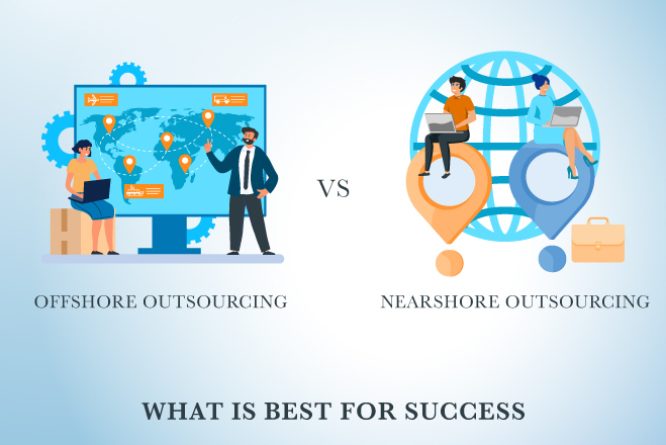
Have you noticed how every business conversation these days seems to circle back to outsourcing? Whether you’re running a startup or managing a mature operation, the same question keeps popping up: Should we choose between nearshore vs offshore?
According to Deloitte, companies that utilize outsourcing services can reduce costs by 30-40% while maintaining or even improving service quality. Let’s take a closer look at the ten most profitable benefits of offshore outsourcing services.
It sounds simple, but once you dig in, you realize there’s a lot to unpack. Offshore vs nearshore outsourcing isn’t just a geography choice. It’s a decision that affects how fast you move, how you communicate, and how your customers experience your brand.
Let’s break it down the way most leaders think about it, in plain terms, without complications.
What is Offshore Outsourcing? The Definition
When people say offshore outsourcing services, they’re talking about hiring teams in distant countries, places that might be halfway across the globe. For U.S. companies, that usually means India, the Philippines, or Vietnam.
The biggest reason companies go offshore is simple: cost savings. Labor rates can be much lower while still giving access to highly skilled professionals. It’s also about scale. You can build large offshore teams quickly without spending heavily on infrastructure.
Offshore outsourcing works well for structured tasks, such as back-office operations, IT support, or quality assurance. These teams can deliver while your local office sleeps, keeping your business running 24/7.
According to the Gradview Research, the global process outsourcing market is expected to reach $525 billion by 2030.
That said, every advantage comes with a flip side. Different work hours often mean limited real-time communication. Sometimes, projects slow down because responses take half a day. And when you’re working with partners in far offshore destinations, travel, time zones, and cultural nuances can make alignment tricky.
If you’re exploring options for scaling global operations, it’s worth reading about offshore outsourcing services that help businesses manage quality and compliance across borders.
Also Read: The Complete Guide to Understanding What is Customer Support Outsourcing
What is Nearshore Outsourcing? The Definition
Now, let’s shift closer to home. Nearshore outsourcing means partnering with providers in nearby countries. For U.S. businesses, that’s usually Latin American nations such as Mexico, Costa Rica, or Colombia.
The big win here is geographic proximity. You’re often working in similar time zones, so your teams overlap during the day. It’s easier to hop on a call, align quickly, and get real-time feedback.
That overlap also builds relationships. The cultural fit, or cultural affinity, tends to be smoother. You share similar communication styles, holidays, and even humor — small things that make significant differences in collaboration.
And if you need to meet your outsourcing partner face-to-face, you’re just a short flight away. The ease of visiting nearby offices gives you better visibility and control over projects.
For companies that depend on teamwork and agile operations, nearshore often feels like an extension of your local staff. If you’re new to outsourcing, it helps to understand what customer support outsourcing actually involves before deciding which direction to take.
Also Read: Outsourcing vs Insourcing: What’s Affordable for US Leaders
Offshore vs Nearshore Outsourcing: What's the Difference?
If we compare offshore vs nearshore outsourcing side by side, both have strengths — they just solve different business challenges.
- Offshore is about lowering costs and tapping massive talent pools.
- Nearshore is about closeness, faster communication, and smoother collaboration.
Offshore might win when budgets are tight and projects are well defined. Nearshore shines when you need frequent touchpoints and fast turnaround.
In short:
- Offshore saves money.
- Nearshore saves time and reduces miscommunication.
You can read more about balancing cost and control in outsourcing vs insourcing.
When is Offshore Outsourcing Beneficial for Company Success
Here’s where offshore truly works well:
- You want the cost-saving advantage.
- Projects are predictable and can be managed with detailed documentation.
- You have internal managers who can oversee offshore delivery.
- 24/7 coverage gives you a business edge.
Think about software development, testing, or data entry — roles that don’t demand constant collaboration but do require scale.
Offshore also helps when you need specialized software developers. Many offshore teams bring deep expertise in rare local technologies.
Companies that blend automation and global teams often integrate AI in customer support to speed up processes and maintain quality across time zones.
When Nearshore Outsourcing is a Smart Choice?
Nearshore is often the sweet spot when collaboration matters more than sheer cost.
If your project depends on tight schedules, daily stand-ups, or creative problem-solving, similar time zones make a world of difference. You can brainstorm, adapt, and move fast.
Another plus is cultural understanding. The neighboring countries share more than borders; they share work ethics and values. That emotional connection helps teams feel more aligned.
For example, many U.S. brands running long-term projects prefer nearshore setups for smoother engagement and less risk of misunderstandings. The human side of collaboration matters just as much as technical ability.
To see how integrated operations improve business insights, check how CRM cleansing enhances decision-making.
Want to know how much you can save annually with outsourcing? Try our free Outsourcing Cost Calculator.
How to Choose Between Offshore vs Nearshore Outsourcing?
So how do you actually decide? Here’s a thought process I’ve seen work for many leaders:
- Define your priorities. If cutting costs is key, offshore may be the answer. If collaboration drives success, nearshore is safer.
- Assess communication needs. Do you need daily syncs or just weekly updates?
- Check compliance. Certain industries require data to stay within specific jurisdictions.
- Consider project complexity. The more dynamic your project, the more you’ll benefit from nearshore.
- Think long term. It’s not only about saving today—it’s about building a reliable partner for tomorrow.
In the end, choosing between nearshore and offshore isn’t about which is “better.” It’s about which fits your rhythm. If your team works best through constant interaction, go nearshore. If structure and scalability drive you, offshore delivers.
Want to explore how global trends are shaping outsourcing? You can check the latest customer support trends in 2025.
Cultural and Operational Factors to Consider while Choosing Offshore vs Nearshore Outsourcing
Even with the best strategy, human dynamics make or break success. Communication gaps, language nuances, or misaligned expectations can derail good plans.
Nearshore outsourcing reduces that risk through better alignment and a shared culture. But that doesn’t mean offshore can’t succeed. With clarity, trust, and good management tools, even faraway teams can feel connected.
Regular check-ins, feedback sessions, and an openness to cultural differences go a long way. Some firms also use AI in customer experience to streamline communication and track quality. It’s worth reading more about that here.
Why Many Businesses Blend Both Offshore and Nearshore?
Here’s the part many leaders overlook: you don’t have to choose one. Some of the smartest companies use a hybrid outsourcing model.
They run nearshore teams for customer-facing work, where speed and clarity matter, and offshore teams for back-end or maintenance tasks that benefit from low-cost scale.
This approach combines the best of both: the communication benefits of nearshore and the cost-reducing advantage of offshore.
You can see how other U.S. brands balance their approach by exploring top customer support outsourcing companies in the US.
The Future Trends to Look Out for?
The world is changing fast. Remote work isn’t a temporary trend anymore—it’s the backbone of global business. Outsourcing has evolved from a cost-cutting tool into a partnership model where both sides grow together.
Companies no longer just “hire help.” They build long-term collaborations that fuel innovation. With offshore vs nearshore outsourcing, the goal isn’t to find the cheapest option. It’s to find the most compatible one.
If you’re new to outsourcing or looking to refine your approach, you can also read about the benefits of outsourcing customer support.
Final Thoughts
There’s no one-size-fits-all answer here. Offshore opens access to a massive talent market and lets you scale quickly. Nearshore keeps you connected, agile, and in sync.
Both paths can lead to success; it just depends on where your priorities lie. For most U.S. businesses, a blend of the two tends to hit the sweet spot: affordable, efficient, and human.
And that’s the real secret, keeping the “human” part strong, no matter where your teams sit.
If you’re unsure where to begin or want to discuss a hybrid model that brings you the best of both worlds, BolsterBiz can help. Our customer support outsourcing team has deep experience in both models, helping U.S. businesses grow smarter and scale faster.
Frequently Asked Questions (FAQs) about Offshore vs Nearshore Outsourcing
1. What is the biggest difference between nearshore and offshore outsourcing?
Nearshore partners work in neighboring countries with overlapping time zones. Offshore partners are usually much farther away.
2. Which offers better communication?
Nearshore. The shared hours and similar time zones make collaboration easier.
3. Which is cheaper, offshore or nearshore?
Offshore usually costs less but may require more coordination.
4. Can companies combine both models?
Yes. Many organizations use a hybrid model to balance cost and speed.
5. Why does cultural fit matter?
Because cultural affinity affects teamwork, tone, and understanding. It’s what turns a vendor into a true partner.