
In today’s fast-moving US business market, leaders face one challenge more than any other uncertainty. Whether it’s market shifts, changing customer needs, or global supply chain issues, decisions often need to be made faster than ever before.
That’s where predictive analytics tools become a game-changer. These tools transform raw business data into actionable forecasts, giving leaders a clearer view of what’s likely to happen next.
Unlike traditional analytics, which only explain past events, predictive analytics tools use historical and real-time data to forecast trends, customer behavior, and operational risks. For C-level executives, this means better planning, reduced risk, and improved ROI across multiple departments.
According to Fortune Business Insights, the global predictive analytics market is projected to grow from $18.02 billion in 2024 to $67.86 billion by 2032, reflecting the rapid adoption by forward-looking companies.
So, in this blog we will uncover how predictive analytics tools in data analytics helps in business growth. But first, let’s learn some basics.
What is Digital Marketing?
Digital marketing is any marketing done using digital channels. This includes social media, email, websites, mobile apps, and search engines. Instead of posters and billboards, businesses now use data, content, and technology to reach people online.
It involves many moving parts, content generation, social media posting, SEO, paid ads, and more. The goal? To bring the right message to the right person at the right time.
The best part of digital marketing is that it is trackable. You can measure engagement, conversions, and ROI. This helps you tweak strategies in real-time. And when powered with AI-driven marketing strategies, this becomes even more impactful.
Want to understand where to begin? Here's a great breakdown of the 10 best digital marketing strategies for startups that can guide your approach.
What are Predictive Analytics Tools?
Predictive analytics tools include software applications that use statistical algorithms, machine learning (ML), and historical data to forecast future outcomes. They often rely on predictive analytics models built by experienced data scientists who select the best modeling techniques based on the business problem.
These tools may use regression analysis, classification methods, or advanced neural networks. Many combine open source libraries for flexibility and cost-effectiveness. They can process structured and unstructured data, including text, using natural language techniques, to deliver richer insights.
For a deeper framework on aligning analytics with business strategy, explore the Data Analytics Services 2025 Playbook Guide.
In practice, these analytics tools can forecast customer churn, sales volumes, equipment failures, or fraud risks. Leaders then use these insights to act before issues arise. For businesses that lack in-house teams, one option is to outsource data analytics to experts who can set up and manage these systems efficiently.
How Predictive Analytics Tools Support Data Analytics Insights?
Data analytics looks at historical data to explain what happened. Predictive analytics goes a step further, it shows what is likely to happen next. This makes it a powerful extension of your existing analytics capabilities.
When companies do data integration well, predictive tools can connect information from sales, marketing, finance, and operations into a single, reliable dataset. This unified view improves forecast accuracy and makes insights actionable across the organization.
For example, a retail company integrating POS data, online behavior, and inventory levels can predict which products will sell out and when to reorder. These capabilities are also evolving with AI-driven advancements, as seen in data analytics innovations that combine automation with real-time decision-making.
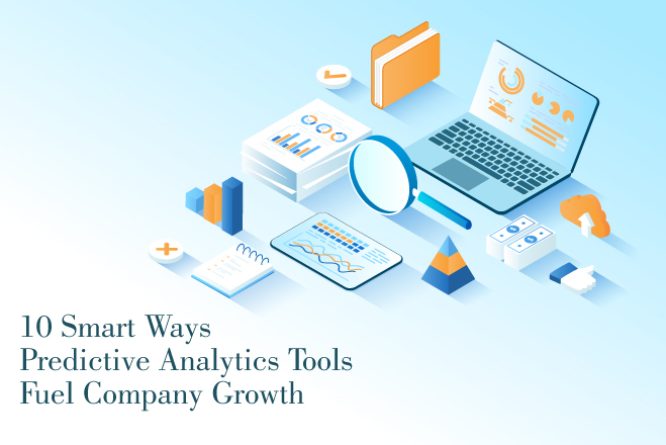
10 Smart Ways Predictive Analytics Tools Drive Company Success
Below are ten proven ways that predictive analytics tools help businesses grow, save costs, and stay ahead of competitors.
1. Customer Retention and Churn Prevention
Predictive models study past customer behavior, such as purchase frequency and support history, to identify potential issues before a customer leaves. This lets companies take quick action. For example, sending a special discount or offering better service. In industries like telecom, churn models have helped reduce customer loss by up to 15% every year. Even small businesses can use data analytics services for small business to track customer loyalty and keep their best clients.
2. Sales Forecasting Accuracy
With predictive analytics tools, sales teams can replace guesswork with clear forecasts. These tools use time series methods to check patterns from past sales, customer activity, and seasonal demand. Leaders can plan inventory, set targets, and decide when to push certain products. This prevents overstock and missed opportunities.
3. Marketing Campaign Optimization
Marketing budgets often get wasted on the wrong audience. Predictive analytics helps focus on the right people by finding the customer groups most likely to respond. Using machine learning, marketers can fine-tune ad campaigns, email lists, and social media targeting. This means more sales and less wasted spending.
4. Risk Management and Fraud Detection
Fraud can hurt profits and brand trust. Predictive analytics tools detect strange patterns that may signal fraud. By using ML models, businesses can stop suspicious transactions in real time. Banks, e-commerce stores, and even insurance companies rely on this to protect customers and reduce losses.
5. Inventory and Supply Chain Efficiency
Having too much or too little stock costs money. Predictive analytics can forecast demand and help order just the right amount. This uses supplier data, shipping times, and sales history to plan. Combining these forecasts with real-time data analytics makes it possible to adjust quickly if something changes.
6. Product Development and Innovation
Launching the wrong product can waste time and money. Predictive tools use natural language processing to scan thousands of reviews, social media posts, and surveys. They can point out what customers really want. Companies then focus on features that are more likely to succeed.
7. Dynamic Pricing Strategies
Prices that change based on demand can increase profits. Predictive analytics studies buying patterns, competitor prices, and seasonal trends. Retailers and travel companies use these tools to adjust prices in real time, keeping customers happy while maximizing revenue.
8. Workforce Planning and Talent Management
Finding and keeping good employees is hard. HR teams use predictive models to guess when you need more staff or when someone might leave. This gives companies time to train or hire in advance. It keeps operations running smoothly without sudden shortages.
9. Predictive Maintenance for Operations
Unexpected equipment breakdowns cause delays and extra costs. Predictive maintenance uses sensors and past repair data to spot problems early. Fixing machines before they fail saves money and keeps production on schedule.
10. Strategic Decision-Making for Executives
Leaders make better decisions when they see what’s coming. Predictive analytics brings together data from sales, finance, and operations to create precise forecasts. This helps executives set goals, plan budgets, and guide their teams with confidence. A single dashboard can keep everyone aligned and focused on the same targets.
How to Start Implementing Predictive Analytics Tools in your Business
Getting started with predictive analytics tools does not have to be complex. Begin by picking one high-impact problem to solve. For example, reducing customer churn, improving sales forecasts, or planning inventory.
Next, look closely at your data. Check if it’s accurate, complete, and well-organized. Poor-quality data will lead to poor predictions.
Then, choose the right tool for your needs. It could be cloud-based for flexibility, on-premise for tighter control, or a mix of both. Involve domain experts who understand the business side, along with technical teams who can build and run the models.
Start with a small pilot project. Use a limited dataset, evaluate the performance of the predictions, and make adjustments. Once you trust the results, expand the use across more areas.
A report says that using predictive analytics in sales can boost lead conversion by up to 20%. Starting small and scaling wisely is the best path to success.
At BolsterBiz, our data analytics services use predictive analytics as a core part of delivering insights. Predictive analysis is one branch of data science, and it’s only the beginning. Data can also be used for real-time monitoring, customer segmentation, fraud detection, market research, and operational optimization.
Conclusion
In a market where speed and accuracy define success, predictive analytics tools give leaders a significant advantage. They turn vast amounts of raw data into forecasts that guide smarter, faster, and more profitable decisions. From boosting customer retention to optimizing supply chains, the applications span every corner of a business.
Adopting predictive analytics is no longer a “future goal.” It’s a present necessity. The companies that thrive will be those that use their data not just to understand the past, but to anticipate the future. By aligning technology, people, and processes, leaders can unlock growth opportunities while minimizing risk.
For B2B executives in the US, now is the time to invest in the tools, talent, and strategy needed to bring predictive analytics into the heart of their decision-making. Those who move early will set the competitive benchmarks that others will try to match in the years ahead.