

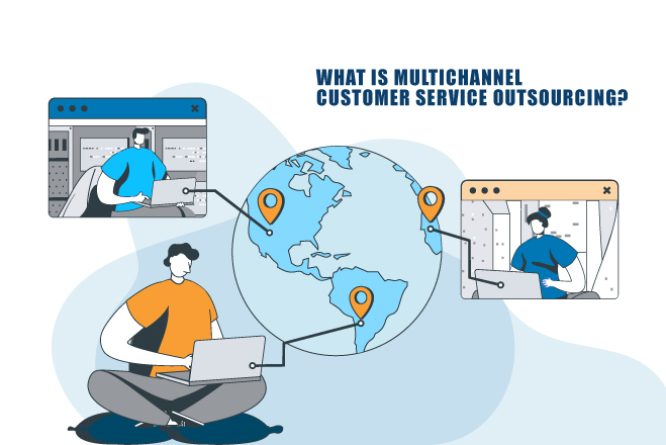
Typically, leaders focus on improving customer support. But maintaining it in-house becomes challenging and expensive. That is when customer support outsourcing comes to the rescue.
If you’ve ever tried juggling emails, chats, social comments, and a flood of phone queries in one afternoon, you already know why multichannel customer service outsourcing exists. It’s the idea of letting a trained external team manage all those channels so your team doesn’t burn out. Imagine having one partner who quietly takes over support across email, chat, social platforms, and phone calls without changing your tone or brand personality. It feels almost like handing over chaos and getting back structure.
Most companies eventually reach a point where customers expect fast, clear responses on whatever channel they choose. One person messages you on Instagram, another sends a long email, someone else calls, and suddenly the whole day disappears. You try your best, but keeping the pace is exhausting and often messy. That’s usually when leaders start asking themselves whether they should continue wrestling with it or simply outsource the heavy lifting.
A Salesforce report found that nearly three-quarters of customers want companies to “understand their expectations across every interaction,” which isn’t surprising anymore. People don’t care about your internal bandwidth. They care about getting help when they need it.
That’s why multichannel outsourcing becomes such a practical move for growing brands. It meets demand without draining resources.
Why Multichannel Customer Service Outsourcing Matters in 2025?
Picture this: you’re in the middle of a launch, messages are pouring in, and your internal team is stretched so thin you can practically see daylight through them. Now imagine having a partner who steps in like, “Don’t worry, we’ve got the inbox, the chat queue, and the social mentions covered.” That’s the comfort multichannel customer service outsourcing brings. It essentially addresses operational gaps before they lead to customer frustration.
External support teams typically bring established processes and years of experience across different industries. They know call center services techniques that give structure to chaotic queues. They also learn how to manage customer conversations without losing the warmth or clarity customers expect. That blend of discipline and empathy is something many internal teams spend months trying to perfect.
When done right, customer support outsourcing doesn’t replace your brand voice—it simply amplifies it. You get trained agents who understand tone, context, and the small nuances that make communication feel human. The result is smoother communication, fewer repeated questions, and a better rhythm across every channel.
For companies that already use call center outsourcing or partial support models, expanding into multichannel systems is a natural next step. It’s basically scaling what’s already working and adding more customer touchpoints without complicating operations.
Find Out: How to choose the best customer service outsourcing company for your business?
How Does Multichannel Customer Support Works Behind the Scenes?
A good provider starts by mapping your customer journey, what people ask, when they ask, and how complex those questions are. They then set up workflows to determine where each query goes and who handles it. Everything updates in real time, so agents never feel lost or disconnected from the previous message. It keeps things moving without customers repeating the same story.
You also get outsourcing solutions that include quality checks, reporting, and escalation paths for sensitive issues. Some brands choose to outsource customer service completely, while others keep a small internal team and outsource overflow. Either way, the flow becomes more predictable and structured. It eliminates the constant fear that something might slip through the cracks.
The beauty of this model is that your support strength isn’t tied to your office headcount anymore. If you suddenly gain traction, the team scales with you rather than scrambling to catch up. It’s a calmer way to grow, especially in markets where demand shifts quickly.
And yes, this approach often leads to improved customer experiences simply because response times stabilize and conversations feel more consistent. People like knowing what to expect when they contact a business.
What are the Benefits of Multichannel Customer Service Outsourcing for Startups and SMBs
A good provider starts by mapping your customer journey, what people ask, when they ask, and how complex those questions are. They then set up workflows to determine where each query goes and who handles it. Everything updates in real time, so agents never feel lost or disconnected from the previous message. It keeps things moving without customers repeating the same story.
Also Read: What Are the Benefits of Outsourcing Customer Support
You also get outsourcing solutions that include quality checks, reporting, and escalation paths for sensitive issues. Some brands choose to outsource customer service completely, while others keep a small internal team and outsource overflow. Either way, the flow becomes more predictable and structured. It eliminates the constant fear that something might slip through the cracks.
The beauty of this model is that your support strength isn’t tied to your office headcount anymore. If you suddenly gain traction, the team scales with you rather than scrambling to catch up. It’s a calmer way to grow, especially in markets where demand shifts quickly.
And yes, this approach often leads to improved customer experiences simply because response times stabilize and conversations feel more consistent. People like knowing what to expect when they contact a business.
Try our free Outsourcing Cost Calculator to see how much you can save annually with customer support outsourcing.
What Channels are Usually Included in Multichannle Customer Support?
Most programs begin with email and chat because they’re predictable and manageable to structure. After that, brands usually add phone calls for high-touch inquiries or urgent matters. Social media support comes next because customer interactions on public platforms require prompt responses to maintain sentiment. Some companies also integrate self-service tools to help reduce workload.
Every channel has its own tone and rhythm, and trained agents adapt to each one naturally. It keeps communication smooth rather than robotic. Because everything runs through shared systems, no message is lost or ignored. That reliability builds confidence for both customers and internal teams.
Explore- Live Chat Support Services
Conclusion
Multichannel customer service outsourcing isn’t just about handling more messages. It’s about giving customers a dependable, consistent experience while your team focuses on growth rather than constantly firefighting. If you want support that feels human, structured, and genuinely helpful without expanding your internal team, this model is worth exploring.
If you want a partner who handles customer support with maturity, empathy, and efficiency, BolsterBiz offers reliable customer support outsourcing services built for growing teams. Reach out and explore how we can start supporting your customers from day one.


