

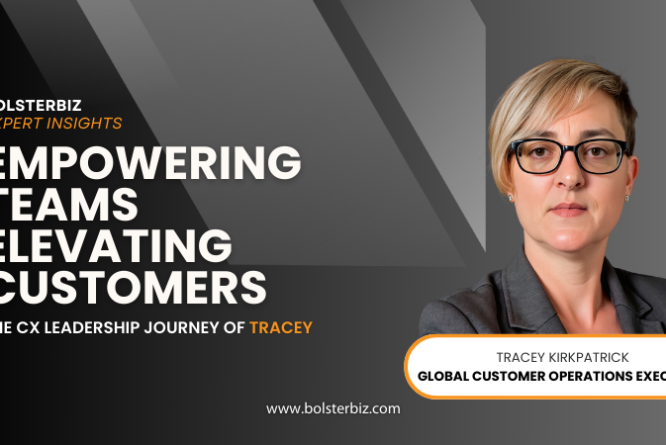
Empowering Teams, Elevating Customers – The CX Leadership Journey of Tracey
Share This Post
You’ve led amazing CX transformations! How did your journey in customer success begin?
Tracey Kirkpatrick: I started in software development and quickly saw that technical precision doesn’t guarantee commercial impact. Real value comes from designing operations around the customer, not just by having a great product.
That insight led me into leadership roles across B2B environments, where I restructured support and services functions to improve satisfaction, retention, and margin. My focus is operational, aligning delivery with customer outcomes, embedding ownership at every level, and building frameworks that scale.
Clarity is a strategic choice. It shapes how teams are structured, how accountability is embedded, and how performance is measured. Ownership is non-negotiable. When teams understand the impact of their work and collaborate across functions with shared purpose, customer outcomes improve and the business becomes more resilient.
You’ve built global SaaS teams. What’s been your most rewarding moment as a leader?
Tracey Kirkpatrick: One of the most rewarding moments came from an underperforming department I was restructuring. I reorganised the team into pods of four, each with a senior member responsible for coaching, mentoring, and supporting junior individuals. To simplify reporting, each pod was assigned a colour, and that took on a life of its own.
The teams fully embraced it. They colour-coded their areas, created mascots, and staged light-hearted rivalries. One pod filled my office with balloons in their colour over a weekend. Another rebranded themselves and introduced a lion mascot, which was promptly kidnapped by a rival pod. I had to avoid wearing team colours on meeting days to avoid being playfully accused of favouritism.
None of it was planned. It validated that structural clarity drives engagement, autonomy, and ownership at scale. The transformation was not driven by incentives or directives. It emerged from designed systems. That is what I build: frameworks that enable capability, cohesion, and sustained performance. The engagement was accidental. The impact was deliberate.
You use data as a strategic tool. What’s your go-to move for turning numbers into action?
Tracey Kirkpatrick: I use data to diagnose, not to report. The goal isn’t to hit a number, it’s to improve the operation. Too many KPIs reward activity over impact. I’ve seen teams rewarded for closing tickets within a set timeframe, yet the underlying issue remains unresolved. That’s not performance, it’s misdirection.
Metrics must reflect system health, not just internal efficiency. Development will celebrate reducing defects from 100 to 50, but if impacted customers rise from 150 to 500, that’s regression disguised as progress. You need to measure what matters to the customer, not just what measures internal efficiency.
Every metric is a diagnostic piece of the puzzle. When combined, they expose causality and make the data interpretable across functions. That enables product, engineering, and support to act without translation.
The right data doesn’t just inform. It provokes action, surfaces failure, clarifies ownership, and drives decisions that protect margin, retention, and reputation.
You’ve led significant changes. What’s one transformation project you’re proud of?
Tracey Kirkpatrick: Turning around teams viewed as underperforming has been the most rewarding. In one case, I led two support teams operating in the same office, on the same systems, yet following vastly different procedures. Customer support faced real challenges, but was blamed for systemic failures rooted in product dysfunction, lack of quality assurance, and zero accountability.
I led a transformation grounded in structural clarity. I standardised processes, clarified cross-functional ownership, and partnered with development and QA. I introduced an initiative to lend resources to QA, enabling defects to be identified before release. This reduced post-release issues, lowered support volume, improved the customer experience, and significantly reduced support costs. It also elevated the organisation’s perception of the support team’s calibre, as development leaders saw their diagnostic expertise first-hand.
Support shifted from reactive scapegoat to strategic diagnostic engine. In customer operations, underperformance is rarely about effort. It is about structure, ownership, and clarity. I do not lead through sentiment or narrative. I lead by diagnosing friction, resolving root causes, and designing systems that enable sustained performance. I transformed a support function from perceived liability to strategic asset by designing for clarity, accountability, and sustained performance.
What’s your honest take on outsourcing support? Can it still deliver great customer experiences?
Tracey Kirkpatrick: My experience is with offshoring and nearshoring, not conventional outsourcing, but the strategic principles are the same. This isn’t about externalising work. It’s about re-architecting operating models to embed scalable structures with the customer at the centre.
Support isn’t a transactional function. It’s a diagnostic engine. That demands proximity to context, not just proximity to tickets. When outsourcing is treated solely as a cost lever, it fragments ownership, obscures accountability, and erodes quality.
The decision must be structural. It should be grounded in a clear operational thesis: where can this function deliver maximum value, accelerate resolution, and protect quality? That’s not a vendor question. It’s a design question.
Success depends on how the model is architected. If it’s built for interpretability, escalation logic, and upstream visibility, location becomes irrelevant. If it’s built to deflect cost, it will deflect outcomes too.
Clarity isn’t a deliverable. It’s a design choice. And that applies to every operational structure, including support.
Summary
Tracey’s path into customer success began in software development, where she quickly realized that technical precision alone doesn’t guarantee commercial impact. Her approach is built on operational clarity, shared ownership, and scalable frameworks that align delivery with customer outcomes. A believer in structure as a driver of engagement, she’s seen cultural transformation emerge organically when teams are empowered within well-designed systems.
For Tracey, data is a diagnostic tool, not a scoreboard—its value lies in revealing root causes, guiding cross-functional action, and measuring what matters most to the customer. One of her proudest achievements was transforming a struggling support function into a strategic diagnostic engine by standardizing processes, embedding accountability, and partnering with QA to prevent issues before they reached customers.
On outsourcing, she emphasizes that success depends on operational design, not geography. Treated as a cost-cutting exercise, it dilutes ownership and outcomes; designed for clarity, escalation, and upstream visibility, it can deliver the same quality and impact as any in-house team.

About Tracey Kirkpatrick
Tracey Kirkpatrick is a global customer operations executive specialising in enterprise SaaS transformation. She restructures fragmented service and support functions into strategic infrastructure that drives retention, margin, and enterprise value. Her expertise lies in rearchitecting operating models, embedding scalable frameworks, and aligning frontline execution with company objectives.
Her leadership has increased NPS, reduced support costs, and improved billable utilisation through structural clarity, performance tracking, and system design that enforces accountability and surfaces operational risk across product, engineering, and service. Tracey applies diagnostic precision to resolve systemic friction and build mechanisms that enable sustained cross-functional performance.
Energised by transformation, she builds resilient operating environments that convert underleveraged data into strategic insight, elevate team capability, and support long-term value creation across global operations.