
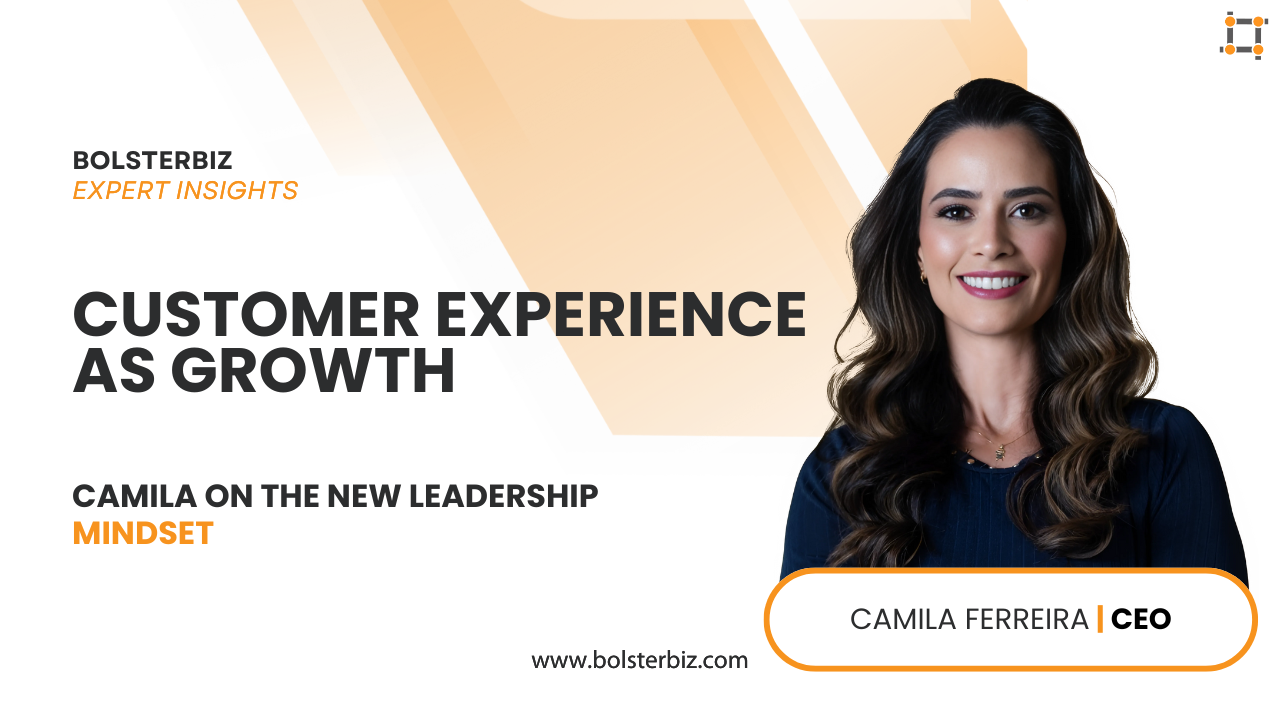
Camila Ferreira, CEO of Rise UP, on why she stopped treating customer experience as a support cost, how to frame CX in the language the C-suite already speaks, and where AI and outsourcing genuinely fit into a growth-driven CX strategy.
You've built your career transforming CX into a true growth engine. What first sparked this vision of CX as more than just a “support cost”?
My turning point came right after I transitioned from operations to finance. I quickly realized that customers were constantly offering valuable insights through service interactions, but those insights weren't reaching other departments. Meanwhile, those same departments were investing heavily in market research (such as focus groups and others), chasing visibility they already had; they just weren't listening to the frontlines.
What changed everything was combining that qualitative customer voice with the financial lens I had developed over 10 years in finance. Suddenly, experience wasn't just about satisfaction; it became a source of strategic, revenue-driving intelligence. That's when I stopped treating CX as a support layer and started building it as a competitive advantage.
Many executives still treat customer experience as an expense line. How can leaders reframe CX as a driver of revenue and profitability?
It all starts with clarity on the company's primary goal, whether that's expansion, efficiency, or profitability. That goal becomes your destination. From there, you identify where improving the experience can directly support that outcome. Once mapped, you connect the operational metric to the boardroom metric, showing exactly how CX drives measurable impact.
The key is to speak the language of the C-suite: revenue, retention, and margin. For example, if you're losing customers due to a poor onboarding experience, fix the friction and you may see a 20% increase in LTV. If support inefficiencies are driving up costs, redesign the journey and watch gross margin improve. Experience isn't a cost, it's a lever. But to earn its seat at the table, it must be framed in financial terms.
Retention, loyalty, and lifetime value are often cited as customer success goals. What specific strategies move the needle fastest on these metrics?
It starts with understanding your Ideal Customer Profile (ICP), and being disciplined about serving the right customers, not just chasing top-line growth. Targeting the wrong ICP creates downstream friction across the entire journey and weakens retention. Growth at any cost eventually becomes a cost.
“Once your ICP is clear, map their expectations, communicate them internally, and ensure every function is equipped to deliver. Customers don't talk to departments, they talk to your brand. The experience must be seamless, regardless of who owns the touchpoint.”Camila Ferreira, CEO, Rise UP
Success begins before onboarding. Align expectations from day one, deliver early wins, and design frictionless handoffs. Proactively manage silent churn with behavioral insights. And don't treat all customers the same (high-performing companies obsess over segmentation). Loyalty isn't just about serving well; it's about adapting, personalizing, and delivering with consistency across time.
Technology and AI are reshaping customer operations. How can companies harness them without losing the human touch that drives customer satisfaction?
Tech should amplify human connection, not replace it. AI is powerful for prediction, triage, and real-time enablement, but the companies winning in CX are those using AI to empower their people, not erase them. Train agents to become advisors, not script readers. Use automation to remove noise, so humans can focus on moments that truly matter.
One of the biggest mistakes I see is using AI as a shortcut to reduce headcount. That may boost short-term efficiency, but it breaks long-term trust. Human connection is what drives loyalty, and loyalty drives growth. AI should support that connection, not replace it. When you blend efficiency with empathy, you don't just scale, you build something customers want to stay loyal to.
Outsourcing is often perceived as a risk for CX. What are the positives leaders overlook, and how can outsourcing actually accelerate growth when done right?
The problem isn't the model; it's the mindset. Too often, companies outsource without defining expected outcomes, integrating culture, or linking execution to customer impact. But when you treat partners as a true extension of your brand and align on KPIs that matter, outsourcing becomes a growth enabler, not a liability.
The real differentiator is culture. Just because employees sit elsewhere or are paid by another company doesn't mean they can't live your values. When you extend your culture intentionally, through onboarding, rituals, coaching, and shared purpose, you build brand consistency across locations. And when you connect operational metrics to boardroom goals, outsourcing no longer feels like delegation. It becomes an acceleration.
“Like any other efficiency initiative, outsourcing fails when it's viewed only through a cost or productivity lens. Efficiency must come with alignment. When you layer in culture, mindset, and purpose, you don't just cut costs, you elevate performance.”Camila Ferreira, CEO, Rise UP
Looking ahead, what mindset shifts do CEOs and boards need to embrace if they want to truly position CX at the center of company growth?
CEOs and boards need to stop treating CX as a department, and start seeing it as a strategic ecosystem. The real opportunity is to design experiences so relevant, seamless, and personalized that they create experiential dependency. That's how you increase not just customer loyalty, but share of life.
This shift demands a new mindset: from reactive to proactive, from sentiment to strategy, from isolated metrics to business outcomes. CX must be embedded into product design, operations, finance, and leadership KPIs. It belongs in the boardroom conversation, not as a feel-good initiative, but as a core growth engine. When experience is owned at the top, measured with discipline, and integrated across the company, that's when it stops being a cost, and becomes a competitive moat.
Camila shares how customer experience can move beyond a “support cost” to become a core growth engine. She explains how linking CX to financial goals drives revenue, loyalty, and efficiency. From leveraging AI without losing the human touch to redefining outsourcing as a growth enabler, her insights show how CEOs can embed CX into the boardroom strategy.

Camila is a global CX leader, keynote speaker, and strategist who helps CEOs turn customer experience into a growth engine. Through her LimitLess CX framework, she has driven measurable results for global brands, from boosting retention to transforming support into sales. Her mission is simple: CX isn't a cost—it's the boardroom's strongest driver of growth.
Connect on LinkedIn