

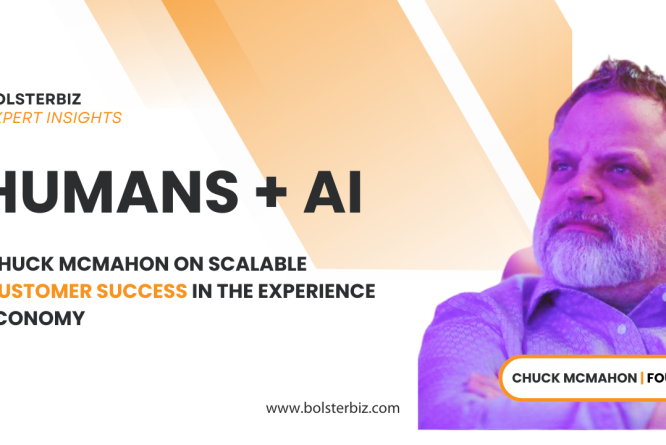
Humans + AI: Chuck McMahon’s Formula for Scalable Customer Success in the Experience Economy
Share This Post
Can you guide us through your journey, from your earliest experiences to developing a framework that integrates AI with human expertise?
Chuck McMahon: My career began at a company that pioneered the shift to B2B hosted and SaaS solutions, long before the term “SaaS” was even commonly used. I learned that his new world of software-as-a-service, customer relationships weren’t transactional; they were ongoing partnerships.
Success wasn’t just about selling software; it was about ensuring customers achieved their desired outcomes, month after month, year after year. This led me to develop a customer success program before the discipline of customer success was recognized.
We were inventing the playbook as we went.
Over the following two decades, I scaled customer experience functions through explosive growth phases at multiple high-growth B2B companies. What fascinated and frustrated me was the pattern I kept seeing: even the most talented teams were hitting fundamental limitations. We were capturing incredible amounts of customer intelligence but struggling to synthesize it quickly enough to act on it.
I began to explore the possibility that AI applications could help bridge that gap, but couldn’t find what I considered a complete and scalable solution.
“The paradigm shift occurred when I realized that the industry’s view of AI’s value was too limited. Companies were focused on either replacing humans with AI or on using AI to gather information and provide signals. I wanted to go further, and I developed the AiCX model.” – Chuck McMahon, Founder, Amplificx
The AiCX model isn’t just about AI doing the grunt work while humans handle the “important stuff.” It is about creating a true collaboration between the two. AI becomes a strategic partner, working alongside CSMs to plan and execute critical customer engagements. It analyzes every data point, conversation, and signal to help determine not just what to discuss with a customer, but also when, how, and why that conversation will have maximum impact.
This symbiotic partnership creates something exponentially more potent than either could achieve alone. AI brings comprehensive intelligence and pattern recognition; humans bring strategic thinking, empathy, and intuitive understanding of relationships. Together, they transform customer experience from reactive to predictive, from good to extraordinary.
Today, Amplificx exists to help others achieve what seemed impossible: customer success at scale, without sacrificing depth, empathy, or strategic alignment.
In your view, what are the most critical areas across the customer lifecycle where this synergy delivers the strongest ROI?
Chuck McMahon: The most critical moments in the customer lifecycle don’t always align with standard journey milestones. They are often invisible inflection points, such as hiring a new stakeholder, shifting business priorities, closing a round of funding, or service impacts, that traditional models miss. This is a perfect example of why it is not humanly possible to maximize the effectiveness of your Customer Success program. Unless you are only going to assign each CSM a small handful of customers (completely unscalable), it is impossible for them to actively track all the information and data paths (including cross-referencing them) to clearly identify those key moments.
So, today we settle for focusing on “a customer journey.” We decide when those key moments are going to be, out of necessity, rather than through optimized strategic engagement. We schedule Business Reviews (but only with our largest customers, due to the significant time and effort required to compile all the necessary information). We give our CSMs mandates, such as “Meet with these customers at least X times per Y,” often not providing them with much direction on what the meetings should be about. We set artificial deadlines: “Begin a renewal process 90 days out from their due date.” We tell them to announce every new feature and option added to the platform, but fail to help them understand which KPI the feature is designed to help so they can track it to their specific customers’ objectives.
Quite honestly, we place a tremendous burden on our CSMs to retain and build Expansion ARR (EARR). Still, our support for them is basically to make data available to them for them to figure out the patterns, or (at best) we use technology to help identify signals of risk or opportunity. Still, we just assume that they know what to do with that information.
So, when do our CSMs need help to ensure the maximum positive impact on EARR? The answer is every day, and at every stage of the customer journey.
We need to do better—and this isn’t a criticism. As leaders, we are even more impacted by our humanity than our contributors. We need help, too.
Many leaders remain skeptical about AI investments in CX. What KPIs or outcomes do you prioritize to prove that AI integration drives tangible, scalable business results?
Chuck McMahon: While the specific KPIs depend on each organization’s goals, we most often see the highest ROI from two areas: reducing churn and increasing expansion revenue.
So, the consulting that we do and the applications that we build focus on two KPIs:
- Reduce Churn
- Increase Revenue
Which AI-driven strategies or frameworks were instrumental in delivering reduced churn, expanding ARR, and improving customer retention?
Chuck McMahon: The strategies and framework are born out of 25+ years of experience, along with what I have learned from others in the space. This isn’t about developing new strategies; it’s about empowering your teams to execute known strategies more effectively and efficiently. Adding a collaborative AI layer enables us to achieve a level of strategic engagement that would have been historically impossible.
The AiCX model helps the CSM manage a larger book of business more effectively than they can currently manage a smaller one. It is a rare instance where a company can achieve better results with a more scalable operation.
It also reduces and, in some areas, eliminates the learning curve between a new CSM and those with greater experience. The AI layer of AiCX provides them with a constant collaborator, providing insight to help guide them based on the combined experiences of many.
What’s your approach to breaking silos and turning voice-of-customer data into strategic execution across teams?
Chuck McMahon: The core issue is misalignment in defining and communicating ‘business value.’ When VoC data is fragmented, it lacks context. When it’s unified through AI, it becomes a shared language across departments. If the company can consistently identify the actual business value of feature requests and roadmap strategies, these teams will all be much better aligned.
Again, this is where the AI layer can help. It can take an idea posted by one customer and help compare its potential impact across multiple customers with similar objectives. It can help estimate the likely actual business impact that could be recognized.
Until/unless Success, Product, and Marketing can all learn to communicate with the common language of Business Value, they will continue to struggle with identifying a clear path that all can agree on. The goal is to consolidate all those disparate signals into a strategic intelligence layer —a customer experience nervous system that informs every team’s decisions.
Some companies have adopted AI, but they’re seeing rising ticket volumes and unchanged human intervention rates. What’s your perspective on why this happens, and how can businesses course-correct?
Chuck McMahon: Nothing will reduce your tickets as much as identifying and resolving the common and critical issues that your customers experience. One of the risks you need to be aware of when using genetic AI is that it could hide common issues by resolving them without human intervention. This may reduce your support costs, but it also reduces the quality of your service.
“AI isn’t a magic wand; it amplifies what’s already working and exposes what’s broken. If your core service design is flawed, AI just scales the inefficiencies.”- Chuck McMahon, Founder, Amplificx
How can companies, especially mid-sized SaaS firms, optimize AI chatbot implementations in a way that’s both effective and cost-efficient, without sacrificing customer experience quality?
Chuck McMahon: With recent advances in agentic AI, chatbots are relatively low-hanging fruit. If you take the time to identify clear objectives and understand what is needed to implement a customer-friendly and effective solution successfully, there are several good options available. Effective and cost-efficient will differ widely, depending on the company, use case, and existing tech stack.
“When considering the addition of AI to your work processes, find a consultant, or an outsourcing partner or a product with consultative elements to help you get it right.” – Chuck McMahon, Founder, Amplificx
Summary
In this BolsterBiz Expert Insights feature, Chuck McMahon—Founder of Amplificx and Partner at Worxwide Consulting—shares how his 25+ years in CX led to the creation of the AiCX model, a framework that merges AI with human expertise to drive scalable customer success. He explains how most companies miss critical inflection points in the customer journey and how AI CX empowers CSMs to act strategically and proactively.
Chuck outlines how AI-driven orchestration reduces churn, boosts Expansion ARR, and aligns cross-functional teams by turning fragmented customer data into actionable business value, proving that the real future of CX lies in humans and AI working in harmony.

About Chuck McMahon
Chuck McMahon is a customer experience visionary with over two decades of experience building and scaling CX programs for high-growth B2B SaaS companies. He’s the creator of the AiCX model—a strategic framework that fuses human expertise with AI to create scalable, predictive, and deeply personalized customer experiences.
His work has helped organizations reduce churn by 15%, increase Expansion ARR by 18%, and drive customer lifetime value up by 15%. Today, through Amplificx, Chuck is leading the AiCX revolution—empowering organizations to deliver smarter, faster, and more human customer engagement at scale.