Outsourced customer service for small businesses shifts everything. It turns chaos into structure, delays into speed, and frustrated customers into loyal ones. These are some of the core pros of outsourcing customer service that make it a reliable strategy for growth.
It has become one of the most reliable strategies for scaling support services, reducing operational costs, and maintaining consistent customer experiences for small businesses. As small and medium enterprises SMEs face rising customer expectations and pressure to stay competitive while working on a limited budget, outsourcing offers a clear alternative path to efficient customer service operations.
But like every business strategy, outsourcing has its own pros and cons, and the results depend on how you approach it. If handled right, outsourcing becomes an engine for better customer interactions, satisfaction, and retention, but if handled poorly, it becomes a source of frustration, miscommunication, and poor brand reputation.
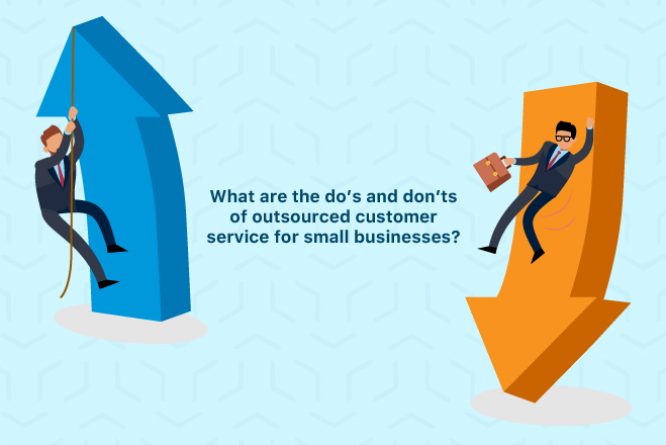
Here are a few do's and don'ts every small or medium-sized business should know before partnering with an outsourced customer support team.
1. Do: Choose a Partner that Understand Small Business Challenges
Not all outsourcing providers are built the same. Some contact centers are experts in enterprise clients, others focus especially on startups or SMEs. For small businesses, choosing a provider with experience working with fast-growing support teams is important.
Look for partners who understand:
- Limited budgets
- Flexible staffing needs
- Sudden scaling
- The importance of consistent brand tone and value
A provider experienced in small business dynamics will adapt faster and offer more cost-efficient solutions.
2. Don't: Pick the Cheapest Option without Considering High Quality
Along with benefits, SMEs should also be aware of the potential cons of outsourcing customer service so they can avoid the common traps that affect the brand identity and support quality.
A common mistake small and medium sized businesses make is picking up the lowest cost provider. The main goal is not to reduce costs, but to build a long-term partnership with the outsourcers for fast growth.
The problem? Cheap service outsourcing companies often leads to:
- Slow response times
- Scripted/robotic interactions
- Poor agent training
- High agent turnover
Customer service is the front line of your brand. It's the first interaction the customer has with your product or service. Even one negative experience can cost you your identity and brand value - something small businesses can't afford.
Focus on value, not just budget. A slightly higher investment can produce significantly stronger customer satisfaction and retention.
3. Do: Share your Brand Voice and Customer Expectations Clearly
One of the biggest reasons outsourcing fails is misalignment in brand voice and customer expectations. Your outsourced team needs to understand not just your products but also the brand tone and style.
Provide:
- Tone guidelines
- Sample past interaction
- Brand values
- Escalation rules
- Customer personas
When your partner understands and mirrors your voice, customers will never feel like they're talking to a third party vendor.
4. Don't: Withhold Data, Docs, or Process Knowledge
Small businesses often think that outsourcing partners will "figure it out". They won't. It's your responsibility to provide them complete information.
If you keep everything in your head, your agents won't have what they need to deliver good customer support.
Share:
- SOPs
- FAQs
- Access to product updates
- Information on upcoming launches
- Insights from customer complaints
Strong knowledge sharing directly impacts excellent customer service.
5. Do: Use Outsourcing to Offer Multi-Channel Support
Today's customers don't limit themselves to calls. They text, DM, email, and chat, and expect the customer support to resolve their query regardless of the time zones.
Outsourced customer service for small businesses is especially useful in expanding support across multiple communication channels such as:
- Live chat
- Social media
- Voice
Even if you're an in-house team of 2-5 people, outsourcing gives you a big-company presence without big-company cost.
6. Don't: Ignore Customer Feedback after your Outsource
Your customers will notice changes once you shift to outsourced customer support - sometimes positive, sometimes not.
Monitor:
- Social media brand mentions
- Reviews
- Feedback forms
- Common complaints
Use this feedback as a direct improvement loop with your outsourcing customer service company. .
Conclusion
Outsourced customer service for SMEs can be a powerful growth tool when used correctly. It helps small businesses expand their reach, improve customer satisfaction, and operate like much larger companies - without the overhead costs headache.
The key is balance.
Outsource what slows you down, but maintain control over what defines your brand. Build strong communication channels, choose the right partner, and treat your outsourced team and an extension of your internal one.
Partner with BolsterBiz and unleash affordable scaling opportunities with our customer support outsourcing services.