| Key Takeaways |
- The SLA lifecycle defines how a service level agreement performs over time, not just on paper.
From identification through renewal or termination, each phase of the SLA lifecycle ensures service providers and customers are aligned.
- Clear identification and negotiation phases prevent misalignment and future disputes.
Well-defined scope, service levels, and performance metrics are the basis of an effective service level agreement.
- Implementation and monitoring ensure SLAs deliver real business value.
Embedding SLA metrics into daily operations and tracking performance regularly helps maintain high service quality and accountability.
- Ongoing SLA monitoring enables proactive issue resolution and service improvement.
Regular reviews, feedback loops, and performance audits strengthen trust and improve long-term service delivery.
- Renewal or termination, based on data-driven decisions, closes the SLA life cycle.
Reviewing results allows businesses to refine, renew, or exit service level agreements based on performance results and evolving goals.
|
What is a Service Level Agreement (SLA)?
A service-level agreement (SLA) is an agreement between a service provider and their client that describes the expectations of both parties. An SLA outlines the standards of the level that the provider will provide, including specific metrics like response time, resolution time, and product-specific terms.
One of the aims of a service level agreement is transparency about consistent quality in the services assigned to the client by assuring responsibility from both places.
In any relationship, everyone concerned needs to understand how they can expect (and not expect) from one another. Wherever that exchange isn't transparent, frustration and conflict ensue.
Not knowing the response time, resolution time, and uptime upfront leads to a misalignment of perception between how you perceive your product quality and how your customers do. Whenever you leave something to interpretation, you will be shocked—and not in a good way.
An SLA is when everyone agrees on a timeframe to handle all services. If the range breaks, a fine is incurred on the side violating the agreement. The penalty is not compulsory, but it is a common practice in B2B.
What are the Key Components of SLA?
While SLAs can differ depending on the industry, vendor, and service type offered. Some elements of a typical service level agreement include:
- Agreement Overview
- A list of stakeholders
- The goals of all stakeholders
- A description of services
- Service levels
- An enumeration of services not included in the contract
- Conditions of cancellation
- Plan B in case targets are not met
- Service performance metrics
It pays to have a basic SLA template ready for the person hiring a vendor and for yourself as a vendor. This will help you prepare for any business situation and customize the template according to stakeholders' needs.
What is the Importance of SLA?
According to a Technology Services Industry Association (TSIA) survey, of all companies that use SLAs, 68% use service-based SLAs, 22% customer-based SLAs and 10% multi-level SLAs. Now, that’s a huge difference.
While SLAs are common in technology, any industry can use an SLA. An SLA or Service Level Agreement is essential to a business process. It has many advantages for organizations, teams, and vendors:
- An SLA ensures trust and gives everyone the peace of mind that things will work as expected.
- An SLA helps to manage the expectations of all stakeholders. It helps clarify service delivery, terms and conditions related to the service, and performance measurement standards.
- Consistent and collaborative SLA practice opens new business avenues. An SLA draft can encompass all stakeholders. By doing this, vendors can provide transparency to the client, offer resolutions for any apprehensions, and provide an overall high level of service.
- SLAs play a pivotal role in laying the foundation for IT staff augmentation, data analytics, and customer support outsourcing. It ensure reliability and excellence. Choosing a trusted partner is crucial to customize the agreements as per your business needs.
Know more: What Is It Staff Augmentation? The Complete Guide
Now that you’ve learned the basics let’s move to the crux of this blog.
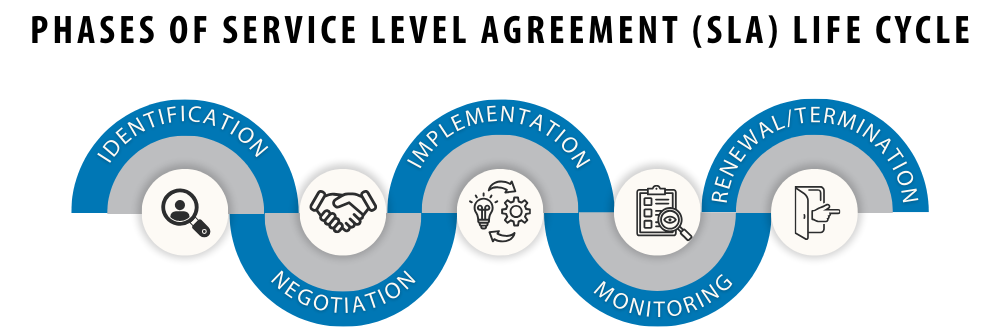
5 Different Phase of Service Level Agreement (SLA) Life Cycle
Starting a SLA life cycle goes through multiple stages. It ranges from Identification to termination. Let’s know each of these phases in detail.
1. Identification Phase
The life cycle of an SLA begins with the initiation phase, laying the groundwork for the agreement. This phase involves identifying the stakeholders, understanding their requirements, and defining the scope of services.
Here, stakeholders collaborate to draft the initial SLA document, outlining key metrics, performance indicators, and the overall framework of the agreement.
Clarity and transparency are paramount at this stage to avoid misunderstandings.
2. Negotiation and Agreement Phase
Once the initiation phase is complete, the negotiation and agreement phase takes center stage. This is where the nitty-gritty details of the SLA are fine-tuned through discussions and negotiations between the service provider and the customer.
Key elements, such as service levels, response times, and penalties for non-compliance, are negotiated and agreed upon during this phase.
This stage is pivotal, where both parties work towards a mutually beneficial arrangement.
Read more: How to handle SLA breach in a support setting?
Every journey has a crossroads, and the SLA life cycle is no exception. Here is one additional phase that decides the future of the SLA agreement.
5. Renewal or Termination Phase
The parties involved enter the renewal or termination phase as the SLA expires.
This stage involves a comprehensive review of the SLA’s effectiveness and whether it has met the expectations outlined in the identification phase. Based on this assessment, the parties can renew the agreement, renegotiate terms, or terminate the contract.
Every journey has a crossroads, and the SLA life cycle is no exception. Here is one additional phase that decides the future of the SLA agreement. In cases where the SLA has proven successful, the renewal phase allows for adjustments and improvements based on lessons learned during the previous term. On the other hand, if the SLA has not met expectations, the termination phase allows the parties to part ways amicably.
FAQs about the SLA Life Cycle
1. What are the Various Stages of the SLA Life Cycle?
The main phases in the SLA lifecycle are SLA Negotiation, SLA Agreement, Performance Monitoring, Review and Evaluation, and Renewal or Termination.
The second step is Negotiation, in which both parties discuss terms, expectations, and key performance indicators.
After that, we formalize the deal in an agreement phase or a phase where you proceed to sign the final SLA.
Then, you track performance with repeated assessments that ensure both parties comply with agreed-upon standards.
Lastly, the agreement is either renewed or terminated based on such review.
Knowing these phases is essential to keep the SLA effective during its life cycle.
2. What is the Role of Negotiation in the SLA Life Cycle?
One of the critical aspects of negotiation is mutual understanding on the part of service providers and clients as to what constitutes realistic and reasonable expectations.
It clarifies deliverables, timelines, and quality expectations from the get-go to minimize ambiguity between both parties.
3. How can Good SLA negotiation Enhance Business Success?
In a way, SLAs can make the overall service standards 100%. This is why effective SLA negotiation can provide a milestone in improving business performance.
With clear SLAs, companies can hold one another accountable by outlining response times, the required service levels, and any penalties for failing to comply.
Consequently, it prevents expensive disputes and eases service delivery.
4. What Should be in an SLA Agreement?
An effective SLA should set out key performance indicators (KPIs) and service level objectives (SLOs), response times, uptime guarantees, penalties, and roles and responsibilities for both parties.
All deliverables should have measurable targets; this helps create accountability and transparency.
5. How can we Monitor SLA Performance?
Monitor the metrics outlined in your SLA, such as response times, uptime of services, and issue resolution times. Real-time data on SLA compliance can be made possible through advanced monitoring tools.
Regular reviews can help identify the areas where improvements are needed. Tracking performance helps avoid breaches and maintain a high service quality level.
6. What Happens when the SLA Review and Renewal Process takes place?
In the SLA review, both parties will examine the effectiveness of the SLA by examining whether they have met the agreement terms and where they can make improvements.
If all goes well with the SLA, one can renew the contract.
Companies can renegotiate if there have been problems. This helps to keep the service level agreement relevant to changing business requirements.