
If you are asking what strategies improve brand visibility in AI search engines, start with clarity, not tricks. This is one of the more practical aspects of AI visibility vs. traditional SEO, since the answer lies in your existing content, not in a new tool. AI models reward content that answers a question directly, then backs it up with detail.
Structured data and schema markup help too, since they tell AI systems what a page is about rather than leaving them to guess. Brand mentions across review sites and news coverage carry weight, because AI tools check a business against more than its own website. It also helps to know how GEO vs SEO actually differ under the hood, since the two disciplines reward slightly different signals even when the underlying content overlaps.
How to Rank in AI Search Results and Optimize Content for AI Search Engines?
How to rank in AI search results comes down to structure and trust. Write short, direct answers near the top of every section, use real headings, and back claims with data. That is also most of the answer to how to optimize content for AI search engines, since AI tools extract chunks of a page, so each section needs to stand on its own.
Google AI Overviews and similar tools favor pages that read like they were written by someone who knows the topic. Keyword research still matters, since it shows the exact language buyers use, but repeating a phrase ten times will not earn an AI-generated response the way a clear answer will.
None of this works if the content behind it cuts corners. Choosing white-hat SEO services rather than shortcuts matters more now, not less, since AI models are quick to flag thin or manipulated pages and simply omit them from their answers.
Best AI Content Optimization Tools for AI Visibility
Teams asking about the best AI content optimization tools for search engine visibility usually want two things: a way to check whether content appears in AI-generated answers, and a way to fix it if it does not. Tools that track brand mentions, audit structured data, and flag thin content all help close that gap.
However, implementing the best digital marketing strategies for startups already double as AI visibility tactics when reframed around direct answers rather than keyword density alone.
Here are some of the best tools to track and improve your brand’s visibility in AI search results:
- Profound: tracks brand mentions and citations across ChatGPT, Perplexity, and Google AI Overviews
- Peec AI: GEO-focused monitoring for AI answer engines with competitor comparison
- Otterly.AI: monitors AI search visibility and citation share of voice
- Surfer SEO: content optimization that also feeds AI citation eligibility
- Ahrefs’ Brand Radar: newer feature tracking AI Overview mentions
- Semrush AI Toolkit: enterprise-level GEO tracking and AI visibility monitoring
- Writesonic’s GEO tools: content generation paired with AI search tracking
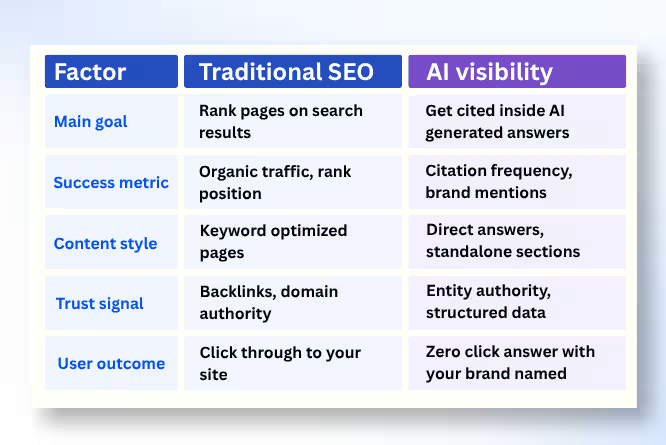
AI Visibility vs Traditional SEO: Full Comparison
Do You Need Both AI Visibility and Traditional SEO?
This is the question most business owners mean when they type AI visibility vs traditional SEO into a search bar. Yes, you need both. Search engine optimization still drives most organic traffic, and that is not changing overnight.
At the same time, AI search platforms are growing fast enough that ignoring them means losing buyers who never scroll past the answer they get. Treat AI visibility as a newer layer on top of a solid SEO base, not a replacement for it.
Anyone building a content plan around this shift should also consider implementing B2B content marketing, since demand generation now runs through AI-summarized research almost as often as through a search bar.
How Outsourcing Helps Enhance AI Visibility and Traditional SEO?
Blue links used to be the whole game. Rank high, get the click, close the sale. That model is fading and reshaping how the AI visibility vs traditional SEO conversation plays out in real workplaces.
Google AI Overviews now answer a large share of searches without sending visitors to a website, and buyers increasingly trust the summary rather than clicking through to compare five sites. A McKinsey estimate puts U.S. revenue funneled through AI-powered search at $750 billion by 2028, showing this is not a trend marketing teams should wait out.
A separate global study from IBM found that nearly half of consumers (45 percent) now turn to AI for help during their buying journey, researching products and comparing deals before visiting a company website at all.
This is why more companies are outsourcing SEO and content work rather than building a full in-house team. AI visibility needs technical SEO, structured data, content writing, and ongoing monitoring, skills most small teams do not have time to build from scratch. Running the numbers through an outsourcing cost calculator usually settles the debate fast, once salary, software, and training are all added up against a monthly retainer.
Outsourcing also solves a workplace problem: keeping up with customer questions across more than one internal team can manage. When AI tools start answering product questions on a brand’s behalf, content needs to stay accurate, not sit as a backlog nobody updates.
There are real reasons to outsource SEO services beyond the cost savings, including speed and immediate access to marketing specialists who already track these platforms every day. Pairing that with PPC for startups keeps leads coming in while the organic and AI visibility work builds momentum in the background.
Not every business hands off marketing all at once. A good first step is figuring out which marketing tasks to outsource and which stay in-house, since the right split looks different for every team. Once that decision is made, picking the right outsourcing partner matters just as much as the decision to outsource itself, since the wrong fit can quickly undo the savings.
None of this replaces the basics. Clean SEO and content built around real customer questions still form the base on which everything else stands. AI visibility adds a layer most in-house teams were never staffed to handle alone.

Conclusion
If you want to know where a brand stands on AI visibility vs traditional SEO right now, the fastest way is an outside audit. Many businesses find gaps they did not know existed, missing structured data, thin content, or zero brand mentions.
A team that already offers full digital marketing services is usually tracking both sides of this shift as a matter of course, not as an add-on service.
You can run a free digital marketing audit with BolsterBiz. Before booking anything, you can schedule a free SEO audit today to see where things stand.