
Data analytics managed services are ongoing, end-to-end outsourced solutions that handle data engineering, reporting, governance, and continuous optimization for a business, as opposed to project-based outsourcing, which covers a single deliverable like a dashboard build. That distinction matters more than most guides let on. Managed services are a continuous function; outsourcing is a one-off project with a start date and an end date.
Most growth-stage companies land in one of two spots: they can’t yet justify a full in-house analytics team, or the team they do have is stretched too thin to keep dashboards, pipelines, and reporting current. Either way, something has to give, and it’s usually the reporting nobody has time to maintain.
This guide breaks down what’s actually included in a data analytics managed services engagement, real 2026 pricing, how the model differs from other outsourcing approaches, and a readiness framework to help you decide if it’s the right fit for where your business is right now.
Key Takeaways
- Data analytics managed services are ongoing, continuous engagements, not one-off projects.
- A properly scoped engagement covers six functions: pipelines, dashboards, governance, ad hoc analysis, optimization, and reporting cadence.
- Monthly retainers for growth-stage companies typically run $3,000–$15,000/month depending on data complexity.
- The break-even vs. in-house is typically reached within 6–9 months when you include fully loaded salary, benefits, and tooling costs.
- Three or more of the readiness checklist signals being true is the clearest indicator a managed engagement is the right next step.
What Are Data Analytics Managed Services?
At the simplest level: a managed service is continuous, and outsourcing is task-based. RSM and other advisory firms draw this line clearly, but it’s worth translating into plain terms for a growth-stage business owner who isn’t fluent in consulting language.
“Ongoing” isn’t a marketing word here, it describes specific, recurring work:
- A dedicated point of contact who knows your business, not a rotating help desk
- A recurring reporting cadence (weekly or monthly, not “whenever someone remembers”)
- Continuous pipeline maintenance so data keeps flowing cleanly from your source systems
- Ad hoc analysis requests handled inside the existing relationship, without a new contract every time
It’s also worth separating this from self-service BI tools. A Power BI or Tableau license is not a managed service, it’s software. Someone still has to build the dashboards, maintain the underlying data connections, catch errors when a source system changes, and actually interpret what the numbers mean. A tool without a team behind it just moves the maintenance burden onto whoever’s left holding it internally.
The real test: if your current setup requires someone internally to remember to update dashboards manually, you don’t have a managed service, you have a manual process with extra software.
What’s Included in Data Analytics Managed Services?
Scope is where most engagements go sideways, so it’s worth being specific. A properly structured managed data analytics team typically covers six functions:
- Data engineering and pipeline maintenance: the ETL/ELT work that keeps data flowing cleanly from source systems into your warehouse or BI layer, including fixes when a source system changes its schema.
- Dashboard and report development and upkeep: not a one-time build. Dashboards should evolve as the business questions behind them change.
- Data governance and quality monitoring: catching broken pipelines, duplicate records, or data that’s quietly drifting out of sync before it corrupts a report leadership is relying on.
- Ad hoc analysis support: a named contact who can answer a new business question without triggering a new statement of work every time.
- Ongoing optimization: query performance tuning, cost management on cloud data warehouses, and refining models as data volume grows.
- Strategic reporting cadence: scheduled weekly or monthly reviews, not just raw dashboard access nobody walks through with you.
AI tooling is changing what these six functions look like day to day. Copilot-style assistants inside Power BI, Tableau’s AI features, and automated pipeline monitoring now handle a meaningful share of the manual maintenance work, flagging anomalies before they hit a dashboard, drafting first-pass report summaries, and answering natural-language questions against existing data. What AI does not do is replace the need for a skilled analyst validating those outputs; automated anomaly detection still needs a human to confirm what’s actually broken versus what’s a genuine business shift, and AI-generated summaries still need a second set of eyes before they reach leadership. In practice, this means managed services in 2026 involve less rote maintenance and more oversight of AI-assisted work, a shift worth asking any provider about directly.
Ad hoc requests are worth a separate note. If what you actually need is a bounded, one-off research task rather than a recurring analytics function, that’s a slightly different service. BolsterBiz’s internet research services are built for exactly that kind of non-recurring, standalone data request.
Before signing with any provider, get a written list of exactly which of these six functions are included versus billed separately. This is the single most common source of scope disputes down the line.
Data Analytics Managed Services vs. Outsourcing vs. Staff Augmentation
These three terms get used interchangeably, but they solve different problems:
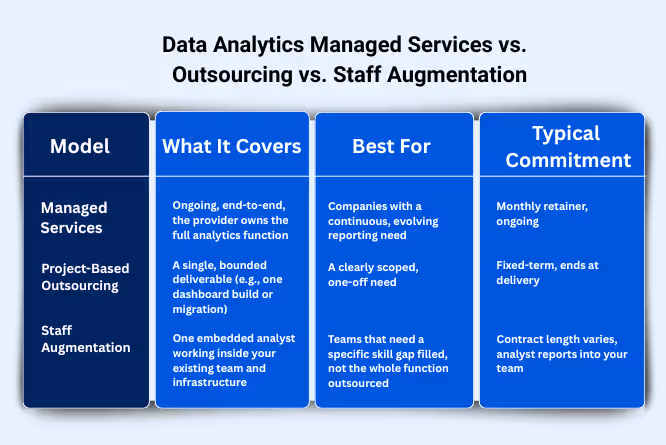
If you want the full landscape beyond these three, there are more ways to structure this than just these models. 5 Best Data Analytics Outsourcing Models to Choose breaks down the complete set of models in more depth. This section is the direct differentiator between the three most commonly confused options; that piece is the broader map.
Staff augmentation deserves its own callout because the same skill-gap problem shows up constantly outside of analytics too; most companies evaluating this are running into it in engineering as much as in data. BolsterBiz’s IT staff augmentation services cover that broader need if an embedded specialist, rather than an outsourced function, is what you’re actually after.
If you find yourself asking for something new every few weeks that always seems to fall outside the current agreement, you likely need managed services, not project-based outsourcing.
How Much Do Data Analytics Managed Services Cost in 2026?
Pricing scales with three variables: data volume, active dashboard count, and governance complexity. Any provider giving you a vague “contact us for pricing” answer before understanding those three inputs isn’t being straight with you.
As a general range for 2026, based on current market benchmarks from Clutch and published provider pricing:

For context, the average cost of hiring a business intelligence, big data, and analytics consultant on Clutch ranges between $25 and $49 per hour, a useful benchmark if you’re pricing out a project-based engagement instead.
The comparison that actually matters is against the fully loaded cost of building this in-house. That means not just a data analyst’s salary, but a BI engineer and a manager layered on top, plus benefits, tooling, and the time cost of hiring. On the salary side alone, Glassdoor’s 2026 data puts the average data analyst salary at roughly $93,406 per year in the US, with pay ranging from about $72,183 to $122,027 for the middle 50% of earners, and that’s before benefits, software licensing, or the cost of a more senior hire to manage the function. Stack a data analyst, a BI engineer, and a fraction of a manager’s time on top of each other, and the fully loaded in-house cost climbs well past what most managed engagements charge for the same output.
Run your own numbers against your specific team size and reporting needs using the outsourcing cost calculator for a figure tailored to your setup, then use the ranges above as your starting benchmark.
One more thing worth noting: most reputable providers structure this as a monthly engagement rather than a fixed-term contract, which matters more than it sounds for budgeting flexibility, you’re not locked into a number that no longer matches your data volume six months from now.
Ask any provider for their pricing model in writing before the first call ends. Complexity-based monthly pricing that flexes with your reporting needs is healthier than a rigid annual retainer for most growth-stage companies.
Is Your Business Ready for Data Analytics Managed Services?
Run through this checklist honestly:
- You have no internal analytics function yet, but decisions are already being made on gut feel or spreadsheets nobody trusts anymore
- Your one internal analyst spends more time firefighting broken dashboards than doing new analysis
- Leadership is asking for recurring reporting that nobody currently owns end to end
- You’ve outgrown a single project-based engagement and keep re-signing new statements of work for what’s really ongoing work
Not ready yet if: your need is a single, clearly bounded project, one migration, one dashboard build, one report redesign. A project-based engagement is the better and cheaper fit in that case, and paying for an ongoing function you don’t need yet just adds cost without adding value.
If three or more of the readiness signals above are true today, a project-based engagement will likely cost you more over 12 months than a managed services relationship would, because you’ll end up re-signing new scopes of work repeatedly instead of paying once for continuous coverage.
If your business operates in a regulated industry, healthcare, financial services, or legal, factor that into your readiness assessment too: data source and governance complexity climb fast once HIPAA, SOC 2, or GDPR obligations enter the picture, and not every managed services provider is equipped to handle them alongside standard analytics work.

How to Choose a Data Analytics Managed Services Provider
Generic advice like “look for experience and trust” doesn’t help you evaluate anyone. Ask these five questions instead:
- Which of the six core functions covered above are included in the base engagement, and which are billed as add-ons?
- What data security certifications does the provider hold, ISO/IEC 27001 in particular, and what encryption practices and access controls are in place before you share any data? If you’re in a regulated industry, also confirm HIPAA readiness and SOC 2 Type II certification specifically, ISO/IEC 27001 alone doesn’t guarantee coverage for healthcare or financial-services compliance obligations.
- Can they show a live example of a dashboard or report built for a client at a comparable stage, not just a sales deck of logos?
- What’s the actual reporting cadence, and do you get a dedicated point of contact or a rotating support queue?
- What happens when your data volume or reporting needs grow, does pricing scale smoothly, or does it require a full contract renegotiation?
A provider who can’t answer these five questions specifically, and instead redirects to generic capability claims, is a signal to keep evaluating other options.
BolsterBiz’s data analytics managed services are structured around exactly this model, a dedicated team, transparent monthly pricing, and ISO/IEC 27001-certified data handling, so growth-stage businesses get the continuous support of an in-house team without the hiring timeline.
Frequently Asked Questions
What is the difference between data analytics managed services and a data analyst hire?
A managed service gives you a full team, analyst, BI engineer, and governance oversight, for a monthly retainer that typically undercuts one fully loaded in-house salary. A single data analyst hire covers only one skill set, still needs management, and leaves pipeline engineering and governance uncovered unless you hire separately for those too.
What security certifications should a data analytics managed services provider have?
At minimum, ISO/IEC 27001 for information security management. If your data involves healthcare or financial records, also confirm HIPAA readiness and SOC 2 Type II certification these aren’t automatically covered by ISO/IEC 27001 alone.
What is the difference between data analytics managed services and data analytics outsourcing?
Managed services are ongoing, the provider continuously owns reporting, pipelines, and governance. Project-based outsourcing covers a single, bounded deliverable, like one dashboard build, with no ongoing retainer once it’s delivered.
How much do data analytics managed services cost?
Cost scales with data volume, number of active dashboards, and governance complexity. As a general 2026 benchmark, early-stage engagements run $3,000–$6,000/month, growth-stage $8,000–$15,000/month, and enterprise or complex-governance engagements $15,000–$40,000/month or more.
What’s included in a data analytics managed services agreement?
Typically six functions: data engineering and pipeline maintenance, dashboard development and upkeep, data governance and quality monitoring, ad hoc analysis support, ongoing optimization, and a set reporting cadence. Get scope confirmed in writing before signing.
Is data analytics managed services worth it for a small business?
It’s worth it once you have recurring reporting needs nobody internally owns end to end. If your need is a single bounded project instead, a project-based engagement is usually the cheaper, better fit.
How long does it take to onboard a data analytics managed services provider?
Onboarding timelines vary by data complexity, but most providers can connect to your existing data sources and stand up initial reporting within the first few weeks, with the reporting cadence fully running shortly after.
Conclusion
The core distinction to carry forward: managed services is the right model for ongoing, evolving analytics needs, not a single deliverable you can check off a list. Choosing the right model for where your business actually is matters more than chasing the “best” provider in the abstract, a great provider running the wrong model for your stage still leaves you paying for the wrong thing.
The data backs up why this decision is worth getting right. According to McKinsey Global Institute research, data-driven organizations are roughly 23 times more likely to acquire customers and about 19 times more likely to be profitable than their less data-mature peers. The gap between companies that treat analytics as a continuously maintained function and those that let it decay between projects shows up directly in the numbers.
If you’re weighing the cost question, run your own team size and reporting needs through the outsourcing cost calculator to get a number specific to your situation rather than a generic range. And if you’re ready to see what a properly structured engagement looks like, BolsterBiz’s data analytics outsourcing services are built around the exact model outlined above.