
The 6 Digital Marketing Agency Pricing Models
Every agency proposal you’ll see in 2026 boils down to one of six structures. Understanding them before you request quotes changes how you read every number that follows.
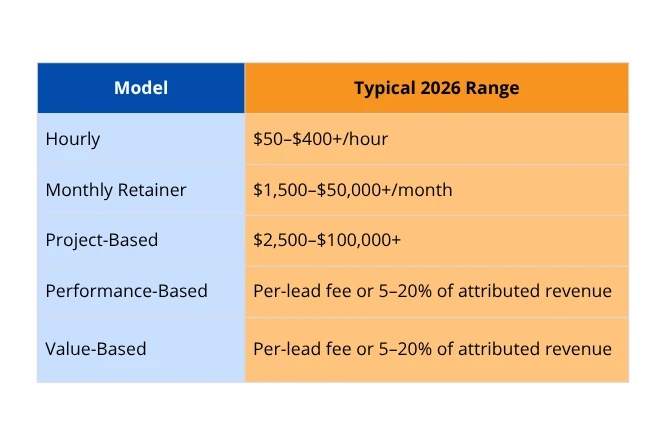
Hourly pricing charges $50 to $400+ per hour depending on seniority and location. It’s the most transparent model but the hardest to budget against, since total cost depends entirely on how long the work takes.
Monthly retainers are the industry default. Per the 2026 Influencer Marketing Hub agency survey, 78% of agencies use retainers as their primary structure, because they give both sides predictable cash flow.
Project-based pricing sets a flat fee for a defined deliverable, like a website audit or a rebrand. Performance-based pricing ties payment to results, typically 5-20% of attributed revenue or a per-lead fee. Value-based pricing charges a share, usually 10-30%, of the business value the work is projected to generate. Hybrid pricing blends two or more of the above, most often a base retainer plus a performance bonus, and it’s the fastest-growing digital marketing agency packages structure this year because it splits risk fairly between agency and client.
Digital Marketing Agency Pricing by Model
Digital marketing agency pricing can vary widely depending on the pricing model, scope of work, and level of expertise involved. From hourly engagements and monthly retainers to project-based and performance-driven models, businesses have several options to choose from. The table below provides a quick overview of typical digital marketing agency pricing ranges in 2026.
Digital Marketing Agency Pricing by Service
Pricing varies as much by service as it does by agency size or model. Here’s what each channel typically costs at three tiers:
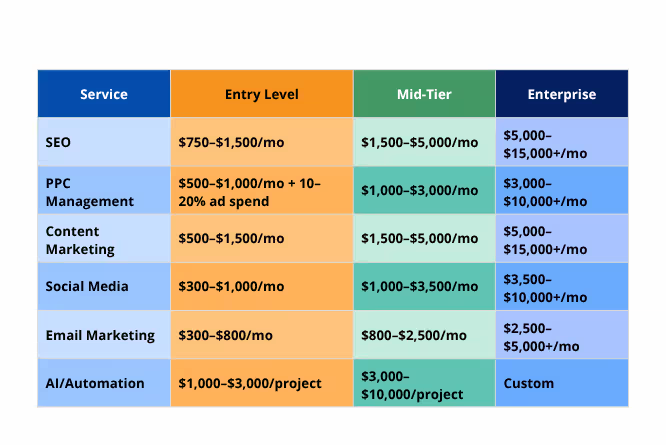
PPC quotes usually assume you already have a working landing page; building one is typically scoped separately.
When Digital Marketing Agency Cost by Agency Size and Tier
Digital marketing agency cost tracks closely with who you’re hiring, not just what you’re buying. A solo consultant and a 40-person agency can quote wildly different numbers for the same scope of work, and both can be fair prices for what they deliver.
Solo and boutique operators typically charge $1,000-3,000/month for a single channel with light reporting. Small agencies (2-10 people) run $2,500-7,500/month, usually covering two or three channels. Mid-size agencies (10-30 people) charge $5,000-15,000/month for comprehensive, multi-channel strategy. SaaS and enterprise-focused agencies charge $10,000-50,000+/month, reflecting the demand-generation and lifecycle complexity that larger marketing teams need to support.
If you’re trying to figure out where your business actually falls before requesting quotes, running your numbers through BolsterBiz’s outsourcing cost calculator gives you a realistic baseline before a single sales call.
Why Hourly Rate Estimates Vary So Widely
If you’ve compared pricing sources, you’ve probably hit this exact confusion: Clutch cites a $25-49/hour marketplace average, while industry guides cite $50-400/hour. Both are correct. They’re just measuring different things.
Clutch’s pricing data is a marketplace-wide average pulled from 106,043 listed digital marketing agencies as of Q3 2026, and that pool skews toward smaller, generalist shops competing on price. The wider $50-400/hour range reflects the full spectrum, including boutique specialists and premium consultants who aren’t optimizing for marketplace listings. Neither number is wrong. They’re answering different questions.
SEO specifically shows this gap clearly: it averages $100-149/hour on Clutch, already three to six times the platform-wide average, because SEO work demands more specialized skill than general digital marketing fees typically cover. When you’re comparing quotes, ask which average you’re actually being compared against before assuming you’re overpaying.
Digital Marketing Pricing Packages: What’s Typically Included
A standard retainer covers strategy, execution, and reporting for the channels you’ve agreed on, whether that’s paid ads or a team that creates content on a schedule, usually SEO, content, paid ads, or social, in some combination. What’s often billed separately is where clients get surprised.
Automated reporting dashboards commonly run $200-500/month as an add-on rather than a built-in feature. Niche-specialist premiums apply if your industry is regulated or technically complex: legal, medical, and SaaS specialists command 20-40% higher retainers than generalist agencies, because compliance knowledge and vertical-specific messaging aren’t things a generalist can fake convincingly.
AI integration services, chatbot setup, automation workflow builds, and LLM-assisted content at scale, are now included or quoted separately by 63% of agencies, up from 28% in 2024. Pricing remains highly variable: $1,000–$10,000+ per project depending on scope, with no established benchmark yet equivalent to the standard “10–20% of ad spend” model for PPC.
Privacy shifts are also reshaping what’s in scope. Agencies now frequently bundle cookieless marketing strategy work, first-party data setup, and consent management into digital marketing pricing packages that didn’t need to account for this a few years ago. Ask explicitly whether privacy-compliant targeting is included or billed as a separate project.

Performance-Based and Value-Based Pricing: How They Work
Performance-based digital marketing agency pricing pays a low base fee plus 5-20% of attributed revenue, or a 10-30% bonus once agreed targets are exceeded. It works well when attribution is clean and conversion rates are trackable end to end, think e-commerce or lead generation with a defined conversion path, but it puts real risk on the agency when algorithms shift or markets move outside anyone’s control.
Startups weighing performance-based paid media specifically should look at how PPC for startups budgets typically get structured before locking into a percentage-of-spend arrangement, since that structure changes the incentive math significantly once ad spend scales.
Value-based pricing skips hours and outputs entirely and charges a share, 10-30%, of the business value the strategy is projected to create. It only works with once the relationship builds trust, since it requires the client to open up real financial data and both sides to agree on what “success” means before work starts.
How to Choose the Right Pricing Model for Your Business
There’s no universally correct model, only the right one for your stage and business goals.
For testing a new agency relationship, project-based or hourly work limits your exposure while you evaluate fit. For ongoing, evolving needs, a retainer gives you predictable costs and priority access to the team. If you’re results-focused with clean attribution, performance pricing aligns incentives directly. If you’re scaling technical work alongside marketing, it’s worth reading how backend development outsourcing engagements get scoped, since the same fixed-fee-versus-retainer logic applies almost identically across technical and marketing outsourcing decisions.
Before signing any agency contract, calculate your breakeven: if a $3,000/month retainer needs to generate 20% more leads to pay for itself, and your current close rate is 15%, work out how many additional leads per month you need to break even. Agencies who refuse to help you build this model before signing are the ones to avoid.
Whatever you land on, go in with clear eyes. A solid rundown of the pros and cons of outsourcing before you sign anything saves you from re-learning these lessons the expensive way.
Red Flags in Digital Marketing Agency Pricing
Some warning signs show up before you’ve even signed anything, if you know where to look.
Pricing with no scope attached is the biggest one. If a number is quoted without a specific list of deliverables, frequency, and output, you have nothing to hold the agency to later. Performance deals with no defined attribution model are a trap: without agreement on what counts as a qualified result, disputes are inevitable once invoices arrive.
Retainers priced well below a 40% gross margin threshold usually mean corner-cutting somewhere, whether that’s junior staff, reused templates, or under-resourced accounts. Hidden add-on fees not disclosed upfront, ad spend markups, reporting tool charges, “strategy refresh” fees, are common enough that Ignition’s 2025 Agency Pricing & Cash Flow Report (2025 data, most recent available) found nearly 80% of agencies surveyed rarely or only sometimes bill for work that falls outside the original scope, which means scope creep quietly erodes margin on both sides when boundaries are not written down clearly.
Conclusion
Six pricing models, four agency size tiers, and a hundred-dollar swing in hourly averages depending on which source you trust: digital marketing agency pricing looks confusing mostly because most guides don’t explain why the numbers differ. Once you understand that a Clutch average and a specialist’s hourly rate are measuring different populations, the confusion mostly disappears and finding the most cost-effective option gets a lot easier.
The right choice isn’t the lowest digital marketing agency fees you can find. It’s the model that matches your stage, budget predictability needs, and how much risk you’re willing to share with your partner. If you would rather skip the spreadsheet and just talk pricing for your specific business, BolsterBiz’s digital marketing services cover the full stack outlined above, and you can schedule a free strategy call to get a real number instead of a range.