A startup usually does not have that much budget to start with all the expensive tools or a dedicated team. There might just be two or three people managing SEO, content, and ads.
Hence, investing in good digital marketing tools is crucial. They are easy to learn and do not require lengthy onboarding or training sessions. If a tool takes longer to show the ROI, then you must be using the wrong tool.
Best Digital Marketing Tools for SEO for Startups
SEO is crucial for startups that want good and long-term organic growth. PPC and paid ads can drive a traffic surge, but SEO brings the right type of traffic that targets the niche. Thus, it is imperative to understand the benefits of SEO for startups, as this gives leaders an added advantage over competitors who rely solely on paid channels.
Here are the best seo tools for small businesses that startups can use for growth:
1. Ahrefs
It is widely considered one of the most used and robust SEO platforms available worldwide. It provides in-depth keyword research data, backlink analysis, site audit features, and competitor gap analysis. If you want to understand why a competitor is ranking and what it would take to outrank them, Ahrefs is the right tool for the job.
1. Semrush
This is a similar tool to Ahrefs. It has features similar to Ahrefs but places greater emphasis on competitor analysis and content marketing. You can use this tool to run both organic an paid campaigns. It dives into competitors’ ad strategies and their SEO reports.
3. Google Search Console
This is a free tool, and everyone needs access to it from the beginning of SEO practice. It is beneficial to analyze search query rankings and use them in your content to attract visitors to your website. Plus, you get the exact details of your ranking pages, along with the pages you need to improve, with technical improvement suggestions included.
4. Ubersuggest
This is a fairly affordable tool from Neil Patel, making it a more budget-friendly option for early-stage startups. It helps mostly with keyword research and on-page SEO suggestions.
Also, ensure the keywords (KW) have significant search volumes but are less competitive. Long-tail keywords usually rank well. For example, the KW “digital marketing tools” will be tough to rank, but it will be easier to rank for the KW “which are the effective digital marketing tools for startups.”
What are the AI Tools for Digital Marketing
There has been a significant rise in AI tools for digital marketing in the modern business world. Tasks that required 2-3 days of human work can now be done in just a few hours. Here are some popular AI tools for digital marketing.
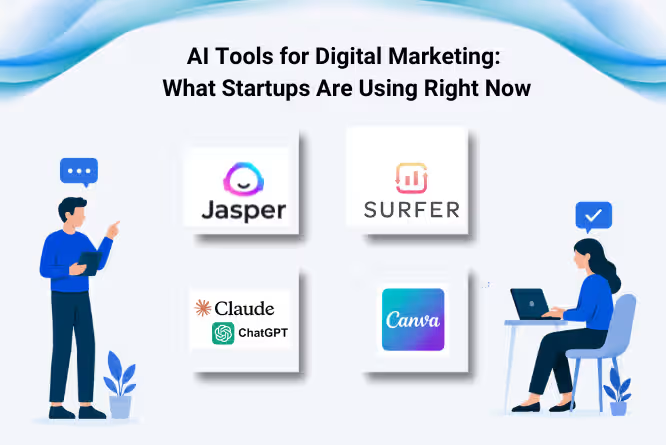
5. Jasper
Formerly Jarvis, it is one of the most popular AI writing tools for marketing teams. It can help with content, be it blogs, drafts, research, ad copies, and emailers. It does not aim to replace a human writer but to help the writer make good content faster.
6. Surfer SEO
An AI tool that combines AI writing assistance with SEO optimization ideas. After you write the blog post, it shows a live score that tells you whether the content will rank at the top of the search results. Small companies and startups trying to ace content marketing can leverage this tool.
7. ChatGPT and Claude
These are popular AI tools that marketers use for efficient content research, writing, drafting, social media copy, and workflow automation. They are not ideal for copying and writing, but they can assist and are a good fit for startups.
8. Canva’s AI features
One of the efficient digital marketing tools that has made designing easy and convenient. Many marketing experts now use Canva for graphics for socials, ads, and blogs. Startups can use this tool to leverage immediate, regular designs needed for marketing collateral.
Pro Tip: Even though AI has made work faster, it still needs human intervention for accuracy and authority. Use it for research, not as autopilot.
All-in-One Marketing Platforms
Some digital marketing tools can do multiple tasks at once. If you need to manage email tools, CRM, social media, and analytics, then you can go for all-in-one marketing platforms.
9. HubSpot
This is one of the most popular all-in-one marketing tools for startups and small businesses. The free version is useful and covers CRM, email marketing, form builders, and basic analytics. As you scale, you can upgrade to get marketing automation, ad tracking, and more. The catch is that HubSpot’s paid tiers get expensive quickly, especially if you want the full feature set.
10. Zoho Marketing Plus
This is a strong alternative, often more affordable than HubSpot. It covers email campaigns, social media management, webinars, surveys, and CRM in one place.
11. ActiveCampaign
This tool sits somewhere between an email platform and a full marketing suite. It is particularly robust for marketing automation, capable of building complex workflows that respond to user behavior in real time.
The main advantage of using an all-in-one marketing platform is that your data is in one place. When your email tool, CRM, and website analytics are connected, you can see the full picture of how a customer found you, what content they engaged with, and what finally pushed them to convert. That kind of visibility is incredibly valuable for making data-driven decisions.
Content Marketing Tools for Small Businesses
Content creation and marketing are the kings of SEO and digital marketing. If your content sells, so will your product/service. It is high leveraging marketing technique for any startup. A well-written blog can rank for years and gain leads. Content builds trust and sales at the same time.
But only consistent, strategic, and actually good content marketing works. Here are the digital marketing tools you can use for content marketing
- Notion or Google Docs: Use this for content planning and editorial calendars, and it can also pair with the Semrush extension. This is very simple, like Word docs. A simple system to help you plan and write content smoothly.
- Surfer SEO or Clearscope: Use for content optimization. These tools analyze the top-ranking pages for a keyword and tell you what topics, headings, and terms your content needs to include to compete. If you want your next blog post to have a real shot at ranking, using a tool like this is now almost essential.
- Grammarly or Hemingway Editor: Good for editing and improving readability. Simple, clear writing outperforms clever, complex writing almost every time. These tools help you catch errors and tighten your prose before it goes live.
- BuzzSumo: Good for content research. It shows you which content in your niche is being shared most, giving you a starting point for topics that are already proven to resonate with your target audience.
Pro Tip: It is imperative to understand B2B content marketing to market effectively. Startups that treat every blog post as a standalone piece rather than as part of a broader content strategy tend to see inconsistent results. The startups that win at content marketing think in terms of topic clusters, pillar pages, and building a library of content that answers every question their potential customers have.
Email Marketing Tools for Digital Marketing
For every dollar spent on email marketing, the average return is around $36, according to Litmus’s Email Marketing ROI Report. Email campaigns consistently outperform most other digital channels when done well, and they remain one of the most underrated channels for early-stage startups.
The key is building your list intentionally from day one. A subscriber who opted in after downloading a useful guide is worth far more than a purchased list of cold contacts who have never heard of you.
- Mailchimp: This is the default choice for early-stage startups. It is free up to 500 contacts, easy to set up, and has enough features to run solid email campaigns without a marketing background.
- ConvertKit: In most cases, it is best for content-driven businesses and creators. It is built around automations and sequences, making it easier to send the right message to the right subscriber based on what they have clicked on or engaged with.
- Klaviyo: This is the go-to for e-commerce startups. It integrates deeply with Shopify and other platforms, and its segmentation capabilities let you be very specific about who sees which message.
Good email marketing for startups is not about promotions alone. It is about staying useful and relevant to your audience over time. A weekly digest of insights, a helpful how-to guide, a behind-the-scenes look at your product journey: these types of emails build the kind of relationship that eventually turns subscribers into buyers and buyers into advocates.
Analytics Tools for Startups and Small Businesses
No stack of digital marketing tools is complete without a way to track performance across all of your channels. Analytics tools turn raw data into decisions and help with the lead-capturing process.
- Google Analytics 4 (GA4): This is the foundation for any company. It is free, it connects to almost everything, and it gives you real-time and historical data you need to understand how people find your site, what they do once they get there, and where they drop off. Setting it up correctly with proper conversion events is one of the highest-value technical tasks a startup marketing team can do early on.
- Hotjar: Its primary job is to add a visual layer to your analytics. Heatmaps and session recordings show you where people are clicking, scrolling, and getting stuck on your site. This kind of qualitative data is incredibly useful for improving your landing pages and reducing drop-off in your conversion funnel.
- Databox or Google Looker Studio: A digital marketing tool that is useful for building dashboards that pull together data from multiple sources. If you are running marketing campaigns across email, paid ads, and organic search, having a single view of performance means less time logging into five different platforms and more time acting on what the data is telling you.
Good analytics is not just about collecting data. It is about building a habit of regularly reviewing the right numbers and using them to make decisions. The best marketing teams at startups are the ones that review their numbers weekly, not just at the end of the quarter when it is too late to course-correct.
Pro Tip: If you are not sure where to start with your analytics setup, the free 2025 digital marketing audit guide can help. It walks you through what to measure and how to structure your tracking for better data-driven decision-making.
What to do When Digital Marketing Tools become Expensive?
Here is something most tool roundup articles will not say directly. The tools listed in this blog, even the mid-tier ones, add up fast. A serious startup running Ahrefs, HubSpot, Surfer SEO, a paid social tool, and a decent email platform can easily be spending $1,000 to $2,500 per month just on software subscriptions.
And that is before you factor in the people cost.
A skilled SEO specialist costs between $60,000 and $100,000 per year as a full-time hire. A good PPC manager is in the same range. A content marketer who can both write and do proper keyword research is another significant investment. When you layer these hiring costs on top of tool subscriptions, the budget required to run a proper in-house marketing strategy operation quickly becomes something that only well-funded companies can afford.
This is why many startups, especially those in the early and growth stages, are looking to outsourcing as a smarter way to access both tools and expertise without the overhead. You can even use the outsourcing cost calculator to see how much you might save compared to hiring in-house.
Outsourcing Digital Marketing is a Smart Choice for Startups in 2026
Outsourcing is not a compromise. For most startups, it is actually the smarter move. Here is why.
When you hire an in-house team, you are paying for one person’s skills, one person’s bandwidth, and one person’s tool subscriptions. When you work with an outsourced digital marketing partner, you get access to a team of specialists across SEO, content, PPC, and social, plus the tools they are already paying for and know how to use well.
Most reputable outsourcing agencies already have enterprise-level subscriptions to Ahrefs, Semrush, Surfer SEO, and other premium platforms. You benefit from those tools without having to pay for them separately.
The reasons to outsource SEO services go beyond just cost savings, though. You also get faster execution, more specialized expertise, and the ability to scale up or down based on what your business actually needs at any given point.
The same logic applies across channels. Understanding which marketing tasks to outsource can help you determine which to keep in-house and which to delegate to external specialists to deliver better results faster.
For example, imagine a SaaS startup with a team of twelve people. Their one marketing hire is decent at content but knows very little about paid search. They spent three months running Google Ads campaigns in-house with mediocre results. When they finally bring in an outsourced PPC specialist, the same budget starts performing two to three times better within weeks, because the specialist knows the platform deeply and has seen what works across dozens of similar clients.
That is the real value of outsourced expertise: not just doing the work, but doing it with the depth of experience that comes from doing it every day across multiple clients and industries.