Where to Find Remote QA Engineers to Hire
If you’re looking to hire directly rather than build fully in-house, a handful of named platforms cover the freelance and outsourced ends of the market: Toptal and Turing for premium, pre-vetted freelance QA talent; Abstracta for specialist outsourced QA and testing services; and Testlio for managed QA testing engagements. Each fits a different model, see the comparison below to match one to your situation.
Why Companies Are Hiring Remote QA Engineers & QA Testers in 2026
Traditional QA hiring is slow. Building an in-house team from scratch typically takes three to four months once you account for sourcing, interviewing, and onboarding, a timeline most release schedules simply cannot absorb. Remote QA engineers & QA testers close that gap, since staff augmentation providers can typically place a vetted candidate within one to three weeks.
Speed isn’t the only driver. Software testing outsourcing gives teams access to specialized skills, automation, performance testing, security testing, that a small in-house team often cannot cover on its own, especially for teams shipping mobile apps or handling more complex software engineering work where an internal team’s bandwidth is already stretched thin. It also adds flexibility: QA demand rarely stays flat across a release cycle, and remote hiring models let you scale testing capacity up before a major launch and back down afterward without the cost of carrying idle full-time headcount.
Cost efficiency compounds all this. Staff augmentation models can reduce overhead costs by up to 70% compared to building an equivalent QA function in-house, once salaries, benefits, tooling, and management overhead are accounted for.
Demand for this talent is also climbing: as of early 2026, Indeed lists over 500 open remote QA engineer positions, putting demand at a multi-year high, a trend we break down further in BolsterBiz’s guide to the remote hiring market.

QA Roles You Can Hire Remotely, and What Each One Costs
Not all QA engineers & QA testers do the same work, and rates vary sharply by role and region. The figures below are contract hourly rates billed by staff augmentation and outsourcing providers, not direct employee salary figures, which run separately on an annual basis.
Manual testers handle functional testing without automated scripts, verifying that features work as intended across devices and scenarios. This is the most affordable QA role, running roughly $15–$25/hr offshore, $30–$45/hr nearshore, and $45–$70/hr onshore.
Automation QA engineers build and maintain automated test scripts using tools like Selenium or Playwright inside your test environment, reducing repetitive manual regression testing work over time. Rates typically run $25–$50/hr offshore, $40–$65/hr nearshore, and $60–$100/hr onshore.
SDETs (Software Development Engineers in Test) blend development and testing skills, writing test frameworks and integrating testing into CI/CD pipelines. This is one of the highest-demand QA roles, commanding $35–$50/hr offshore, $50–$75/hr nearshore, and $70–$120/hr or more onshore.
Performance and security testers are specialists, often brought in for specific projects rather than ongoing engagements, with rates comparable to or above SDET pricing depending on the complexity and compliance requirements involved.
Outsourced QA testing through offshore providers offers the lowest headline rates, but outsourced QA testing services structured as a managed pod, bundling oversight with automation, often deliver the lowest total cost once you factor in reduced management overhead and fewer repeated manual regression hours.
BolsterBiz’s dedicated QA outsourcing services cover manual, automation, and specialized testing roles under one flexible engagement.
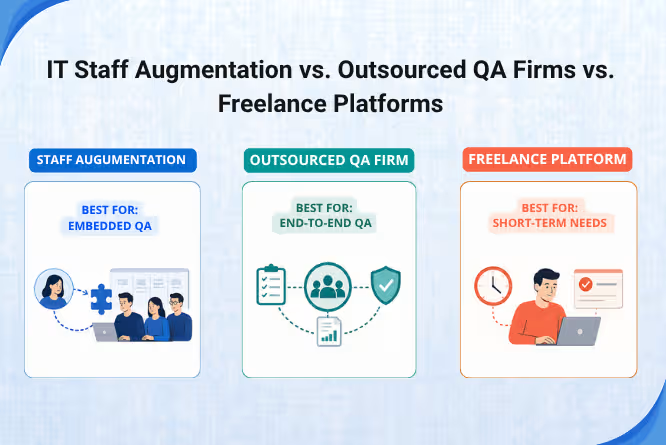
Choosing how to hire matters as much as choosing who to hire. Each of the three main paths fits a different situation.
IT staff augmentation embeds a dedicated QA engineer directly into your existing team, sprints, and tools. This is the strongest fit when you want QA fully integrated into planning, standups, and retrospectives rather than operating as a separate, disconnected function.
An augmentation service like this brings technical expertise straight into your existing teams without disrupting how your team members already work together, unlike traditional in-house teams, which have to build that expertise from scratch.
Staff augmentation suits automation QA roles particularly well here, since an embedded automation engineer can build test frameworks that match your exact codebase and CI/CD setup rather than working from a generic external process.
Outsourced QA testing services hand off the entire testing function to an external firm that manages test planning, execution, and reporting largely independently. This suits companies that want QA handled end to end without day-to-day oversight, at the cost of somewhat less integration with internal engineering workflows. Abstracta is a well-known specialist option in this category, while Testlio focuses on managed QA testing engagements.
Freelance platforms work best for short-term, narrow-scope needs, a single testing sprint before a launch, or a one-off security audit, where a long-term engagement isn’t justified. Toptal and Turing are commonly used for sourcing premium, pre-vetted freelance QA talent.
What to Look for When Vetting Remote QA Engineers
Before hiring, run a real technical assessment using a test scenario from your own product, not a generic quiz. Confirm time-zone overlap sufficient for daily standups and real-time bug triage. Verify hands-on experience with your actual toolchain, Selenium, Playwright, Jira, TestRail, or whatever primary testing tool and CI CD pipeline setup your team already uses.
Additionally, Ask for case studies or references from comparable engagements before committing to a long-term contract, request a short trial period, and set a clear reporting cadence upfront so defect tracking and test coverage stay visible from day one.
How to Get Started Hiring Remote QA Engineers & QA Testers
Start by defining your actual scope and release cadence, since a weekly release cycle requires a fundamentally different QA setup than a quarterly release cycle. Loop in project managers and your development team early so the engagement aligns with existing sprint planning from day one, rather than being layered on after the fact.
Choose the hiring model that fits: staff augmentation for embedded, ongoing QA integrated into your team, an outsourced firm for fully managed end-to-end testing, or a freelancer for a narrow, time-boxed need. Request a trial engagement before signing a long-term contract, and set clear KPIs upfront, defect detection rate, test coverage percentage, and turnaround time on bug reports, so performance is measurable from the start rather than judged on gut feel months in.
Software testing outsourcing works best when these steps happen in order, not when a hiring decision gets made before scope is actually defined.
ISTQB’s software testing standards offer a useful benchmark for evaluating QA process maturity and terminology across providers. If you’re weighing engagement structures at this stage, BolsterBiz’s staff augmentation pricing page breaks down typical rate models in more detail.
Conclusion
Hiring remote QA engineers & QA testers in 2026 isn’t a single decision, it’s a choice between three genuinely different models, each suited to a different kind of need. Staff augmentation offers the tightest integration and the strongest fit for teams that want QA embedded in their actual sprints. Outsourced QA firms suit companies wanting testing handled end to end. Freelance platforms cover short, narrow engagements well.
For most growing teams, staff augmentation delivers the best balance of speed, cost, and integration, without the multi-month timeline traditional hiring requires. Outsourced QA testing does not have to mean losing visibility into quality; it just means getting there faster.
Ready to embed dedicated QA talent into your team? Talk to BolsterBiz about QA staff augmentation today.
ISTQB Certified Tester (Foundation and Advanced levels) is the most widely recognized QA certification. Companies are increasingly expecting automation skills even for manual tester roles, so candidates with both ISTQB certification and hands-on tooling experience are the strongest fit.
7. Where can I find remote QA engineers to hire?
You can source remote QA talent through pre-vetted freelance platforms like Toptal or Turing, specialist outsourced QA firms like Abstracta, managed QA testing providers like Testlio, or through an IT staff augmentation partner like BolsterBiz for fully embedded, ongoing QA support.