
Hiring a data analyst means bringing in a professional who collects, cleans, and interprets your business data to surface patterns and produce reports your leadership team can act on, covering everything from SQL querying and dashboard building to predictive modeling and executive reporting.
To hire a data analyst means bringing in a professional who turns your raw business numbers into decisions your team can act on.
If you are asking how to hire a data analyst, the short answer is this. Define the business problem first, then screen for someone who can turn data into a clear story, not just a spreadsheet.
Every week your business runs without a data analyst, you make calls on gut feel instead of facts. Sales trends, customer churn, and marketing spend all hide patterns that only trained data analysis work can surface.
This guide walks you through the exact steps to hire a data analyst who fits your company, and shows you a faster path many US businesses now use to fill this seat without the cost of a full-time hire.
Before you post the job or search for an outsourced team, here is what you need to know first.
|
Key Takeaways |
|
A Step-by-Step Guide on How to Hire a Data Analyst Every Leader Should Know
Here are some the best ways to hire a data analyst without excessive costs and hassle. Let’s take a look at them in detail.
Step 1: Define the Business Problem First
Before you write a single line of a job post, name the problem you want solved. Do you need someone to track customer churn, clean up messy sales reports, or build a pricing model? A clear problem statement shapes everything that follows, from the job title to the interview questions. Companies that skip this step often end up with a data analyst hire who is technically strong but solves the wrong problem.
This is also why many company leaders start exploring big data analytics outsourcing services to get expert input on scope before committing to a full-time role.
Step 2: Write a Job Description with Real Skills
List the tools your analyst will touch every day. Most roles need SQL for pulling data, Excel or Power BI for reporting, and some grasp of data modeling to connect tables and build clean dashboards. Skip vague lines like detail-oriented team player. Instead, specify the software, reporting cadence, and dataset sizes they will handle. A sharp job post attracts sharper applicants and cuts your screening time in half.
Step 3: Test for Tools
Anyone can describe good work in an interview. Fewer candidates can actually clean a messy spreadsheet or build a report from complex data on the spot. Give applicants a short, real task. Ask them to build one chart from a sample dataset and explain it in two minutes. Watch how they handle predictive work too, since many roles now blend reporting with basic forecasting.
In addition, leaders must look for different approaches and predictive analytics models as useful references to share with their hiring panel.
Score the task on three points. Accuracy: meaning, did they get the right answer? Clarity, meaning could a nontechnical stakeholder act on their explanation. And handling of ambiguity, meaning what they did when the data did not give a clean answer. Weight clarity as heavily as accuracy, since most failed data hires fail on communication, not raw skill.
Step 4: Score Communication as High as Technical Skill
A data analyst who cannot explain a chart to your sales team is not much help. Ask candidates to walk a nontechnical person through a finding. Good hires turn numbers into actionable insights your leadership team can use the same day, not a report that sits unread. Weight this as high as technical skills.
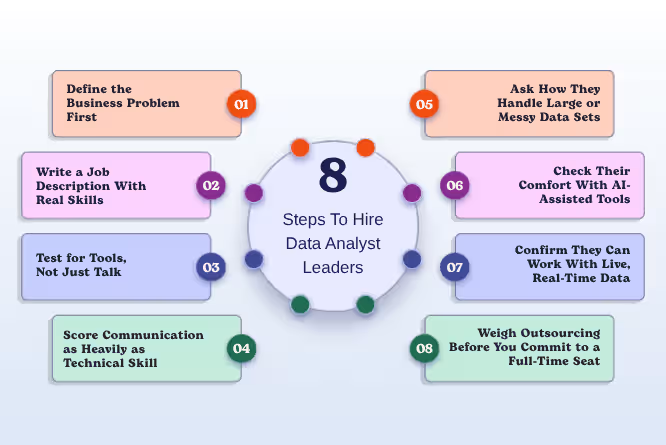
Step 5: Ask how they Handle Large or Big Data
Real business data is rarely clean. It arrives from five systems, with typos, gaps, and duplicate entries. Ask candidates to describe a time they had to fix or organize a messy dataset before they could analyze it. If your data lives across many tools and needs heavy cleanup, it may be smarter to hand this piece to a team that specializes in it. Many US companies now outsource data processing services for exactly this reason, keeping the extra load off their core team’s plate.
Step 6: Check their Comfort with AI-Assisted Tools
In 2026, the SQL test is no longer the primary signal. AI tools write routine queries in seconds. What they cannot do is identify which question is worth answering in the first place, or sit across the table from a VP of Marketing and figure out which of three vaguely worded asks actually matters.
Test for that instead. Ask how a candidate has used AI tools in their past work, and what they still do by hand. Roles that touch data engineering pipelines benefit from analysts who understand both the machine and business sides.
Also Read: Role of AI in Data Analytics for Smarter Business Insights.
Step 7: Confirm they can Work with Live, Real-Time Data
If your business needs same-day answers, such as live inventory tracking or daily ad spend, ask how a candidate has built dashboards that update automatically rather than only once a month. This single question separates analysts who report on the past from analysts who help you act today.
Thus, it is imperative for teams to monitor real-time data analytics and master the insights and best practices.
Step 8: Try Outsourcing Services before you Commit to a Full-Time Seat
A full-time data analyst comes with salary, benefits, a laptop, software licenses, and months of onboarding. An outsourced data analyst comes ready to work, often within days, and you pay only for the hours or the project.
This route also gives you bench strength. If an analyst is out sick or your workload spikes, a partner team can step in without stalling your project. Many US firms handle live business questions this way, treating data analytics outsourcing as a standing part of their operations rather than a stopgap.

Internal Hiring vs Outsourcing: How Outsourced Data Analytics Reduces Overhead
Building an internal data team is expensive. You are paying for salary, healthcare, retirement contributions, office space, software seats, and the manager’s time spent training and reviewing work. Data analyst salaries in the US range from $72,000 for junior profiles to $135,000 for senior analytics engineers, with marketing and product analysts typically landing in the $85,000 to $110,000 band (BLS, 2026; Glassdoor, 2026), all before benefits and overhead are added.
The US Bureau of Labor Statistics also projects 21 percent growth through 2034 for closely related analyst roles, which means this hiring competition will only get tighter.
On top of that, SHRM’s benchmarking research shows the average open role sits unfilled for about 44 days, which means lost time on top of lost budget.
Outsourcing changes this concept. You get the option to choose from different data analytics outsourcing models, such as project-based work, a dedicated analyst, or a full managed team, and you scale up or down as your needs change. There is no severance, no recruiter fee, and no gap while a seat sits empty.
Want to know how much you can save by outsourcing data analytics? Use this free outsourcing cost calculator to know how to hire a data analyst and calculate your annual savings.
Conclusion
Hiring the right data analyst comes down to clearly defining your problem, testing real skills rather than talk, and being honest about whether a full-time seat is the right tool for the job. For many growing US companies, the smarter first move is a flexible outsourced setup that delivers the same insights without the long wait or fixed costs.
If you would rather skip months of interviews, you can see how a ready-made analytics team handles this work through BolsterBiz’s data analytics services.
And if you want to talk through your situation with someone who has seen it before, you can schedule a free consultation today.
Frequently Asked Questions on How to Hire a Data Analyst
1. What does a data analyst do for business?
A data analyst gathers, cleans, and studies your business data, then turns it into reports and dashboards leaders can use to make decisions. They focus on what already happened and why.
2. How much does it cost to hire a data analyst?
A full-time data analyst in the US typically earns a base salary of $72,000 to $135,000, depending on seniority, before benefits, office space, and software are added. Outsourced data analysts usually cost a fraction of that, since you pay only for the work delivered.
3. Should I hire a full-time data analyst or outsource the work?
If your data needs are steady and large, a full-time hire can make sense. If your needs shift month to month, outsourcing gives you the same skill set without the fixed overhead or the long hiring wait.
4. What skills should I look for when I hire a data analyst?
Look for SQL, spreadsheet skills, and basic statistics, plus the ability to explain findings in plain language. Communication matters as much as raw number crunching.
5. How long does it take to hire a data analyst?
Traditional hiring often takes over a month from the job posting to an accepted offer. Outsourced analysts can typically start within days, since the vetting work is already done.


