Local SEO Ranking Factors 2026: What Actually Moves the Needle
Google’s own documentation still boils local ranking down to three inputs: relevance, distance, and prominence. Relevance is how well your profile matches what someone searched for. Distance is largely out of your control. Prominence is reviews, citations, links, and reputation, the part you can actually build. Together, that combination is the foundation of how to improve local SEO rankings in almost any category.
In 2026, a fourth input is impossible to ignore: how cleanly your structured data and business information feed AI-generated answers, since a growing share of “local” searches never produce a traditional click at all.
If you want one stat that explains why any of this matters, look at behavior: 76% of people who search on their smartphones for something nearby visit a business within a day, according to Think With Google. That’s not a browsing audience. That’s someone deciding where to spend money in the next few hours. Fall short on any of the local SEO ranking factors 2026 businesses are graded on, and you’re not losing a click, you’re losing a customer who was ready to walk in the door.
Google explains all three in detail in its own local ranking guidance, which is worth bookmarking.

The Complete Local SEO Checklist for Small Businesses
Here’s the full SEO checklist for local small business websites, broken into three tiers: what to do first, what to do next, and what needs ongoing attention. Skipping the order is the most common mistake we see; businesses jump straight to schema markup while their Google Business Profile is still half-finished.
Do First: Google Business Profile Optimization Checklist
Your Google Business Profile optimization checklist starts with claiming and verifying your listing. An unclaimed or unverified profile essentially removes you from local search before you’ve even started. From there:
- Confirm your business name, address, and phone number match exactly what’s on your website and invoices.
- Pick the most specific primary category available, not the broadest one that technically fits.
- Write a complete business description using the actual terms customers search for, not marketing language.
- Upload a minimum of 10 real photos of your storefront, team, and work, profiles with more photos consistently pull more calls and direction requests.
- List every service you offer as its own line item, with a short description for each.
- Publish a Google Business Profile post weekly- an offer, an event, or a useful tip for local customers. Posts are a confirmed engagement signal, not an optional extra.
- Monitor and answer the Q&A section yourself before a competitor or a confused customer does it for you.
A mistake worth flagging: businesses expand into a new service area but never update their primary category to match, so Google keeps showing them for the wrong searches. Getting these basics complete is also the fastest way to learn how to rank higher on Google Maps, GBP signals carry more weight in local pack rankings than almost anything else on this list. It’s also the natural starting point if you’re building out an SEO checklist for local small business websites from scratch.
Do Next: Citations and NAP Consistency
Citations are mentions of your business Name, Address, and Phone number (NAP) on other sites, directories, industry associations, and local chambers of commerce. They’re not just a listing exercise. Inconsistent NAP data across even a handful of directories signals to Google that it can’t fully trust your information, and that uncertainty shows up as a ranking penalty, not just a minor inconvenience.
A common mistake here: a business lists its address as “Suite 4” on its website and “Ste. 4” on a directory. Trivial to a human, confusing to Google’s matching algorithm.
- Start with the big three: Google Business Profile, Bing Places, and Apple Maps.
- Move to industry-specific and local directories relevant to what you do.
- Use identical formatting everywhere: same abbreviations, same phone format, same suite number style.
- Build local backlinks through chambers of commerce, sponsorships, local news coverage, and business association memberships; these are confirmed local ranking signals distinct from standard NAP citations, and most checklists skip them entirely.
This is one of the more tedious items on any local SEO checklist, which is exactly why it gets skipped. It shouldn’t be. Cleaning up existing, inconsistent listings and building a handful of genuine local links is one of the more reliable ways to see how to improve local SEO rankings without touching your website at all.
If citation cleanup and structured local search execution isn’t something your team has bandwidth for, BolsterBiz SEO and content services handle this as part of a broader local search program.
Do Next: Reviews and Reputation Signals
Review velocity, how consistently new reviews come in, not just your total count, is one of the strongest prominence signals Google has. A business with 40 reviews spread over three years reads very differently to the algorithm than one with 40 reviews earned in the last two months.
- Build a simple, repeatable ask into your process: a text or email sent right after a completed job or purchase, with a direct link to your review page.
- Respond to every review, positive or negative, within a few days, a thoughtful reply to a negative review often does more for trust than a dozen unanswered five-star ratings.
- Never gate reviews by only asking satisfied customers, and never offer incentives for positive ones. It’s against Google’s policies, and it’s easy for Google to detect.
Treat review management as a permanent line item on your local SEO checklist, not a project you finish and move on from.
Ongoing: On-Page Local SEO and Schema Markup
Your website needs to reinforce what your GBP already says. That means dedicated location pages for each area you serve, not one generic “service area” paragraph, with local keywords worked naturally into titles, headers, and body content. Your NAP should appear in the footer of every page, matching your citations exactly.
- Add LocalBusiness schema markup to your homepage and every location page.
- Check Core Web Vitals and mobile page speed on location pages specifically, technical performance is now a confirmed local ranking factor, and a slow location page can undercut everything else on this list.
- Refresh local content on a regular cadence rather than publishing once and leaving it static.
Schema markup doesn’t guarantee better rankings, but it gives search engines, and increasingly AI systems, a clean, structured version of your business details to pull from, which matters more than it used to.
This is where most SEO checklists for local small business websites projects lose momentum, because on-page work doesn’t produce the quick wins a GBP change does. Treat it as ongoing maintenance: new location pages as you expand, schema updates as your services change, fresh local content added on a regular cadence.
Ongoing: AI Search and Local Visibility
One item worth adding to any local SEO checklist in 2026: how your business shows up when someone asks an AI assistant instead of typing into Google. AI tools lean heavily on structured data, consistent citations, and clearly written business information- the same fundamentals covered above, just read by a different system.
This isn’t the whole game, and treating it that way is a mistake other checklists tend to make. It’s one factor among the local SEO ranking factors 2026 introduces, not a replacement for GBP, citations, or reviews. According to BrightLocal’s 2025 Consumer Review Survey, a growing share of consumers now use ChatGPT or similar tools when researching local businesses, but that visibility is considerably harder to earn than a standard Maps ranking, and it rewards businesses that already have the fundamentals locked down.
For a deeper look at how this shift is reshaping search more broadly, see BolsterBiz’s guide to AI visibility. For context on how much ground there is to cover locally: 86% of people look up local businesses on Google Maps before they decide to visit, still the dominant discovery channel this checklist is built around.
This is the part most local SEO checklists leave out entirely, even though it’s usually the first question a business owner actually wants answered.
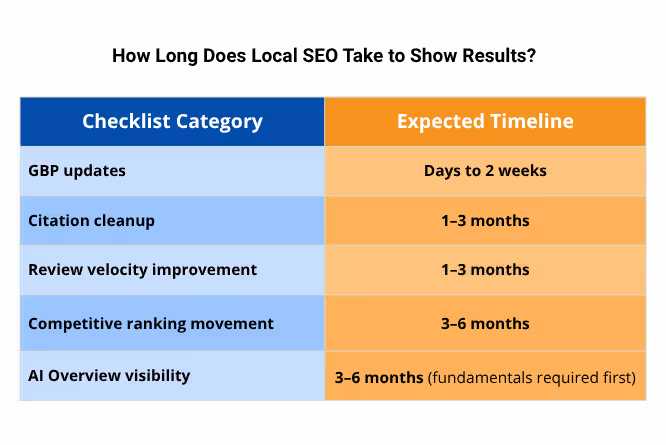
None of this is really about how to rank higher on Google Maps overnight; anyone promising a first-page ranking in two weeks is selling something. Working through a local SEO checklist consistently, in the priority order above, is what actually compounds over that timeline. For a deeper look at what sustained, properly executed SEO involves versus quick fixes, this breakdown of white hat SEO services is a useful next read.
DIY vs. Outsourcing Your Local SEO Checklist
DIY makes sense if you’re a single-location business, you or someone on your team has a few hours a week to commit, and you’re not in a hyper-competitive category. The checklist above is entirely doable in-house; it takes consistency more than specialized expertise.
Outsourcing starts to make sense once any of that changes: you’re managing multiple locations, you don’t have the bandwidth to keep citations and reviews current, or competitors in your category are already running a full local search program, and you’re falling behind by standing still. Speed matters too; a team that has already built this workflow for other clients typically compresses that 3-to-6-month competitive timeline.
You’re not alone in weighing it: a Clutch survey of 1,000 business decision-makers found that 26% plan to outsource digital marketing in the next year, and local SEO is one of the more commonly delegated pieces of that work. Whichever route you pick, the fastest way forward is working through your local SEO checklist consistently rather than switching strategies every few months.
Conclusion
A working local SEO checklist isn’t complicated, but it does require sequencing. Get your Google Business Profile optimization checklist done first; it’s the highest-leverage, fastest-moving piece. Follow with citations and reviews. Treat on-page SEO, schema, and AI search visibility as ongoing maintenance, not a one-time project.
Consistency beats intensity here. A business that works through this checklist steadily for six months will consistently outperform one that runs an intense one-week sprint and then goes quiet. If you would rather have that consistency handled for you, see reasons small businesses outsource SEO services and what it could save you.
Ready to see where your local SEO stands? Start with your Google Business Profile today; it’s the one item on this list you can improve in the next twenty minutes.
Not always, a well-optimized Google Business Profile alone can rank for some local searches, especially for service-area businesses. But a dedicated website with location pages, schema markup, and local content significantly extends your visibility and gives you far more control over how you appear in search results.
7. What tools do I need for local SEO?
Most small businesses can cover the fundamentals with Google Search Console for tracking performance, BrightLocal for citation and review monitoring, and Semrush Local for keyword and competitor tracking. None of these replace doing the actual work on this checklist, but they make it far easier to measure progress.