

A DSAT dashboard is a single screen that tracks dissatisfied customer tickets and groups them by cause. It improves CX because it turns unhappy survey replies into a clear fix list for your team. A CSAT survey asks customers to rate one support interaction, while a CX survey asks how the whole experience felt.
We use a DSAT dashboard with our clients every month. Honestly, the results surprised us the first time we saw them.
Collecting feedback is the easy part. Turning it into change is where most teams get stuck. We believe software cannot replace human judgment, so we pair monthly ticket audits with live dashboard analytics.
If you are also comparing partners, the best outsourcing companies in the US or Australia are the ones that give you trained agents, honest reporting, and room to scale, without forcing a big contract on day one.
| Key Takeaways |
|
What a DSAT Dashboard Shows That a Normal Report Hides
Most teams already have a customer service dashboard. It shows ticket volume, response time, and an average CSAT survey score. The average is the problem.
A 92% score sounds great. But the other 8% are real people who had a bad day with you. A DSAT dashboard puts those people at the center.
Think about standardized tests in high school. A class average can look fine while three students quietly fail. You only help them when you look at their papers.
A good customer support dashboard should answer three questions. What went wrong, how often, and who can fix it. Some teams call this a customer satisfaction survey dashboard, and the name matters less than the job.
Our customer experience dashboard setup shows category, agent, and month side by side, so patterns show up fast. Support habits are also changing quickly, and our guide on ways to handle customer support in 2025 covers what teams are trying now.
How our Team and Managers Handle the Dashboard?
A DSAT dashboard only helps if human agents act on it. Three views do most of the work.
- Month-over-month comparison: Did DSAT go up or down, and did one cause grow? We also compare DSAT rates, not just counts, because ticket volume changes every month.
- Recurring patterns: The same cause showing up month after month is not bad luck. It points to a gap in a process, a script or the product.
- Individual performance: Agent-level numbers show who needs help and on what. We read them next to the root cause, so one agent is not blamed for a bug or a policy.
How Our DSAT Dashboard Monthly Audit Works
Here is the process we follow with every client:
- Structured monthly audits: Our quality team reviews dissatisfied (DSAT) tickets each month and enters the audited records straight into the central tracker.
- Whole-month data synthesis: The dashboard reads the month-over-month data and adds up volume, category trends, and agent-level numbers.
- Actionable insight: Instead of raw numbers, it points to focus areas like policy friction, training gaps, or product and delivery bugs.
We do not let a bot decide why a customer was upset. A tool can count tickets, but it can miss tone, sarcasm, and context. That is why we are careful about where we use AI in customer support.
So where does AI helps and where it does not? Usually it is a person who reads every DSAT ticket. Yes, it takes time. It is also the reason our tags are right.
We do use AI, just not as the judge. It helps us group similar tickets and spot patterns across months.
A pattern is a clue, not an answer. A person still reads the full ticket and confirms the cause before the root cause analysis (RCA) is final.

Root Cause Analysis: Where the Real Fixes Come From
Root cause analysis sounds heavy, but it is not. We ask one question about each DSAT ticket. What actually caused this?
Then we tag it as policy friction, agent training gap, product bug, or slow response.
How We at BolsterBiz Investigate a DSAT Ticket
A negative survey is a signal to investigate, not proof of who was at fault. So we do not stop at the comment.
- Read the survey comment, the customer’s original query and the full conversation.
- Check if the agent followed the SOP and used the right tools and steps.
- Link the customer’s feedback to what was asked, what the agent did and how it ended.
- Pick one root cause based on the evidence. If the evidence is unclear, we flag the ticket for review instead of guessing.
- Log the ticket ID, category, process and a short reason in the monthly tracker. The dashboard reads from it.
The Four Root Cause Categories
Not every DSAT is the agent’s fault. We sort each ticket into one of four groups.
- Policy / Process: The customer is unhappy with a rule or a process limit, even when it was applied correctly. It may just need a review.
- Bug / System: A tool, product or technical issue affected the outcome. The agent may have done everything right.
- Agent Error: An avoidable mistake, like a missed step, wrong information or not following the SOP. This is the group coaching can fix.
- Customer Error: Missing or wrong information, or a customer-side action, was the main factor, and the ticket shows it.
This split matters especially if you tend to think it is the agents’ mistake for everything. Could be, you coach the wrong people and the real problem still persist.
Here is a pattern we see often. A customer writes in three times about a refund, and each agent gives a slightly different answer. The CSAT survey comes back with one star. The cause was not rude agents. It was a refund rule nobody explained clearly.
Another common cause is slow replies after hours. A shopper messages at 9 pm and hears back the next afternoon. That needs coverage, not coaching, and it is where the benefits of outsourcing customer support start to show.
Once tickets are tagged, coaching gets specific. Instead of “be more empathetic,” a manager can say “use the verification script on refund calls.” People improve faster when feedback is that clear.
What We Do After the Root Cause Is Clear
Finding the cause is only half the job. The action should match the cause.
- Agent Error: Focused coaching, or a refresher on the SOP.
- Policy / Process: A review by the process owner.
- Bug / System: Escalation to the right team, with ticket examples.
- Customer Error: Clearer guidance for customers.
Every action gets an owner, a due date and a goal. We close it only after later months show it worked, not when the task is ticked off.
Real Results: Three Quarters of DSAT Dashboard Data
This is what one client account looked like once we used the DSAT dashboard to guide coaching and policy fixes. The numbers are shared in aggregate.
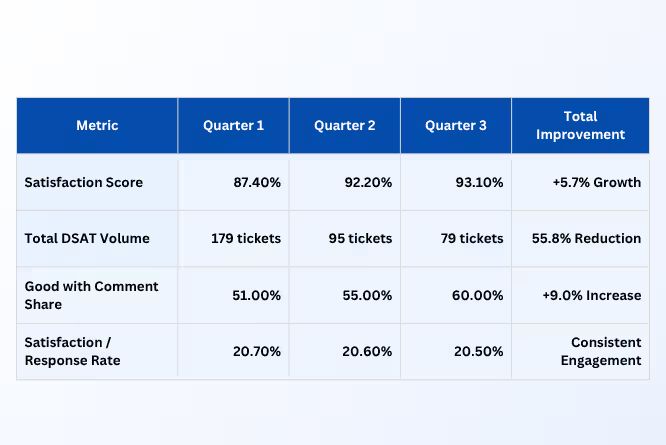
Key performance highlights:
- Over 55% drop in dissatisfaction: DSAT volume fell from 179 tickets in Q1 to 79 in Q3 as we found and fixed repeat problems.
- Steadily rising satisfaction: The overall score moved from 87.4% in Q1 to 93.1% in Q3.
- Higher customer appreciation: “Good with Comment” feedback grew from 51% to 60%, so customers noticed the better service.
For context, Simplesat’s 2026 CSAT and NPS benchmark report, built on 3.5 million responses from 2025, puts the average CSAT at 87.8%. This account started just below that and finished well above it.
The response rate stayed near 20% throughout. That matters, because it shows the gains did not come from fewer unhappy people answering.
One account is not a guarantee. Results depend on your ticket mix, team size and how quickly you act on what you find.
The cost of ignoring it is real. A Coveo survey of almost 2,000 U.S. consumers found that 73% would stop buying from a brand after three bad service experiences.
Online stores face this issue most often. If that is you, you can assess the top ecommerce customer service outsourcing companies to learn how others staff their queues.
Why Live Inquiries are Where DSAT Often Starts
Many DSAT tickets begin with a live inquiry that waited too long. Chat and phone customers expect an answer now, not tomorrow.
Outsourcing can cover those hours without a full night team. Trained agents take live chat and calls, so your in-house staff can focus on harder cases. This differs from staffing agencies, which usually send resumes and leave training and quality to you.
We see three quick wins. First replies get faster, after-hours messages get answered, and quality stays steady on busy days.
Choosing the right chat partner matters a lot. We shared our view on the best live chat support provider if you want a checklist.
Customers also jump between chat, email, and phone in a single issue. If your tools do not connect, they repeat themselves, and DSAT goes up. Our guide to the best omnichannel customer support outsourcing companies explains what to look for.
What to Look For in an Outsourcing Partner
If you are new to outsourcing, start with what is customer support outsourcing. It covers the basics in plain words.
A good partner trains agents on your product and shares its own quality data. Ask to see how they track DSAT and what they do with it. If they cannot show you, that tells you something.
When you are ready to compare, the list of top 10 customer support outsourcing companies in the US is a fair starting shortlist.

How BolsterBiz Helps Improve Customer Satisfaction with Our DSAT Dashboard
At BolsterBiz, we offer customer support outsourcing that fits small and mid-size budgets. That includes affordable live chat support, voice support, email and ticket support, and technical support.
You can start with just one agent and add more as you grow. There is no need to build a big team on day one.
Our agents work inside your tools, and we share the same DSAT dashboard reporting you read about above. So you see what is going wrong, not just how many tickets came in.
If you want to see how this could work for your team, learn about BolsterBiz customer support outsourcing services or schedule a free consultation today.
Frequently Asked Questions
What is a DSAT dashboard?
A DSAT dashboard is a view that tracks dissatisfied customer ratings and groups them by cause, agent, and time. It helps support leaders see what to fix first.
What does DSAT mean in customer service?
DSAT stands for dissatisfied. It usually means a customer who gave a low rating, such as 1 or 2 on a 5-point CSAT survey.
How is DSAT calculated?
Divide the number of dissatisfied responses by the total responses, then multiply by 100. Teams should use the same rating cutoff every month so trends stay fair.
What is the difference between CSAT and DSAT?
CSAT measures the share of customers who were satisfied. DSAT measures the share who were not, and it shows you where to act.
What is a good CSAT score?
It depends on the source and industry. Simplesat’s 2026 benchmark average is 87.8%, and other reports put it closer to 78%.
How do you improve CSAT scores?
Read your DSAT tickets, tag the causes, fix the top few, and coach agents on specific skills. Then check the numbers again next month.
Can outsourcing improve customer satisfaction?
Yes, when the partner is trained on your product and tracks quality. Faster live chat and after-hours coverage remove some of the most common causes of DSAT.
What are the main root causes of DSAT?
Most DSAT tickets trace back to one of four causes: Policy / Process, Bug / System, Agent Error or Customer Error. Agent error is only one part of the picture.
Is every DSAT the agent’s fault?
No. Many DSAT tickets come from unclear processes, system bugs or customer-side issues. That is why we find the root cause before we coach anyone.
Can AI do root cause analysis for DSAT tickets?
AI can help group tickets and spot patterns. A person should still read the ticket and confirm the cause before the RCA is final.