What Is IT Staff Augmentation?
IT staff augmentation is a flexible talent model where businesses add skilled technology professionals from an external provider directly into their existing internal teams. The client manages the day-to-day work while the augmentation company handles HR, payroll, and compliance. It works by assessing skill gaps, matching vetted candidates, and onboarding them into your workflows, typically within five to ten business days.
Unlike full outsourcing, you keep complete control over tasks, priorities, and daily workflow. The augmented professional works within your processes, reports to your existing team, and executes your direction. The vendor handles sourcing, vetting, and payroll.
For small businesses, this model solves a specific problem: you need a React Native developer for four months, but you cannot justify or afford a full-time hire with salary, benefits, taxes, and equipment overhead. Staff augmentation fills that gap precisely.
IT Staff Augmentation Cost Breakdown for Small Businesses
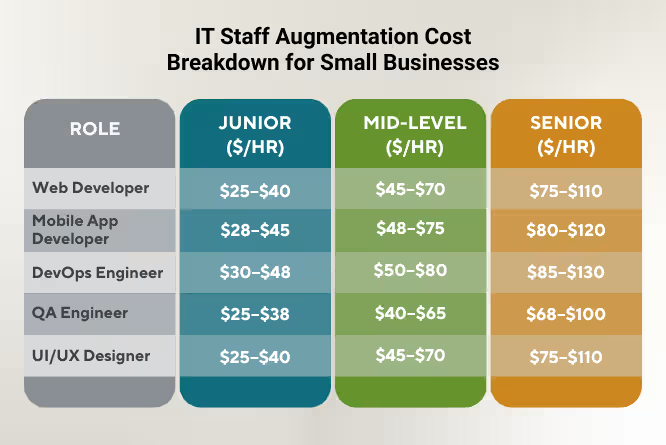
The table below reflects 2026 market rates across offshore and nearshore regions. North American rates run 2–3x higher across every role.
Regional Breakdown by Country:
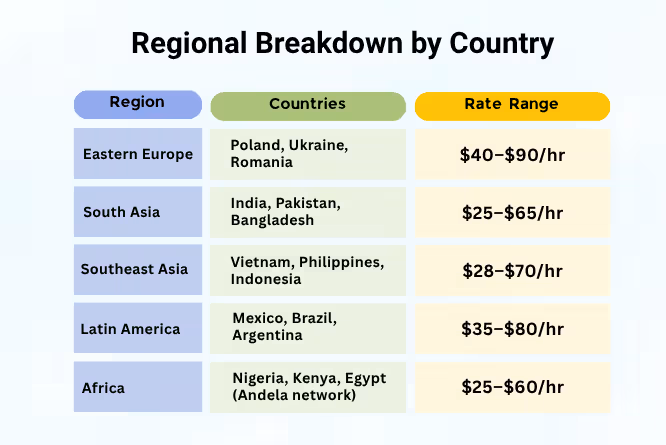
For a 3-month small business project at 480 hours, a mid-level offshore developer costs roughly $21,600–$36,000 total. Run the same project with a dedicated onshore developer, and you are looking at $48,000–$96,000.
That is the core math behind why affordable IT staff augmentation almost always means going offshore or nearshore. It is not a compromise on quality. It is a geography decision that reflects labor market realities.
Project Complexity as a Cost Driver
Hourly rate and seniority level are not the only variables that determine your final cost. Project complexity is an equally important factor that most guides overlook.
A React Native developer building a simple MVP costs differently than one integrating a fintech API, even at the same seniority level. Here is how complexity typically maps to cost:
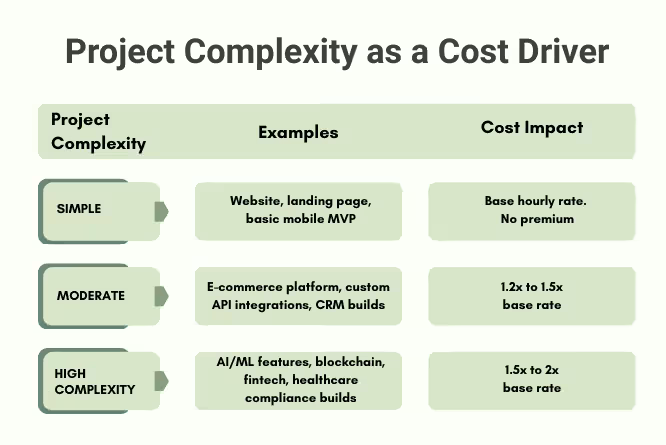
When budgeting, identify where your project sits on this scale before requesting quotes. A vendor who quotes a flat hourly rate without asking about complexity is either underquoting or planning to bill for overruns later.
Pricing Models: Which One Fits a Small Business Budget?
The IT staff augmentation cost you pay depends not just on the hourly rate, but on how you structure the engagement. There are four models worth understanding in 2026.
Time and Materials (T&M)
You pay per hour worked. The scope can evolve as the project progresses, making this the most flexible model available. It works especially well for MVP builds and iterative development where requirements shift week to week.
The risk: if your project scope expands, so does the bill. Build in a budget buffer of 15–20% and agree on weekly hour caps to keep costs predictable.
Best for: MVP development, iterative feature builds, projects with evolving requirements.
Fixed-Price
You agree on scope, deliverables, and total cost upfront. No surprises on the invoice.
In practice, fixed-price contracts typically charge extra for out-of-scope requests. Change requests can increase the final project cost by 20–30% or more, making it essential to define the scope in detail before signing.
Best for: Website redesigns, specific feature additions, short projects with a tightly defined deliverable.
Dedicated Team (Monthly Retainer)
The hourly rate is only the starting point. Hidden expenses can add 15–30% or more to your budget if they are not accounted for upfront.
Onboarding time: The first one to two weeks are typically low-productivity. Your new developer needs to learn your codebase, tools, and workflow. Budget this time as a ramp cost, not billable output.
Software licenses: Augmented staff need access to your project management tools, code repositories, design platforms, and communication apps. Extra seats on Jira, Figma, GitHub, or Slack add $50–$300 per month per person depending on your stack.
Communication overhead: Async tool setup, documentation, and cross-timezone meeting coordination all consume time. Budget one to two hours per week per augmented team member for coordination, especially in the first month.
Contract compliance fees: NDAs, IP assignment clauses, and vendor agreements often require legal review. Expect a one-time cost of $500–$2,000 depending on complexity.
Change request charges: Fixed-price contracts bill separately for out-of-scope work. T&M contracts have no ceiling unless you negotiate a cap clause. Both risks are manageable with the right contract language.
The smartest way to control hidden costs is to choose a vendor with transparent pricing and no-lock-in contracts from day one.
When Does IT Staff Augmentation Make Financial Sense for Small Businesses?
Not every project is the right fit. Here is a direct decision framework.
Staff augmentation makes sense when:
- Your project requires certain skill sets, which your team does not have and will not need permanently
- The engagement runs one to twelve months. Long enough to justify onboarding but not long enough to warrant a full-time hire
- You need to launch faster than your internal hiring timeline allows (average full-time hire takes 42 days; augmented staff typically onboard in one to three weeks)
- Your project budget is $7,000 or more. Below that threshold, setup and onboarding overhead may erode the cost advantage
It may not make sense when:
- Short-term projects running under four weeks with a narrow, tightly scoped deliverable (freelance marketplaces are faster and cheaper for this)
- You need in-person daily collaboration. Remote augmentation adds friction that some teams are not set up to manage
- You do not have an internal point of contact who can direct and review the augmented developer’s work
If you are on the fence about IT staff augmentation cost for a $10,000–$30,000 project, run the numbers. A mid-level offshore developer at $50/hr working 160 hours per month costs $8,000/month fully loaded. A US-based junior developer costs $8,000–$12,000 per month in salary alone before benefits. The math typically resolves quickly.
How to Choose Affordable IT Staff Augmentation Services
Not all vendors price fairly or contract cleanly. When evaluating affordable IT staff augmentation services, apply these five criteria before committing:
Transparent hourly rates published upfront: If the website says “contact us for pricing” with no range given, that is a signal you will be paying for their sales process. Vendors who publish rates operate with more accountability.
No minimum seat requirements for small teams: Many enterprise-focused vendors require three to five seats minimum. Look for vendors who serve single-developer engagements.
Month-to-month contracts or short-term options: Avoid vendors who lock you into six or twelve-month minimums on your first engagement. The right vendor earns retention through performance, not contract terms.
Proven experience with businesses at your scale: Ask for case studies from companies with 5–50 employees running $10K–$100K projects.
Clear SLAs on response time, code review, and bug fixing: Verbal commitments are not enforceable. Your contract should specify maximum response time, code review turnaround, and bug fix windows.
Reference Vendors Worth Knowing in 2026
When evaluating the market, these providers are frequently referenced as top IT staff augmentation companies:
BolsterBiz: 48-hour delivery, 70% overhead reduction, dedicated partnership. Best for small and mid-size businesses wanting speed, transparency, and no enterprise pricing.
BairesDev: Nearshore Latin America focus, strong time zone overlap with US businesses, good mid-market fit for six-plus month engagements.
Andela: African talent pool with strong engineering quality, competitive pricing, and a growing track record with US and European small businesses.
Conclusion
For small businesses, IT staff augmentation cost ranges from $25–$75/hr with offshore and nearshore talent to $75–$150/hr with onshore developers in 2026. The right model saves 40–60% compared to full-time local hiring according to ISG 2025 IT sourcing benchmarks.
Run your numbers before you choose a vendor. Take your project duration in hours, multiply by the hourly rate for the role you need, factor in your project complexity tier, add 15–20% for hidden costs, and compare that total against what a full-time hire would cost over the same period. That comparison will make the decision clear.
At BolsterBiz, our IT staff augmentation services are built around exactly this kind of clarity: transparent hourly rates, no minimum seat requirements, and pre-vetted developers who plug into your workflow within days, not weeks. We help small businesses cut overhead by up to 70% while keeping full control over how the work gets done.
If you are ready to see what the IT staff augmentation advantages looks like for your specific project, get a quote from BolsterBiz and receive a transparent rate within 24 hours.
Frequently Asked Questions
1. How much does IT staff augmentation cost for a small business project?
For most small business projects in 2026, IT staff augmentation cost runs $25–$75/hr for offshore talent and $75–$150/hr for onshore developers. A 3-month project with one mid-level developer costs $21,600–$36,000 offshore or $48,000–$96,000 onshore, depending on the role and region.
2. What is the difference between IT staff augmentation and outsourcing??
IT staff augmentation means you add external professionals to your in-house team and manage their daily work directly. Full outsourcing means the vendor manages the project, the team, and the deliverables on your behalf.
Augmentation gives you control. Outsourcing gives you a finished product. For businesses that want skilled talent without giving up project ownership, augmentation is the right model.
3. Is offshore staff augmentation reliable for small businesses?
Yes, when you work with a vendor that pre-vets talent and provides structured onboarding. Offshore staff augmentation is particularly reliable for software engineers with well-defined technical skills like backend development, QA engineering, and DevOps. The key is choosing a vendor with documented processes and clear SLAs, not sourcing blind from a marketplace.
4. How quickly can I onboard an augmented IT professional?
Most vetted vendors can place a qualified developer within one to three weeks from the time of engagement. Onboarding to your specific codebase and tools takes an additional one to two weeks of ramp time. Budget this into your project timeline and treat the first two weeks as lower-output while the developer gets oriented.
5. What is the cheapest way to get IT support for a small business project?
Offshore IT staff augmentation services are consistently the most cost-effective route for projects lasting one to twelve months. For short, narrowly scoped tasks under four weeks, freelance marketplaces may cost less once you factor in augmentation onboarding overhead.
6. Can I hire just one developer through IT staff augmentation services?