
An IT solutions provider is a company you hire to plan, install, and run your business technology, including networks, cloud setups, security, software, and managed IT support.
To find the best one in the US, check four things: proof in your industry, clear pricing, fast response times, and room to scale. Then test the firm with a small project before you sign a long deal.
Managed IT support means a team monitors and fixes your systems for a flat monthly fee, replacing or adding to an in-house team.
Any IT provider or IT service provider offers some version of it. The quality gap between them is large.
Many owners start by searching IT managed services near me. Local is fine, but it is not required. Most IT support companies work remotely now, so you judge them on skill and speed, not where they are based.
Key Takeaways |
|
What does an IT Solutions Provider do?
Take a dental group with six offices. It needs patient records, email, Wi-Fi, and daily backups. The provider sets up all four and monitors them daily. When a front desk computer fails at 8 a.m., someone fixes it before patients line up.
The market is big, so you have many options. The US managed services market is set to grow from $161.1 billion in 2026 to $234.6 billion in 2031, according to MarketsandMarkets. More providers enter each year, and the quality gap widens. A wrong pick costs more as more of your work runs on technology. This is why the choice needs a process, not a guess.
If the model is new to you, It is imperative to know what is IT staff augmentation.
Which Type of IT provider Fits your Business?
Providers fall into four groups. A managed services firm runs daily IT for a monthly fee. A project firm builds one thing, such as a cloud migration. A staff augmentation firm adds engineers to your team. A help desk firm answers user tickets. Many offer a wide-ranging mix of these.
Match the type to your gap. A ten-person law firm needs managed IT support from an IT solutions provider. A SaaS startup with a release date needs developers. Size also matters. A firm with 15 staff rarely needs a 24/7 enterprise desk. A firm with 400 staff outgrows a one-person shop fast.
Ticket volume grows fast. Before you hire three more agents, you must understand how an outsourced IT help desk works.
How can I Find the Best IT Solutions Provider?
Follow these steps in order.
- Write down your gaps. List what breaks, what runs slowly, and which skills you lack.
- Build a shortlist. Pick three to five firms from referrals, review sites, and local business groups.
- Ask for references. Get two in your industry and call them.
- Request a written quote. It must list scope, response times, and exit terms.
- Run a paid pilot. Keep it to 30 days.
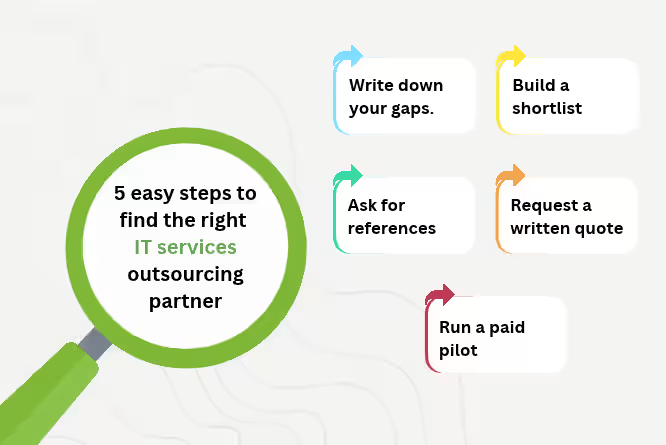
Most owners skip step three, but a reference shows how the firm acts when something breaks.
Watch for warning signs during the pitch. A firm unwilling to name a client is hiding something. A quote with no response times is incomplete. A sales rep who pushes you to sign this week is selling, not solving.
In addition, it is imperative to know on how to choose the right IT staff augmentation partner. It also applies to any other IT service provider.
Which IT Solutions Providers are Worth Evaluating?
Buyers see these names most often in provider lists. Match each firm to your size and need before you book a call. Large enterprises suit Accenture or TCS. Smaller firms get more attention from a mid-size or specialist partner.
| Company | Best For | Model | Standout Strength |
| CNiC Solutions | Small and mid-size businesses wanting a dedicated IT partner | Managed IT support | Close, steady support |
| Accenture | Large enterprise transformation | Consulting and delivery | Program scale |
| Tata Consultancy Services | Global-scale outsourcing | Outsourcing and delivery | Worldwide delivery reach |
| Cognizant | Enterprise digital operations | Managed digital and IT operations | Large operations experience |
| EPAM Systems | Software engineering and end-to-end product builds | Engineering services | Deep engineering bench |
| SoftServe | Mid-tier software and product projects | Project and engineering services | Product engineering |
| Andersen | Mid-tier custom software development | Project and dedicated teams | Custom development |
| BolsterBiz | Growing teams needing skilled IT staff | Offshore IT staff augmentation | Affordable, start with one agent |
Disclaimer: BolsterBiz publishes this guide, so its row is listed for transparency. Judge every firm in the table with the same five steps.
Plus, as a company leader, one must make an informed decision while choosing top IT staff augmentation companies in the US and see what buyers compare.

What Should you Check Before you Sign a Contract?
Check security first. Ask for an ISO 27001 or SOC 2 Type II report. If you work in healthcare, ask about HIPAA compliance too. Ask how the firm stores passwords and what it does after a breach.
Check response times next. A promise of fast support means nothing. Ask for numbers, such as 15 minutes for urgent tickets and four hours for normal ones. Ask what happens when the firm misses those targets. A fair contract gives you a service credit or a way out.
Check scale. A firm with clients in Australia and the US already handles time zones and distributed teams. Experience like this helps you when you open a second office.
Check the contract of any IT solutions provider. Avoid lock-ins longer than 12 months at the start. Read the exit fees.
Check how you pay. These ranges are typical, and they shift by region, scope, and service level.
| Pricing Model | Typical Range | Best Fit |
| Per-user managed IT | $100 to $200 per user each month | Small offices with steady headcount |
| Per-device managed IT | $30 to $70 per device each month | Shops with many machines and few staff |
| Enterprise contract | $10,000 to $50,000 or more each month | Large, multi-site organizations |
| Project-based work | $5,000 to $100,000 or more | One-time builds and migrations |
A flat fee gives you a fixed monthly cost, but read what it excludes. Hourly rates look cheap until a bad week arrives. Ask each firm to price the same scenario so you compare real numbers.
If you plan to add engineers instead of buying a service, vet each IT staff augmentation partner on the same terms.
How does Outsourcing Help with Live Calls and Chats?
Mark runs an online store in Texas. His two IT staff answer password resets, order tool errors, and live chats. In peak season, chats wait 20 minutes. Customer service scores drop, and the IT team falls behind on store fixes.
He moves live chat and first-level tickets to an outsourced team. His IT staff go back to the store systems. Wait times fall within weeks. He pays for the hours he needs and adds agents only in busy months.
Mark is not an exception. In a Clutch survey reported by DestinationCRM, 27% of small businesses planned to outsource IT services in 2022, the most named function on the list. Small firms do it because a full support shift costs too much.
Software firms face the same gap at night. Users sit in many time zones, and bugs do not wait for Monday. IT staff augmentation for SaaS adds agents and engineers who cover those hours.
How do you Choose an QA Outsourcing Partner?
Testing gaps fill your support lines with bug reports. A tester finds a broken checkout in an hour. Users find it on a Saturday. Many support tickets trace back to bugs shipped without a second check. Check five things before you pick a partner.
- Testing types. Ask if the partner covers manual, automation, API, mobile, performance, and security testing.
- Tools and reports. Look for tools such as Selenium, Cypress, Postman, and Jira. Each bug needs steps, screenshots, and a severity level.
- Industry experience. Ask for a case study. Healthcare and finance carry rules new testers miss.
- Communication. Check time zone overlap and daily updates. Run a two-week pilot on one feature.
- Cost by result. Ask for the cost per release, not only the hourly rate.
Also Read: The full guide on QA outsourcing services to see what a testing team does and what it costs.
Where does BolsterBiz fit?
BolsterBiz is a white-label outsourcing company focused on IT staff augmentation. It fits when you need skilled people, not a fully managed contract.
Here is what sets it apart.
- Affordability. BolsterBiz reports overhead drops by up to 70% compared with equivalent in-house hiring costs.
- Easy scale. Start with one agent. Add more as you grow. There is no large team commitment on day one.
- Speed. Pre-screened, interview-ready candidates arrive within 48 hours.
- Control. Your hires join your standups, use your tools, and follow your priorities.
- Range. Roles include front-end, back-end, full-stack, DevOps, automation, data, UI and UX, business analysts, and QA testers.
Consider a ten-person software firm with one overloaded developer. It hires one remote developer first. Three months later, release dates hold, so it adds a tester. The team grows in steps, and the budget follows.
You also get a dedicated account manager and support after the hire. Offshore teams work as an extension of your own, so your process stays yours. For the hiring steps, you must assess the process to hire remote QA engineers and QA testers in 2026.
To see how BolsterBiz IT outsourcing solutions and offshore IT staff augmentation fit your team, schedule a free consultation today.
FAQs
What is an IT solutions provider?
An IT solutions provider is a company you hire to plan, set up, and manage your business technology. Services include cloud, security, software, support, and staffing.
How much does an IT solutions provider cost?
Managed IT support typically runs $100 to $200 per user each month for small businesses. Per device plans run $30 to $70 per device each month. Enterprise contracts often run $10,000 to $50,000 or more each month. Project work ranges from $5,000 to $100,000 or more, depending on scope.
What is the difference between an IT solutions provider and an MSP?
An MSP provides proactive, ongoing management under a recurring contract. An IT solutions provider also builds custom solutions, handles one-off projects, or supplies staff. The scope is broader, and the engagement model varies.
Is it better to outsource IT or keep it in-house?
A mix works for most firms. Keep a small core team and outsource testing and first-level support. Compare QA outsourcing companies if testing is your gap.
How long does it take to switch IT providers?
Plan for four to eight weeks. The new firm audits your systems first, then transitions ticket handling in two-week phases. Keep your old provider on call until the handover ends. Collect your admin passwords and documentation before you give notice.