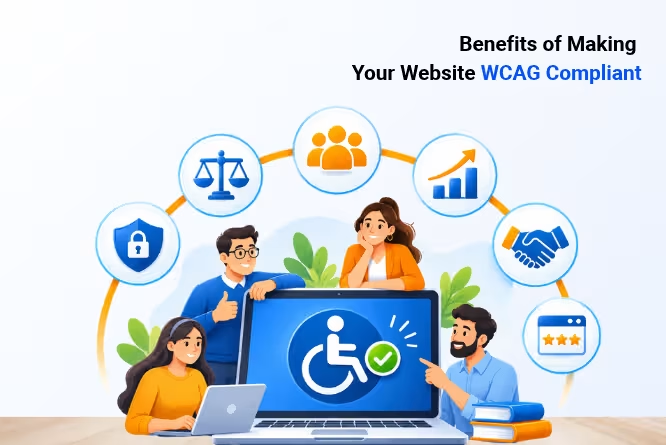
WCAG compliance means your website follows the Web Content Accessibility Guidelines, a global standard that helps people with disabilities use your site. The main benefits of WCAG are lower legal risk, a better experience for every visitor, stronger search visibility and a wider customer base.
If you run a company and want a WCAG-compliant website, the path is simple. Aim for WCAG 2.1 AA, audit what you have, fix the biggest barriers first, and bring in experts so it stays fixed.
Waiting is the risky choice. According to Seyfarth Shaw, in 2025, plaintiffs filed 3,117 website accessibility lawsuits in federal court, a 27% jump from 2024.
| Key Takeaways |
|
What is Website Accessibility and WCAG Compliance?
Website accessibility means anyone can use your site, whatever their ability or device. That includes people who are blind, deaf, have limited mobility, or have difficulty reading.
WCAG is the standard behind it. It tells you how to make your content accessible, built on four ideas: perceivable, operable, understandable, and robust.
In plain words, people should be able to see or hear your content. They should be able to use it with a keyboard. They should understand your forms and error messages. It should also work with assistive technologies.
The content accessibility guidelines WCAG publishes come in three levels. Level AA is what most laws and lawsuits point to. WCAG 2.2 is the newest version, but WCAG 2.1 AA is still the common benchmark.
Most sites fall short. WebAIM tested one million home pages in 2025 and found WCAG 2 failures on 94.8% of them. The top issue was weak color contrast, so make sure your text has a contrast ratio of at least 4.5 to 1.
Skipping this process is one of those quiet digital marketing mistakes that costs you leads without any warning.
5 Benefits of WCAG Compliance and Making the Website Accessible
Here are the WCAG benefits that matter most to a business and why it helps improve the overall user experience making it more accessible for all visitors.
1. Lower Legal Risk
Domino’s learned this the hard way. A blind customer sued because he could not order on its website and app. The Ninth Circuit sided with him in 2019, and the Supreme Court refused to hear Domino’s appeal.
A lawsuit is only part of the bill. Legal fees and rushed fixes add up fast.
2. A Better Visitor Experience
Picture someone checking out on mobile devices in bright sun. Faint gray text is hard to read, just like for someone with low vision. Good accessible design fixes both and lifts the user experience for everyone.
3. Stronger SEO
Search engine optimization SEO and accessibility share many habits. Clear headings, alt text, descriptive links, and real text content help search bots and screen readers alike.
Here is a free digital marketing audit guide that is a handy way to spot gaps like these.
4. A Wider Audience
About 1 in 4 US adults has a disability, according to the CDC. Many of them shop online. If they get stuck at checkout, you lose the sale. This is one of the benefits of WCAG compliance that shows up directly in revenue.
5. A Trusted Brand
This is one of the benefits of WCAG you cannot buy with ads. People notice when a company makes the effort. Digital accessibility tells customers you care about all of them, and they pass that on. It helps build a sense of trust and knowing in the community about your brand.

How to Make your Website WCAG Compliant?
Work through these steps in order.
- Audit first. Run an automated scan, then test by hand. Tools catch only some problems.
- Fix repeat offenders. Contrast, missing alt text, skipped headings, unlabeled form fields, and poor keyboard use cause most errors.
- Test like a real user. Turn on VoiceOver or NVDA and try to buy something. If you get stuck, your customers will too.
- Publish an accessibility statement. Give people an easy way to report a barrier.
- Recheck every release. New pop-ups and banners often break old fixes. Keep an eye on current accessibility standards too.
Here is a simple example. Say your “Add to cart” button is just an icon with no label. Someone using VoiceOver hears “button” and nothing more. One short label fixes it.
Then decide who owns the work. The trade-offs look a lot like SEO in-house vs outsourcing, so weigh cost, speed, and skills before you hire. The benefits of WCAG only last if someone keeps the fixes alive.
How Outsourcing Helps you Build a WCAG-Compliant Website
Most teams have no accessibility expert on staff. Developers are busy shipping features, and marketers are busy chasing leads.
So fixes get pushed back, and the site stays the same. Outsourcing breaks that loop, because one team owns the audit, the fixes, and the follow-up.
It also protects your marketing budget. Ads and SEO bring people to your site, but a hard-to-use page loses them at the door.
Here is how the main options compare:
- In-house team: full control, but slow to hire and train.
- Freelance auditors: fine for a one-time report, weak on ongoing work.
- Accessibility plugins: quick to install, but they rarely fix root problems.
- BolsterBiz: experts who help build or fix a WCAG-compliant website and keep your digital marketing moving on top of it. It is affordable, easy to scale, and you can start with just one agent and add more as you grow.
That last point matters. You do not pay for a big team on day one. You add people only when your needs grow, so costs stay in step with your business.
BolsterBiz’s digital marketing service is built around that idea. Accessibility fixes and marketing goals get planned together, not as two separate projects.
Still comparing partners? This list of top digital marketing agencies for startups is a good place to start.
Partner with BolsterBiz for a Robust WCAG-Compliant Website
If your team is stretched, BolsterBiz’s digital marketing service is the best way to get expert marketing and website development help without a high upfront cost or hiring in-house developers. .
If you’re thinking of updating your website and making it WCAG-compliant, you can schedule a free consultation and talk through your site and your support needs. Our team of experts can help you reap the benefits of WCAG and make your website more accessible.
Frequently Asked Questions
1. What are the benefits of WCAG compliance?
The benefits of WCAG include lower legal risk, better usability, stronger SEO, a wider audience and a more trusted brand.
2. What is WCAG compliance in simple words?
It means your site passes the WCAG tests for being usable by people with disabilities. Most teams aim for level AA.
3. Is WCAG required by law?
In the US, the ADA does not name WCAG. But courts and settlements often use WCAG 2.1 AA as the yardstick. Rules differ by country, so check yours.
4. What is the difference between WCAG 2.1 and 2.2?
Version 2.2 builds on 2.1 and adds checks for things like focus visibility and target size. A site that meets 2.2 AA is in good shape for 2.1 AA too.
5. Does accessibility help marketing?
Yes. Easier pages keep more visitors, and that helps every channel. Read the 10 best digital marketing strategies for startups to plan where to send that traffic.
Author
-
This article is written by Gautam Gayan. He works as a Content Marketer at BolsterBiz. Apart from being a passionate content creator for Customer Support, CX, and Digital Marketing, Gautam is a theatre enthusiast, an avid reader, and an aspiring poet. For any related queries reach gautam.gayan@bolsterbiz.com