
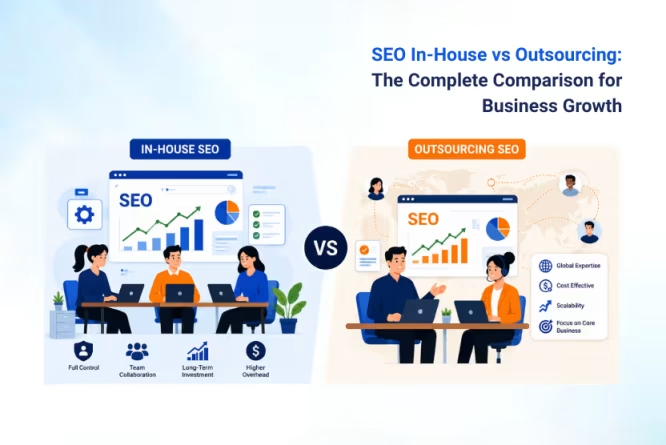
For most growing businesses, the SEO in-house vs outsourcing decision comes down to budget, speed, and the depth of expertise you need. Outsourcing gives you immediate access to a full team of specialists, advanced tools, and faster execution, usually at a fraction of the cost of building an internal team. If you need to grow organic traffic now and keep your marketing budget lean, outsourcing is almost always the smarter starting point.
If you are searching for an honest breakdown of SEO in-house vs outsourcing, here is the short answer: outsourcing SEO services almost always makes more financial sense for small and mid-sized businesses, especially those that want to grow organic traffic without the overhead of hiring a full team. Building an in-house SEO team is expensive, time-consuming, and requires constant upskilling to stay relevant with algorithm changes. An experienced SEO agency, on the other hand, gives you a ready-made team with the tools, processes, and expertise already in place.
That said, the right choice depends on your business size, goals, and how much control you want over day-to-day operations. This blog breaks down the pros and cons of each approach, the real costs involved, and when outsourcing makes the most sense for sustainable business growth.
| Key Takeaways |
|
What is In-House SEO?
In-house SEO means hiring dedicated employees, whether one SEO specialist or a full team, who work exclusively on your brand's search engine optimization. They are fully embedded in your company culture, sit in on product meetings, and have direct access to every internal resource.
This model works well for large enterprises with a substantial marketing budget allocation, complex websites, or industries where brand nuance and compliance matter deeply. If your SEO strategy requires extremely tight coordination with engineering or legal teams on a weekly basis, an internal team avoids the back-and-forth delays that can come with outside partners.
However, building an in-house SEO team from scratch is rarely cheap. You are looking at competitive salaries, recruitment fees, ongoing training costs, and subscriptions to premium SEO tools, all before a single page is optimized. For businesses exploring what business process outsourcing looks like across different functions, SEO is often one of the first areas where the numbers stop making sense in-house.
Common challenges with in-house SEO:
- High upfront investment in hiring and onboarding
- Difficult to cover every SEO discipline, from technical to content to link building
- Slower to scale during growth periods or product launches
- Risk of skill gaps as algorithm changes accelerate
What is Outsourced SEO?
When you outsource SEO service work to an agency, you are essentially hiring an entire department for a monthly retainer or project fee. A good SEO agency brings together strategists, technical specialists, content writers, SEO link building experts, and analytics professionals under one roof.
You get the full lineup without managing individual salaries, benefits, or training schedules. And because agencies work with multiple clients across industries, they bring cross-sector insights that an internal team simply cannot replicate on its own.
For businesses already thinking about ways to keep customers happy and generating consistent inbound interest, outsourcing SEO is a direct lever for increasing the volume of live inquiries your website handles every month. More organic traffic means more people landing on your pages, reading your content, and reaching out through your contact forms or chat tools, all without spending more on paid ads.
What is the Cost Difference Between SEO In-House vs Outsourcing?
This is where the conversation usually gets serious. According to data from Near, outsourcing SEO can reduce costs by 30 to 70 percent compared to maintaining an in-house team. When you factor in salaries, tools, recruitment, and training, the gap widens even further.

Here is a rough comparison for a mid-sized business:
In-House SEO Annual Costs (approximately):
- SEO Manager salary: $60,000 to $90,000
- Content writer(s): $40,000 to $60,000 per person
- SEO tools (Ahrefs, SEMrush, Screaming Frog, etc.): $5,000 to $15,000 per year
- Recruitment and onboarding: $5,000 to $15,000
- Ongoing training and conferences: $2,000 to $5,000
Total: $112,000 to $185,000+ per year
Outsourced SEO Agency Costs (approximately):
- Monthly retainer for a mid-level agency: $2,000 to $8,000
Total: $24,000 to $96,000 per year
Pro Tip: If you want to get a clearer picture of what outsourcing specific functions could cost your business, the outsourcing cost calculator at BolsterBiz is a practical starting point.
For businesses reviewing their marketing budget allocation, those savings are significant and can be redirected toward other growth activities like paid media, product development, or customer retention.
8 Reasons to Outsource SEO Services for Business Growth
Here is where the decision gets clearer. If you are weighing the SEO in-house vs outsourcing question for your business, here are eight concrete reasons why outsourcing tends to win, especially for growing companies.
1. Immediate Access to SEO Expertise Across Every Discipline
A single in-house hire, no matter how talented, cannot be an expert in technical SEO audits, keyword research, content strategy, SEO link building, and analytics all at once. An agency gives you a team of specialists who each own a lane.
For a deeper look at the specific reasons businesses make this shift, this breakdown of reasons to outsource SEO services covers the full picture.
2. Technical SEO Audits Without the Learning Curve
Technical SEO is one of the most complex parts of search engine optimization, covering site speed, crawlability, schema markup, Core Web Vitals, and more. Getting this right matters enormously for rankings. Agencies that perform regular technical SEO audits have done this dozens or hundreds of times and can identify and fix issues far faster than a generalist hire.
3. Faster Execution and Results
In-house teams can get slowed down by internal approvals, competing priorities, and the natural inertia of corporate workflows. SEO agencies are built around execution. Their business depends on delivering results, so they tend to move quickly and systematically.
This speed is especially valuable for businesses looking to handle more live inquiries through organic search. Every week of delayed optimization is a week of potential traffic, leads, and conversions left on the table.
4. Access to Premium SEO Tools Without the Overhead
Enterprise-grade SEO tools are expensive. An agency spreads that cost across dozens of clients, meaning you get access to tools your team could never justify purchasing independently. This directly improves the quality of keyword research, competitive analysis, and technical audits they can deliver for your brand.
5. Scalability that Matches your Business Needs
One of the clearest advantages in the SEO in-house vs outsourcing debate is scalability. If you are running a product launch, entering a new market, or experiencing seasonal spikes, an agency can scale up its SEO efforts without you posting new job listings. An internal team's capacity is fixed.
This ties into broader offshore vs nearshore outsourcing decisions that businesses make when building flexible support structures across departments.
6. A Smarter Marketing Budget Allocation
When you outsource SEO service work, you convert a large fixed cost into a flexible, results-linked expense. That predictability is a genuine advantage for businesses managing tight or growth-stage budgets. You know what you are paying, you know what deliverables you are getting, and you can adjust the scope without laying anyone off.
7. Reduced Risk of Outdated Practices
SEO changes constantly. Algorithm updates, the rise of AI overviews, and shifting user behavior mean that what worked two years ago might actively hurt your rankings today. Agencies stay current because it is literally their job. An internal team risks falling behind unless there is a dedicated budget for training and professional development.
For a comprehensive resource on keeping your digital marketing current, the free 2025 digital marketing audit guide is worth a read.
8. Better Long Term Organic Traffic Growth
When SEO is done consistently and by experienced hands, the compounding effect is real. Organic traffic builds over the long term as your domain earns authority, content ranks for more keywords, and backlinks accumulate. An agency working on your account month after month understands how to build this flywheel systematically, which is something that can get lost when internal teams turn over or shift priorities.

The Pros and Cons of Doing SEO In-House vs Outsourcing
No comparison is complete without a fair look at both sides. Here is a straightforward breakdown.
In-House SEO: Pros and Cons
Pros:
- Deep brand familiarity and consistent tone of voice
- Real-time access and quick internal communication
- Full control over strategy and day-to-day execution
- Long-term institutional knowledge builds over time
Cons:
- High cost to build and maintain a capable team
- Hard to cover all SEO disciplines with a small team
- Skill gaps are common, especially in technical SEO
- Slower to scale when business needs shift
- Risk of team becoming siloed from broader industry trends
Outsourced SEO: Pros and Cons
Pros:
- Lower cost with predictable monthly fees
- Access to a full team of SEO specialists from day one
- Faster execution and more agile response to algorithm changes
- Scalable up or down based on your business cycle
- Cross-industry insight that internal teams rarely have
Cons:
- Less day-to-day control over specific tasks
- Requires clear communication and onboarding to align on brand voice
- Quality varies significantly by agency, so due diligence matters
- Some agencies may handle multiple clients in the same industry
Choosing the right outsourcing partner matters as much as the decision to outsource. For guidance on that process, this resource on how to choose the best outsourcing partner walks through the key criteria to evaluate.
What to Look for in a Quality Outsource SEO Service
Not every agency is worth your investment. Here is what separates quality SEO partners from the rest.
Transparent reporting: You should receive regular updates on keyword rankings, organic traffic trends, and work completed, not just vanity metrics. A good agency ties its reporting to your actual business goals.
A clear technical SEO process: Ask any agency how they handle technical SEO audits before signing a contract. If they cannot clearly walk you through their methodology, that is a red flag.
Realistic timelines: SEO takes time. Any agency promising page-one rankings in 30 days is either misleading you or planning to use shortcuts that will eventually damage your site. Long term results require consistent, ethical effort.
Content and link building expertise: Good SEO is not just about on-page optimization. Keyword research needs to translate into content that earns links naturally. Experienced SEO professionals understand how to do this sustainably.
Industry knowledge: You want a partner who understands your market. For businesses managing multiple marketing functions, this resource on marketing tasks to outsource can help you think about how SEO fits into a broader outsourcing strategy.
SEO Agency Pricing and How it is Affordable Compared to In-House
SEO agency pricing varies widely depending on the scope of work, the agency's experience level, and your industry's competitiveness. Here is a general range to help you benchmark:
- Entry-level or freelance SEO: $500 to $1,500 per month. Good for basic keyword research and on-page optimization, but limited in scope and speed.
- Mid-tier agency: $2,000 to $5,000 per month. Covers keyword research, content strategy, technical SEO audits, and some link building. This is the most common range for growing SMBs.
- Premium or enterprise agency: $5,000 to $20,000+ per month. Full-service SEO with dedicated account teams, advanced analytics, PR-driven link building, and deep technical work.
For startups and early-stage businesses, understanding how SEO fits into overall marketing spend is important. The 10 best digital marketing strategies for startups is a useful reference for thinking about priorities.
The key is matching the agency tier to your current needs and growth stage. Overpaying for enterprise services when you are a small business wastes money. Underpaying and getting shallow work wastes time.
When to Choose the Hybrid Model?
For mid-to-large businesses, a hybrid model often yields the best SEO outcome in the in-house vs. outsourcing debate. This means having one internal SEO lead or manager who owns strategy, communicates with internal stakeholders, and maintains brand consistency, while an external agency handles the heavy execution work: content production, technical SEO, link building, and reporting.
This structure gives you control without sacrificing speed or depth. The internal lead ensures the agency is aligned with company goals. The agency ensures the work actually gets done at scale.
According to research cited by Marketing LTB, over 54 percent of enterprise brands already outsource their SEO campaigns in some form, which suggests that even large organizations with dedicated marketing teams recognize the value of external SEO expertise.
For businesses thinking about this kind of layered structure, understanding the types of BPO that exist can help you see how different outsourcing models apply to different business functions, including marketing.
How Outsourcing SEO Helps Handle More Live Inquiries
One of the most direct business outcomes of a strong outsourced SEO service is a steady increase in live inquiries. When your website ranks for high-intent keywords, more qualified visitors arrive on your pages. They read your content, explore your services, and reach out.
This is not just about traffic numbers. It is about building a predictable pipeline of inbound interest that does not depend on constant ad spend. Businesses that follow the golden rules of customer service know that handling inquiries well converts visitors into customers. SEO consistently fills the top of that funnel.
Outsourced SEO teams are also skilled at optimizing landing pages, CTAs, and content structure to make those conversations happen more naturally, which means more form fills, more calls, and more chat conversations coming in from organic search.
For B2B businesses in particular, understanding how content drives this process is covered in depth in this complete guide to B2B content marketing.
Conclusion
If you have been going back and forth on the SEO in-house vs outsourcing question, the most useful next step is to see exactly where your website stands right now. A proper audit tells you what is working, what is not, and where the biggest opportunities are, before you commit to any approach.
BolsterBiz offers digital marketing services built around sustainable, measurable growth. Whether you need a full outsource SEO service strategy or a targeted audit to identify quick wins, the team can help you build an approach that fits your business and your budget.
Schedule a free SEO audit today and get a clear picture of where your organic search stands and what it will take to improve it.
Explore BolsterBiz Digital Marketing Services
FAQs on SEO In-House vs Outsourcing
1. What is the main difference between in-house SEO and outsourcing?
In-house SEO means hiring employees who work exclusively for your brand. Outsourcing SEO means working with an external agency or specialist team that manages your SEO as a service. In-house offers more direct control. Outsourcing offers more expertise, speed, and cost efficiency for most businesses.
2. Is it cheaper to outsource SEO than to hire in-house?
In most cases, yes. Building an in-house SEO team with the right skills, tools, and experience typically costs $100,000 or more annually when you factor in salaries, software, and training. A mid-level agency retainer often falls between $2,000 and $5,000 per month, making outsourcing significantly more affordable for small and medium-sized businesses.
3. How long does it take to see results from outsourced SEO?
SEO is a long-term investment. Most businesses start seeing measurable improvements in organic traffic within 3 to 6 months, with stronger, more sustainable growth typically visible around the 6 to 12 month mark. Be cautious of any agency promising results faster than this through shortcuts.
4. Can I do both in-house and outsourced SEO at the same time?
Yes, and many businesses find a hybrid model works well. Having one internal person manage strategy and agency communication while an external team handles execution is a common setup for growing companies. It balances brand control with execution capacity.