
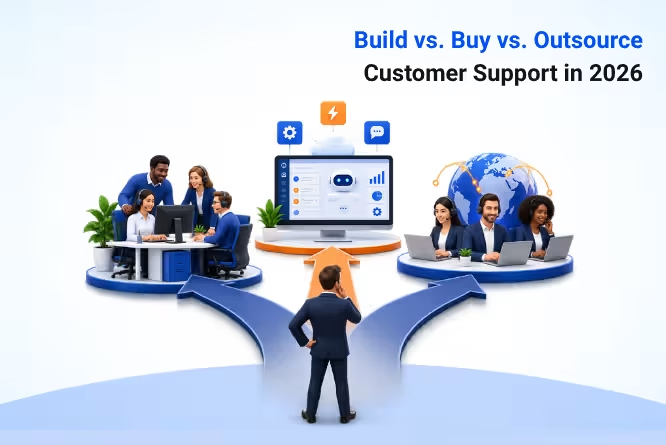
The Three Paths: What Build, Buy, and Outsource Actually Mean
Build means hiring and managing your own support team, often paired with custom or self-built tooling designed around your exact workflows.
This path gives you the most direct control over brand voice, escalation handling, and process design. But it also carries the highest fixed cost and the longest runway before you’re actually taking tickets, since hiring, training, and tooling all have to happen before support goes live.
Buy sits in the middle. You license an off-the-shelf platform, tools like Zendesk or Intercom, and staff it with your own hires. Setup is faster than building custom infrastructure from scratch, since the underlying platform already exists.
You still own hiring, training, and day-to-day management under Buy, which means moderate control but real ongoing overhead.
The platform choice itself matters more than a single line suggests. Mid-tier support platforms, Zendesk, Intercom, and Freshdesk are the three most common, typically run $50 to $150 per agent per month depending on tier and add-ons like AI copilots or advanced automation.
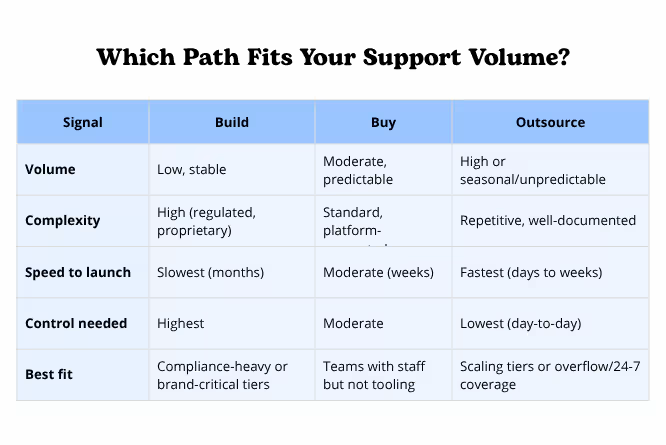
Buy tends to beat both Build and Outsource when you already have a capable support team but lack the tooling to scale it, when your workflows are standard enough that a platform’s built-in automation covers most cases, or when you need a fast upgrade path without handing over process control.
Increasingly, these platforms are AI driven, offering built-in chatbots and routing logic that adapts to your specific product or services without heavy custom development. Where Buy falls short is the integration layer: most 2026 platforms handle core ticketing and routing well but still require custom work to connect deeply with product data, billing systems, or a proprietary LLM layer, which is why many teams end up building that connective layer themselves even after buying the platform.
Outsource hands off both the people and the process to a BPO or managed partner. This is the fastest path to launch and carries the lowest fixed cost, since you’re not building infrastructure or a hiring pipeline at all, but it does mean less direct, day-to-day control over exactly how each interaction unfolds.
A strong outsourcing partner brings trained customer service representatives who are already fluent in the tools and communication channels your customers use, and who are measured on response times from day one.
Deciding to outsource customer support isn’t a downgrade from Build or Buy, it’s a different tradeoff entirely, one that increasingly makes sense for a specific slice of ticket volume even at companies that keep other tiers in-house.


In-House vs. Outsourcing: The Real Cost Comparison
Most cost comparisons stop at salary, which understates the real number badly.
The full in-house cost stack includes turnover (support roles churn constantly, and every departure restarts hiring and training), benefits and payroll overhead, tooling and platform licenses, and the management layer needed to run quality assurance and performance reviews. Once you add all of that up, in-house vs outsourcing looks very different from a simple salary-versus-hourly-rate comparison.
Outsourcing reduces customer service operating costs by 60 to 70 percent compared to building an equivalent function in-house, largely through labor arbitrage, shared technology infrastructure, and variable rather than fixed capacity.
Nearshore and onshore outsourced agent rates average $30 to $35 per hour, a figure that already includes the technology, management, and quality systems an in-house build would require you to fund separately. The honest in-house vs outsourcing comparison isn’t rate versus salary, it’s fully loaded in-house cost versus fully loaded outsourced cost, and BolsterBiz’s breakdown of customer support outsourcing costs in 2026 walks through that fuller comparison in detail.
For most companies, the appeal isn’t just headline cost savings, it’s a genuinely more cost effective structure overall. Outsourcing converts fixed labor costs into a variable expense that scales with ticket volume rather than headcount.
How Much Does It Cost to Outsource Customer Support in 2026?
The direct answer: outsourcing typically costs 60 to 70 percent less than building an equivalent in-house function, once you account for the full cost stack rather than salary alone.
For context on the baseline you’re comparing against, the median cost per assisted customer contact sits at $13.50 across the industry, a figure that includes every channel and every type of inquiry, from a simple order status check to a complex escalation.
So, how much does it cost to outsource customer service relative to that baseline? It depends heavily on ticket complexity, required coverage hours, and whether you need a dedicated team versus a shared pool. The 60 to 70 percent savings range holds fairly consistently across company sizes once the full in-house comparison is made honestly.
As your customer base grows, the math tends to favor outsourcing even further, since a larger base means more predictable ticket volume for a partner to plan around.
Before signing any contract, it’s worth reviewing BolsterBiz’s SLA checklist for outsourced customer support to make sure the pricing you’re quoted actually maps to enforceable service commitments, not just a headline rate.
When Building In-House Customer Support Makes Sense in 2026
Build wins in a few specific situations.
Highly regulated or deeply proprietary workflows, where compliance requirements or specialized product knowledge make external delegation genuinely risky, often justify the fixed cost of an in-house team. Very low ticket volume is another case, since most outsourcing partners have practical minimums that don’t make sense below a certain scale.
Brand-critical support that requires deep, continuously updated product training, the kind that’s hard to transfer to an external partner quickly, tends to favor keeping that specific tier in-house, closely aligned with the standards outlined in BolsterBiz’s 5 principles of quality customer service.
This is especially true for technical support tiers where product depth matters most, and where losing experienced team members to turnover is costliest.
Choosing this path is a legitimate customer support outsource decision in reverse: deciding which tier of support is valuable enough to keep internal, rather than assuming everything should move externally by default.
When Outsourcing Customer Support Makes Sense in 2026
Outsourcing wins when you need to scale support quickly, handle seasonal or unpredictable volume without over-hiring for the slow months, or provide 24/7 and multilingual coverage that would take years to build internally.
The quality objection that used to justify keeping everything in-house doesn’t hold up as strongly anymore: top outsourced operations now reach 85–90% on both CSAT and first-contact resolution, comparable to the best in-house teams rather than a clear step down.
A partner with coverage across every time zone can hand off tickets in real time as one region logs off and another comes online, provided your outsourcing partner has secure protocols in place for handling customer data. Well-trained customer service agents are what keep that handoff consistent from one shift to the next.
If you’re evaluating providers for this path, BolsterBiz’s guide to the best omnichannel customer support outsourcing companies is a useful starting point for comparing what genuinely strong outsource customer support partners look like versus ones cutting corners on quality to hit a lower rate.
Why Hybrid Is Becoming the Default in 2026
The data tells a clear story: pure in-house and fully outsourced models are both becoming the exception rather than the rule.
80% of executives plan to maintain or increase outsourcing investment, while 70% have selectively brought some scope back in-house over the past five years. Read together, those two stats aren’t contradictory. They describe a market that’s converged on 72% of executives now running a blended, multidimensional sourcing model instead of committing fully to either extreme.
The practical framework: keep brand-sensitive, high-complexity tickets in-house where deep product knowledge and judgment matter most, and customer support outsource the high-volume, repetitive tiers where speed and cost efficiency matter more than bespoke handling.
Many businesses now run blended customer service teams that combine internal specialists with outsourced agents handling first-line volume.
Getting this split wrong in either direction is exactly how businesses end up in BolsterBiz’s breakdown of what poor customer service actually costs, whether that’s an overwhelmed in-house team or an outsourced partner handling tickets they were never equipped for.
Which Path Fits Your Support Volume?
 Conclusion
The build-versus-buy-versus-outsource decision isn’t really about picking one permanent answer.
It’s about matching each path to the specific slice of support volume it’s actually suited for. Cost structure, control, and speed to launch all pull in different directions depending on what you’re solving for. The in-house vs outsourcing debate that dominated this conversation for years is giving way to a more deliberate hybrid approach, and the data backs that shift clearly.
If you’re trying to figure out where your own support volume should land across these three paths, BolsterBiz’s customer support outsourcing services can help you model the actual cost and volume tradeoffs specific to your business.
The fastest way to get a straight answer on your own numbers is to book a free 30-minute consultation and walk through where Build, Buy, and Outsource actually land for your support volume, before you commit to any single path.