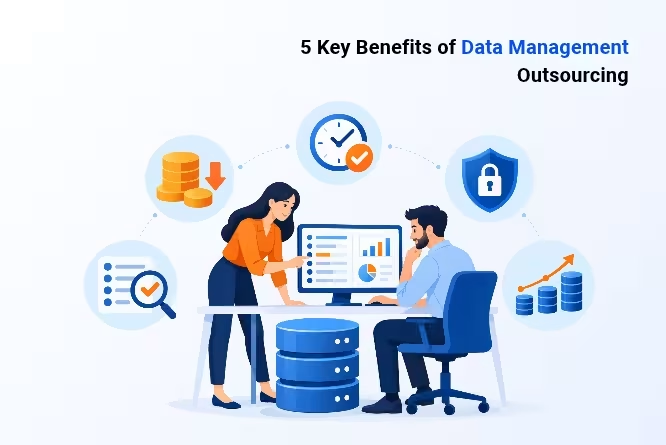
 Benefit 1: Specialist Expertise Through Data Management Outsourcing
Data management outsourcing gives you a trained team of engineers, analysts, and quality specialists without a long hiring search. Skill gaps are common. A July 2024 Gartner survey of 1,203 data management leaders found that 63% of organizations lack confidence in their data management practices for AI.
Take a mid sized retailer that needs a data engineer, a quality analyst, and a database administrator. Hiring all three can take months. Companies that outsource data management services get that bench from day one. For a deeper look at the trade off, read our build vs buy vs outsource guide.
Benefit 2: Lower Costs When You Outsource Data Management
When you outsource data management, you replace salaries, software licenses, and infrastructure with one service fee. Data management outsourcing also turns fixed costs into variable ones, so you pay for output, not idle capacity. Many providers and industry guides report 30% to 60% lower operating costs than equivalent in-house builds once salaries, software licenses, and infrastructure are counted. Results vary by scope and location, so confirm the number in a pilot.
Cost still matters, but it is no longer the whole story. Deloitte’s 2024 survey shows only 34% of companies put cost reduction first, down from 70% in 2020 (Deloitte, 2020 Global Outsourcing Survey). The same survey found that companies with mature vendor management offices save 20% or more. Savings come from managing the provider well, not only from signing the contract. For market rates, see our breakdown of data analytics consulting costs in 2026.
Ask about pricing models up front. Common options are per hour, per record, fixed project fee, and monthly retainer. A finance team with seasonal invoice spikes may do better with per record pricing than with a full year team.

Benefit 3: Stronger Security and Compliance
Reputable providers run certified security programs that many mid sized teams cannot build alone. The stakes are high. IBM’s 2026 Cost of a Data Breach Report puts the global average breach at a record $4.99 million and the US average at $11.5 million.
Look for ISO 27001 certification, SOC 2 reports, encryption, role based access, and audit logs. Confirm coverage for the rules that apply to you, such as GDPR, HIPAA, or India’s DPDP Act. With data management outsourcing, your contract should state who owns the data and who can touch it. Data outsourcing does not mean giving up control.
A healthcare billing group, for example, can require HIPAA aligned workflows in the contract before any records move.
Benefit 4: Scale Up or Down Without a Hiring Cycle
Workloads are rarely flat. Migrations, launches, and month end closes all create spikes. Deloitte’s 2024 survey found that 96% of organizations use third party outsourcing, and many blend it with in house centers and freelancers. Data management outsourcing fits that mix because you change capacity by changing scope, not headcount.
A company moving to a new CRM, for example, can add a cleansing team for eight weeks and then scale back. See how the same model works for software teams in our QA outsourcing guide.
Benefit 5: Cleaner Data for Analytics and AI
AI is only as good as the data behind it. Gartner’s forecast is blunt: 60% of AI projects without AI-ready data face abandonment through 2026. Data management outsourcing builds the clean, governed foundation those projects need.
Once that foundation exists, many teams outsource data science services too. A provider can build dashboards, forecasts, and churn models on top of the cleaned pipeline. A lender might first deduplicate customer records, then commission a churn model. You get one accountable partner from raw data to insight. To see what to expect from a provider, read about the best features of data analytics service providers.
Which Industries Benefit Most From Data Management Outsourcing?
Any data heavy business can gain, but three sectors see the clearest returns.
Healthcare. Patient records and billing data need HIPAA aligned workflows, strict access controls, and clean coding. IBM’s 2026 report ranks healthcare as the costliest sector for breaches for the 13th year, at $6.64 million on average, so provider security matters most here.
Financial services. Audit trails, reconciliation, and regulatory reporting depend on accurate, traceable data. IBM puts the average financial sector breach at $6.29 million in 2026, up from $5.56 million. Look for providers that log every change and retain records.
Retail and e-commerce. Product catalogs, pricing, and inventory feeds change daily and spike during sales seasons. A provider can cleanse catalog data and keep inventory in sync across channels without a permanent team.
In House vs Data Management Outsourcing: A Quick Comparison
Choosing between building a team and outsourcing rarely comes down to cost alone. This table sets an in-house data team beside data management outsourcing on seven factors that shape most decisions: setup, cost structure, expertise, security, scalability, control, and fit. Use it to see where each model is strongest.
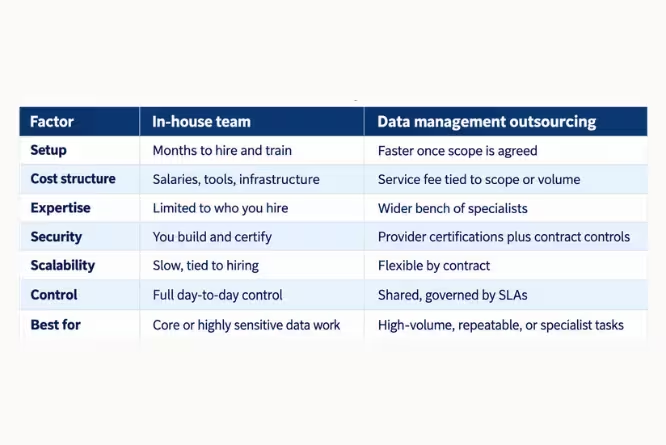
In short, an in-house team gives you full control and suits sensitive, strategic work, but it is slower and costlier to build. Outsourcing wins on speed, expertise, and flexibility for high volume or specialist tasks, though shared control means you need clear SLAs. Many companies combine both: strategy and governance stay in house, and daily operations move out.
How to Choose a Data Management Outsourcing Partner
Use this checklist when you evaluate providers for data management outsourcing:
- Experience with your industry and data types
- Security certifications and a written policy on AI tools used with your data
- SLAs with measurable accuracy and turnaround targets
- Transparent pricing and a defined model
- A paid pilot before full commitment
- Exit terms, data portability, and process documentation
- Regular reporting and a named account lead
Run a short pilot on one workflow and compare results against the SLA. For a wider vendor screen, see our guide on how to find the best IT solutions provider.
Risks of Data Management Outsourcing and How to Handle Them
Security and AI use. IBM’s 2025 report found that only 37% of organizations have policies to manage AI or detect shadow AI. Ask providers whether they use AI tools on your data, and require written rules.
Compliance. Map each data type to the rules that govern it. Put those duties in the contract and audit them yearly.
Vendor lock in. Insist on standard formats, documented processes, and a clear exit plan. Data outsourcing risks are manageable when switching stays possible.
Quality drift. Set accuracy thresholds and review samples monthly. Tie fees to results where you can.
Our SLA checklist for outsourced customer support shows how to write measurable service terms, and the same approach applies here.
Data Management Outsourcing Trends in 2026
Three shifts are shaping the market this year.
AI inside outsourced workflows. Providers increasingly use automation for cleansing and validation, so ask how AI touches your data. The upside is real: IBM’s 2026 report found that organizations using AI and automation in security operations paid $1.93 million less per breach.
Hybrid models. Companies keep strategy and governance in house and move operations out. Deloitte’s 2024 survey found that 96% of organizations already use third party outsourcing.
Tougher compliance. GDPR and HIPAA now sit beside India’s DPDP Act and other regional rules. Contracts should cover data residency, breach notice, and audit rights.
Conclusion
Data management outsourcing pays off when you need expertise, flexibility, and clean data faster than you can hire. The five benefits compound: expertise, lower cost, stronger security, easy scaling, and Al ready data. Start with one workflow, measure results, then expand.
Ready to outsource data management services, or even outsource data science services? Our data analytics services turn clean data into decisions with reporting, dashboards, and forecasting.
Start a data management outsourcing pilot today. Book a 30 minute call with our team to scope your first workflow.