
Every quote for customer support outsourcing looks different because five variables move independently: geography, service complexity, channel mix, pricing model, and contract minimums. Two providers quoting “$15 an hour” can mean very different things once you factor in what’s actually included.
Geography sets the floor. Service complexity sets the ceiling. Simple, high-volume tasks like FAQs and order status updates cost far less than technical troubleshooting, billing disputes, or multilingual support requiring dedicated, trained specialists. Channel mix matters too: voice support generally costs more than chat or email due to real-time staffing requirements. And the pricing model itself, hourly, per-agent, per-resolution, or flat monthly, changes how the same underlying cost gets billed to you.
Overall, customer service outsourcing pricing across the market spans a wide $7 to $60 per hour range once you account for every combination of these variables, which is exactly why a single “average cost” figure is nearly useless without context.
Customer Support Outsourcing Cost by Region and Service Tier
The clearest way to estimate call center outsourcing costs is to combine two dimensions most guides only cover separately: where the team is based, and how complex the work is.
Offshore (Asia — India, Philippines, Pakistan): Transactional support (FAQs, order updates) runs $7 to $12 per hour. Specialized support (billing, product questions) runs $12 to $18 per hour. This region offers the strongest low-cost customer support outsourcing option for high-volume, straightforward ticket types.
Nearshore (Latin America, Eastern Europe): Transactional support runs $15 to $22 per hour. Specialized support runs $22 to $35 per hour. This tier balances cost savings with closer time-zone alignment and stronger English or multilingual fluency than offshore options typically offer.
Onshore (US, UK, Canada): Transactional support starts around $15 to $20 per hour under shared-agent models, or $25 and up for dedicated agents. Expert-led support, including technical troubleshooting and trust and safety work, can reach $60 to $65 per hour. This tier is reserved for compliance-heavy industries or brands where domestic-only support is a hard requirement.
Complexity moves the price within each region as much as geography moves it between regions. A specialized nearshore agent can easily cost more than a transactional onshore-adjacent shared-team option, which is why matching tier to actual ticket complexity matters more than defaulting to the cheapest region available.
Poor support isn’t just a cost problem. Poor customer service actively drives customers away, which is worth weighing against any bargain-tier pricing decision.
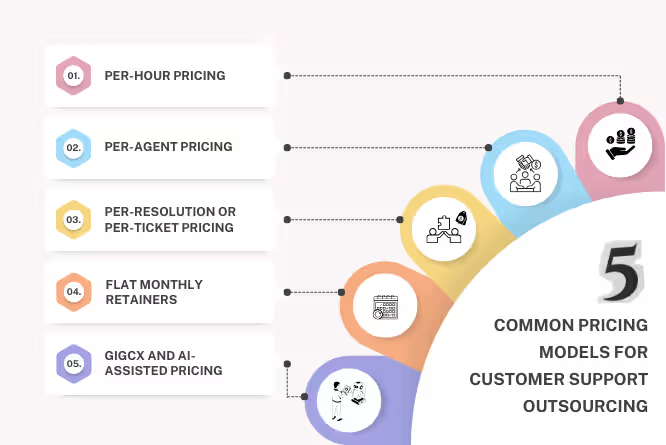
Five Common Pricing Models for Customer Support Outsourcing
3. Per-resolution or per-ticket pricing
Per-resolution or per-ticket pricing charges based on completed interactions rather than time worked, generally $1 to $7 per resolution with an industry average near $4. This fits companies with unpredictable or seasonal volume, since how much it costs to outsource customer service becomes directly tied to actual demand rather than a fixed headcount.
4. Flat monthly retainers
Flat monthly retainers bundle a full team, reporting, and management into one predictable fee, common for mid-size and enterprise engagements that want simplified budgeting over granular, itemized billing.
5. GigCX and AI-assisted pricing
GigCX and AI-assisted pricing is the fastest-growing model in 2026. Rather than billing per hour or per resolution, GigCX platforms price per conversation or per minute, drawing on a flexible, gig-economy workforce that scales up or down with demand. AI-assisted hybrid packages pair this flexible staffing with automation that resolves simpler tickets before they reach a human agent, which can push blended per-ticket costs well below traditional offshore rates. This model fits businesses with sharply seasonal or unpredictable volume that don’t want to commit to fixed headcount, though it typically requires more hands-on quality management than a traditional dedicated team.
Everest Group’s research on outsourcing trends notes that BPO providers using AI-assisted and gig-based staffing models have driven per-ticket costs down substantially while maintaining service-level performance.
Hidden Fees to Watch For
The quoted hourly or per-agent rate is rarely the full picture. Customer service outsourcing pricing often includes separate setup fees ranging from $5,000 to $200,000 depending on integration complexity and provider size, a cost most buyers do not account for in initial budgets. Watch for idle-time charges billed even when ticket volume is low, overage fees once you exceed contracted volume, technology or platform integration costs, and compliance fees for handling sensitive data like payment information or healthcare records. Ask any provider for a fully itemized quote before signing, not just a headline rate.

Performance Standards and SLA Cost Factors
A cheaper hourly rate with no performance commitments often costs more in the long run than a higher-priced provider with clear guarantees. Before signing any multi-year agreement, treat CSAT and attrition commitments as non-negotiable, not as a nice-to-have. Industry standard CSAT targets sit at 85% or higher, and first contact resolution (FCR) benchmarks typically run 70–75%. Providers that fall short of these numbers tend to generate repeat contacts, longer handle times, and higher customer churn, costs that don’t show up on the invoice but show up in your retention numbers.
SLA compliance guarantees also affect pricing directly: providers backing response-time and resolution commitments with financial penalties for missed targets generally price a few points higher than those offering no such guarantee. The true cost of outsourcing isn’t just the hourly rate, it’s the total cost of ownership once management, technology, training, and performance risk are factored in.
ICMI’s customer experience benchmarking data is a useful baseline when evaluating whether a provider’s proposed CSAT and FCR targets are competitive.
Real Cost Example: Budgeting for a 10-Agent Outsourced Team
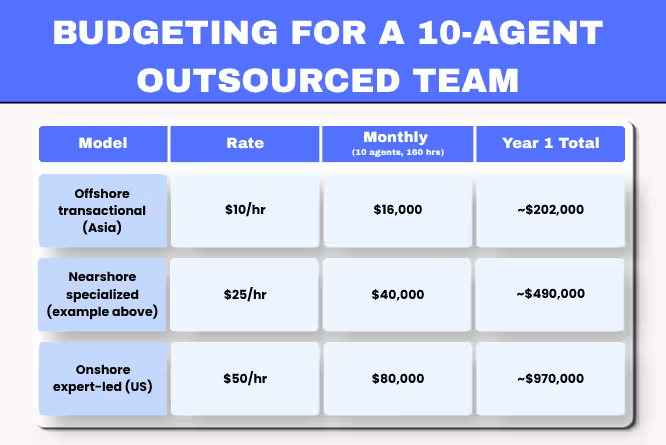
Here’s what customer support outsourcing actually costs in practice. Take a mid-size ecommerce company hiring 10 nearshore agents for specialized support (billing, order issues, returns) at an average rate of $25 per hour, a realistic mid-tier nearshore rate.
At 160 productive hours per agent per month, that’s $4,000 per agent, or $40,000 per month for the full team before setup costs. Add a one-time setup fee of roughly $10,000 for platform integration and training, and year-one costs land around $490,000, dropping to roughly $480,000 in year two once setup costs are removed.
Compare that to an equivalent US-based in-house team: 10 support reps at a loaded cost (salary, benefits, management, software) of roughly $65,000 to $75,000 per year each puts in-house spend at $650,000 to $750,000 annually. That gap reflects the widely cited 35 to 70% savings outsourcing delivers over in-house builds, and it’s before accounting for the multi-month hiring timeline an in-house team requires before it’s even fully staffed.
For context, here’s how the same 10-agent team would price out across all three regional tiers:
Want to run these numbers for your own team size? Try BolsterBiz’s outsourcing cost calculator for a tailored estimate.
Conclusion
Customer support outsourcing costs vary enormously, from $7 an hour for offshore transactional support to $65 an hour for onshore expert-led work, and the right choice depends far more on ticket complexity and required coverage than on chasing the lowest regional rate available. Understanding customer service outsourcing pricing means looking past the headline number to the pricing model, hidden fees, performance standards, and total cost of ownership before signing anything.
Whatever combination of region, tier, and pricing model fits your business, the fundamentals stay the same: match complexity to the right tier, get an itemized quote, and pilot before committing to a long-term contract.
Ready to build a support team that matches your actual needs and budget? Explore how the five principles of quality customer service shape how BolsterBiz structures every engagement, then talk to our expert about your specific pricing needs.
Typically 35–70% compared to fully loaded in-house costs, based on the elimination of salary, benefits, management overhead, and infrastructure costs. The exact savings depend on region, service tier, and how quickly an in-house team could otherwise be hired and trained.
7. Which countries offer the best customer support outsourcing value in 2026?
The Philippines and India lead offshore value for transactional and specialized support at $7–$18 per hour. For nearshore options with closer time-zone alignment, Latin American countries like Mexico and Colombia, along with Eastern European countries like Poland and Romania, typically run $15–$35 per hour.