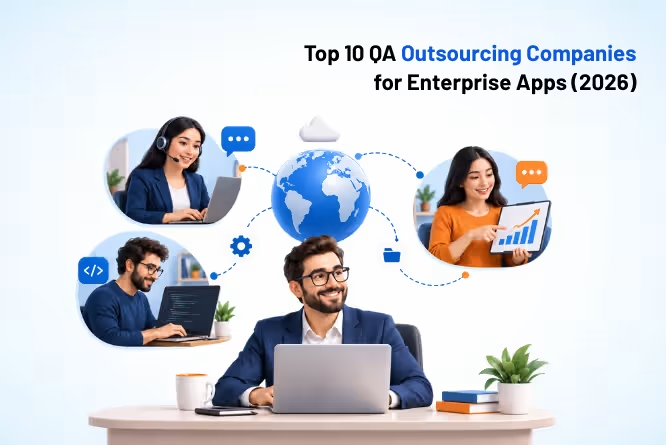
Top 10 QA Outsourcing Companies for Enterprise Apps (2026)

QA Outsourcing Companies
Share This Post

The best QA outsourcing companies for enterprise apps in 2026 combine compliance-grade security, multi-region delivery, and both manual and automated testing depth. 

Qualitest leads this list with true global follow-the-sun coverage across seven delivery regions. Testlio brings the broadest device and locale testing network for multi-market apps. Cigniti specializes in large-scale QA transformation programs for complex legacy environments. QASource blends dedicated augmentation with fully managed testing.

BolsterBiz rounds out the list with dedicated QA teams, transparent pricing, and flexible engagement models that don’t require enterprise-only minimums. 

Choosing the right partner among these QA outsourcing companies comes down to matching compliance needs, delivery scale, and testing depth to your specific enterprise environment, not just picking the most recognizable name.

Key Takeaways
  • Qualitest leads this list with true global follow-the-sun coverage across seven delivery regions

  • BolsterBiz rounds out the list with dedicated QA teams, transparent pricing, and no enterprise-only minimums

  • The outsourced QA market is valued at $50.6B in 2026, growing at 11.5% annually

  • 61% of Fortune 1000 companies already rely on third-party testing partners

  • A production bug that slips through QA costs 6x more to fix than catching it during testing

  • Offshore and nearshore QA models cut costs 60–70% compared to building an equivalent in-house team

What Enterprise Apps Need From QA Outsourcing Companies

Enterprise QA needs look nothing like startup QA needs, and most buying guides blur the two together. Before comparing providers, know what actually matters at enterprise scale.

  • Start with compliance certifications: SOC 2 Type II and ISO 27001 are baseline requirements when a testing partner touches production-adjacent data or systems. 
  • Confirm multi-region, follow-the-sun delivery capability if your release cadence demands round-the-clock coverage across time zones. 
  • Look for governance and reporting that can scale across multiple applications simultaneously, not just a single product line. 
  • Verify the partner integrates directly into your existing SDLC and DevOps pipeline rather than operating as a disconnected external process. 

This kind of setup is common in IT staff augmentation models, where the partner works inside your systems rather than alongside them.

Finally, confirm they cover both manual and automated testing. Enterprise environments rarely run on one testing approach alone.

The stakes justify this scrutiny. 61% of Fortune 1000 companies already rely on third-party testing partners, and the math behind that decision is straightforward: a production bug that slips through QA costs 6 times more to fix than catching it during testing. Getting the QA outsourcing decision right isn’t a cost-cutting exercise at this scale, it’s risk management.

Top 10 QA Outsourcing Companies for Enterprise Apps
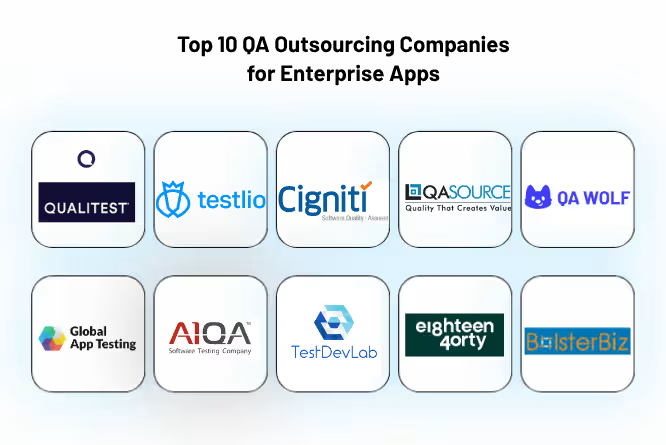
Top 10 QA Outsourcing Companies in 2026


1. Qualitest

Qualitest is the largest pure-play QA outsourcing provider globally, with delivery centers spanning the US, UK, India, Romania, Canada, Mexico, and the Philippines. That footprint gives genuine follow-the-sun coverage few competitors can match.

Best for: enterprise teams shipping complex, multi-platform products that need true round-the-clock testing coverage across time zones. Pricing is enterprise-tier, typically exceeding $15,000 per month, skewing toward companies with $10M+ in annual revenue.

IT Staff Augmentation

2. Testlio

Testlio coordinates a global network of vetted testers with dedicated program management layered on top, giving it strong breadth across devices, operating systems, and localization requirements.

Best for: large enterprises needing wide device and locale coverage for apps shipping across many markets simultaneously.

3. Cigniti

Cigniti focuses on large-scale QA transformation programs, positioning itself for enterprises modernizing testing practices across complex, often legacy-heavy environments rather than single-product engagements.

Best for: enterprises undertaking a broader QA strategy overhaul across multiple applications, not just adding testing capacity to one product.

4. QASource

QASource sits between staff augmentation and full outsourced testing, integrating dedicated QA professionals into an existing development process while also supporting managed and project-based testing when a company needs more structure.

Best for: enterprises wanting the flexibility to move between embedded augmentation and fully managed testing as needs shift.

5. QA Wolf

QA Wolf specializes in automated regression suite coverage, building and maintaining comprehensive automation suites rather than leading with manual testing services.

Best for: enterprises with mature release pipelines that need broad, reliable automated regression coverage above all else.

6. Global App Testing

Global App Testing is a crowdsourced testing provider strong in on-demand functional and localization coverage across many markets, typically with higher engagement minimums than boutique providers.

Best for: enterprises needing fast, wide-reaching functional testing across diverse markets and device configurations.

7. A1QA

A1QA brings deep experience in regulated industries, positioning itself for enterprises where compliance and audit-readiness are as important as testing coverage itself.

Best for: enterprises in healthcare, finance, or other compliance-heavy sectors needing a QA outsourcing partner fluent in regulatory requirements.

8. TestDevLab

TestDevLab specializes in AI-augmented testing, combining human-driven QA expertise with AI-powered delivery designed to reduce regression cycles significantly and close coverage gaps automatically.

Best for: enterprises building complex or AI-driven products that need testing depth matching that technical complexity.

9. 1840 & Company

1840 & Company takes a dedicated global staffing model approach to QA outsourcing, representing a distinct alternative to the managed-service model most other providers on this list use.

Best for: enterprises that prefer a global staffing structure over a fully managed testing engagement.

10. BolsterBiz

Most providers on this list ask enterprises to choose between rigid, enterprise-only contracts or flexible engagement with limited depth. BolsterBiz doesn’t force that trade-off.

Its QA outsourcing services cover manual testing, automation, performance, and security, delivered by dedicated QA engineers who work inside your existing sprints and CI/CD pipeline rather than as a disconnected external team.

Pricing scales with your actual testing scope, not a fixed enterprise minimum, so mid-market and enterprise teams both get compliance-ready, dedicated QA talent without a $10M-revenue price of entry. Onboarding is built for speed, and engagement models flex as release cadence and testing needs change.

Best for: enterprise and growth-stage teams that want dedicated QA depth and compliance readiness, without the inflexible minimums most enterprise-only providers require.


According to Kore BPO’s 2026 QA outsourcing market analysis, the outsourced QA market is valued at $50.6 billion in 2026, growing at 11.5% annually, citing Coherent Market Insights.

Enterprise QA Outsourcing Pricing: What to Expect

Pricing among QA outsourcing providers varies sharply by delivery model and region. Offshore QA rates typically run $18 to $50 per hour, compared to $130,000 or more per year for a single US-based in-house QA engineer once salary, benefits, and overhead are factored in. That gap is why offshore and nearshore models can cut overall QA costs by 60 to 70 percent compared to building an equivalent function in-house.

At the true enterprise tier, expect managed engagements to run north of $15,000 per month for providers like Qualitest, a pricing structure that typically assumes $10M+ in annual revenue and rigid contract minimums. Providers like BolsterBiz occupy a different position, offering enterprise-grade delivery without forcing that same commitment threshold, which matters for mid-market companies with enterprise-level compliance needs but without enterprise-level budgets to match.

For leaders considering this route, transparency in how talent is sourced and managed matters just as much as the testing itself. It’s worth understanding hiring remote QA engineers and testers before choosing between direct placement and a managed engagement.

Conclusion  

The right choice among QA outsourcing providers depends on compliance requirements, delivery scale, and how rigid a commitment structure your organization can accept. BolsterBiz stands out as the strongest all-around pick for enterprise and growth-stage teams that need dedicated QA depth and compliance readiness without the inflexible minimums larger providers like Qualitest require. Enterprises with extensive multi-market device needs may lean toward Testlio or Global App Testing, while those managing regulated environments should look closely at A1QA.

Whichever partner you choose, the decision to work with any of these QA outsourcing services should come down to compliance posture, delivery model fit, and pricing transparency, not just brand recognition.

Ready to build enterprise-grade QA without enterprise-only minimums? See BolsterBiz’s IT staff augmentation services to extend your broader engineering capacity alongside QA.

Schedule a free demo to talk through what QA outsourcing could look like for your team.

Frequently Asked Questions

1. What are the best QA outsourcing companies for enterprise apps?

BolsterBiz, Qualitest, Testlio, Cigniti, and QASource are among the strongest options in 2026. BolsterBiz leads for enterprises wanting dedicated QA depth and compliance readiness without rigid minimums, while Qualitest and Testlio suit large-scale, multi-region, multi-market testing needs specifically.

2. How much does enterprise QA outsourcing cost?

Offshore rates typically run $18–$50 per hour, versus $130,000+ per year for an in-house QA engineer. True enterprise-tier managed engagements often exceed $15,000 per month. Offshore and nearshore models generally cut total QA costs by 60–70% compared to building an equivalent in-house team.

3. What is the difference between manual QA testing services and automated testing?

Manual QA testing services rely on human testers to explore functionality, usability, and edge cases that require judgment. Automated testing uses scripted test suites to run repetitive regression checks quickly and consistently. Enterprise environments typically need both working together, not one in isolation.

4. What compliance certifications should an enterprise QA outsourcing partner have?

Look for SOC 2 Type II and ISO 27001 certifications at minimum, especially if the partner will touch production-adjacent data or systems. Regulated industries like healthcare and finance should also confirm sector-specific compliance experience, such as HIPAA or PCI DSS familiarity, before signing.

Sign Up to Our Monthly Newsletter and Get Access to the Latest CX Insights

Discover more from BolsterBiz

Subscribe now to keep reading and get access to the full archive.

Continue reading