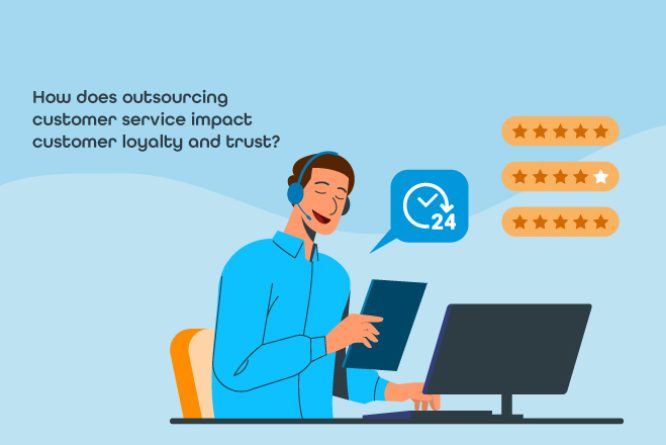
Outsourced customer service is increasingly becoming a go-to strategic move for small and medium enterprises to enhance customer loyalty. Especially those with rapid growth and who want to scale quickly, ensure seamless support, and reduce operational overheads. With increasing customer expectations and demands for faster response times, efficient resolutions, omnichannel access, and seamless interactions across different time zones, outsourcing companies offer the solution to meet these expectations.
This question keeps business owners awake at night, especially when they are trying to balance cost savings with customer satisfaction: Does outsourcing customer service help or hurt customer loyalty and relationships?
The reality is that customer support outsourcing affects millions of interactions every day. For some companies, it works in their favor, as customer satisfaction scores rise after partnering with their service providers. In contrast, for others, it turns out to be a bad investment, as they face backlash from customers who feel disconnected from the brand they once trusted.
This article explores how outsourcing customer service impacts customer loyalty and trust.
How Outsourced Customer Services Impacts Customer Loyalty in 4 Ways?
1. Communication Quality can Make or Break Relationships
- The first thing customers notice is how well outsourced agents communicate. Usually, outsourced teams receive more training than in-house staff. This works in the business's favour. They follow proven scripts, use advanced tools, and focus solely on customer service, unlike in-house agents, who might also have other tasks.
- However, language barriers and cultural differences can create a communication gap. If customers don’t feel a connection, it severely affects customer satisfaction.
- Therefore, to maintain customer loyalty and trust in the brand, it is important for the business to invest in language and cultural alignment training for its outsourced teams to achieve higher customer satisfaction scores.
Also Read: How much does outsourcing customer service cost vs. in-house support?
2. Fast Response Times and 24/7 Availability
- Think from your own perspective: when you have a problem at 2 AM, being able to reach out to support immediately creates a positive impression of the brand.
- This is the area where outsourcing often shines. Many outsourced customer service operations operate 24/7 across multiple time zones, something that is expensive to maintain in-house. This directly impacts customer loyalty, especially for businesses that target global markets.
- Customers tend to recommend the brands that make them feel valuable. However, longer wait times can have the opposite effect. If outsourcing leads to understaffed call centres or they fail to achieve the desired response times, customers quickly lose patience and trust.
Find Out: How to choose the best customer service outsourcing company for your business?
3. Expertise and Fast Resolution Enhance Customer Experience
- Handling common inquiries is easy, but when it comes to complex, product-specific questions, it is essential that the outsourced agents have deep product knowledge and technical expertise.
- In-house teams naturally have more profound product knowledge through daily exposure to company culture, updates, and informal knowledge sharing.
- Businesses should, therefore, hire outsourcers with expertise and experience in their industry, as well as:
- Provide extensive product training
- Create detailed knowledge bases that outsourced agents can access
- Regularly update outsourced teams about product changes and company news
4. Cost Savings
- The cost-saving benefits of outsourcing are obvious - reduced overhead, lower labour costs, and predictable service costs.
- Innovative companies invest these savings into better technology, training, and additional service channels. When customer benefits from these improvements, loyalty often increases.
- But it is advised not just to choose the cheapest call centres; do more research before selecting the right outsourcing partner.
- An ill-matched partnership can lead to rushed customer interactions, undertrained staff, and limited resources, resulting in negative experiences that damage customer loyalty and trust.
Try our free Outsourcing Cost Calculator to see how much you can save annually with customer support outsourcing.
Conclusion
The impact of outsourcing customer service on customer loyalty and trust is not definite. It depends entirely on your outsourcing partner and how businesses approach outsourcing.
Companies can strengthen customer relationships through outsourcing with providers who share the same commitment to quality service. At the same time, some companies damage their reputation by choosing providers based solely on cost. The key is treating the outsourced firm as a long-term partner rather than a simple vendor.
Success comes down to prioritizing customer experience over cost savings, choosing partners who understand your brand values, and maintaining oversight to ensure service quality remains high and consistent. Companies that get this balance right often find that outsourcing customer service becomes a competitive edge rather than a necessary compromise.
Are you a business leader who is looking for outsourcing customer service? It is wise investment for your business and helps you improve your outsourcing strategies with enhanced customer loyalty.
Looking to outsource your customer service?
Schedule a free consultation today
Frequently Asked Questions
1. Does outsourcing customer service hurt or help customer loyalty?
The impact isn't fixed either way — it depends entirely on the outsourcing partner and how a business approaches the relationship, since some companies see satisfaction scores rise after partnering with the right provider, while others face customer backlash after choosing based on cost alone.
2. How does communication quality affect customer loyalty in outsourced support?
Outsourced agents often receive more focused training than in-house staff and follow proven scripts, which works in a business's favor, but language barriers and cultural differences can create a disconnect that hurts satisfaction unless the business invests in language and cultural alignment training.
3. Does 24/7 outsourced support actually improve customer trust?
Yes. Many outsourced operations run 24/7 across multiple time zones, something expensive to replicate in-house, and customers tend to recommend brands that make them feel valued through fast response times, though understaffed outsourced teams can just as easily damage trust through long wait times.
4. Can outsourced agents match in-house teams on product expertise?
It requires deliberate effort, in-house teams naturally build deeper product knowledge through daily exposure, so businesses should provide outsourced agents with extensive product training, detailed knowledge bases, and regular updates on product changes to close that gap.
5. Do cost savings from outsourcing customer service come at the expense of loyalty?
Not necessarily. Cost savings only hurt loyalty when businesses choose the cheapest provider without proper vetting, resulting in rushed interactions and undertrained staff, whereas businesses that reinvest savings into better technology and training often see loyalty increase instead.