
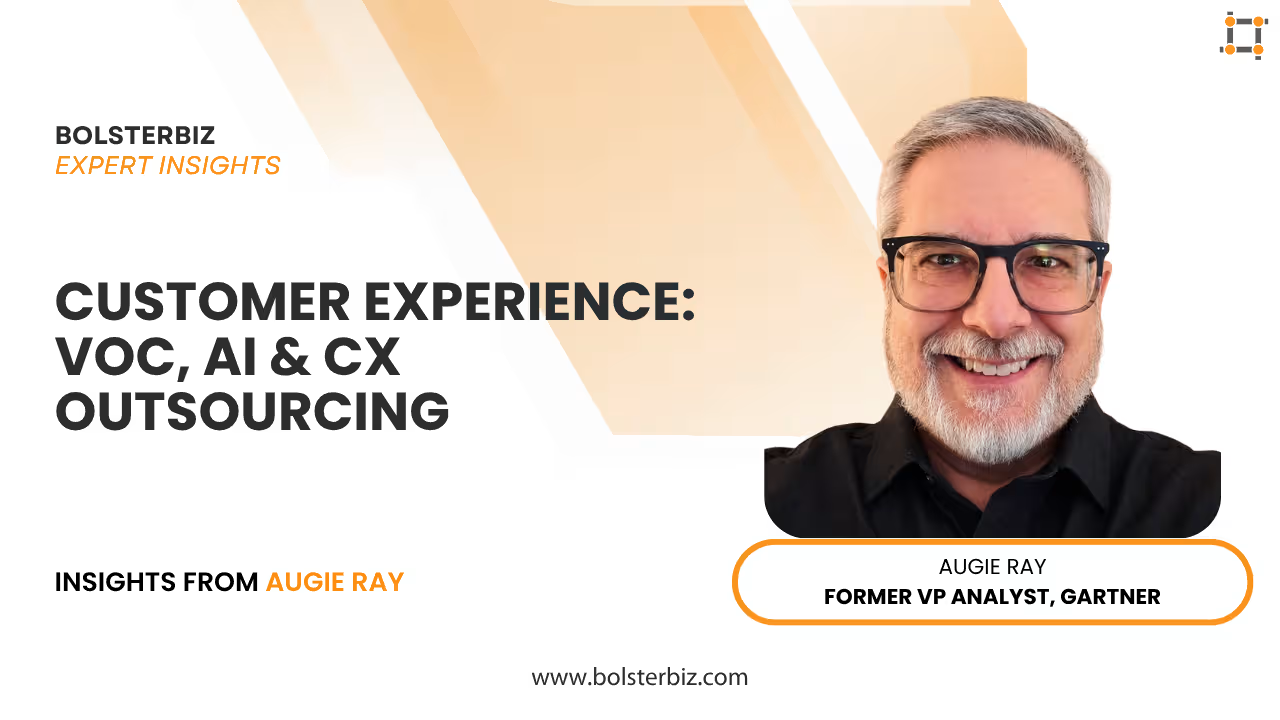
Augie Ray spent 15 years building and researching customer experience programs at American Express, USAA, Prudential, and Gartner. In this conversation, he explains why CX is a discipline rather than a framework, why AI should make you know customers better rather than cheaper, and why the hardest parts of CX shouldn't be outsourced at all.
As a former VP Analyst at Gartner, what key experiences shaped your journey into customer experience (CX) leadership, and how has your leadership philosophy evolved?
In a way, I feel I've been chasing CX my whole career without even knowing it. Out of college, I worked in financial jobs, but I felt frustrated with a lack of my employers' commitment to quality and to the customer. Then I made my first trip to Disney World and was impressed with the unmistakable commitment to the guest. I started reading everything I could find about Disney and its culture. I became enthused with the idea that 1) it is possible to invest in better customer experiences that differentiate and deliver value for the brand, and 2) that there are (some) companies and leaders that get it right (or at least better).
Then, the dot-com era happened, and I quickly leaped out of finance and into digital marketing. At the time, I wasn't excited about the idea of annoying people with emails or banner ads, but that the Internet as a new way for brands to deliver experiences to customers. Brands that understand the internet use it not just for more advertising and acquisition, but to offer new products and services customers value more.
Along came the social media era, and I felt the same. While many brands raced to broadcast marketing messages and collect “fans” with giveaways, I was talking to clients about how social platforms shifted power and voice to customers; this required brands to approach social as an experience medium, not just a marketing and PR one.
For decades, I was committed to listening to customers and uncovering new ways to innovate and make branded experiences meaningful - but I didn't start talking about customer experience (CX) until about fifteen years ago. So, over time, I evolved from someone who merely applied customer-centric approaches to someone who came to understand (and help clients understand) CX as a sustainable discipline that could help companies differentiate themselves in ways that build satisfaction, loyalty, and advocacy.
I realized that CX isn't just a mindset but requires an organized approach to collect and disseminate customer feedback, set proper priorities, and encourage customer-centric behaviors at all levels in an organization. As a Gartner analyst, I helped clients recognize that CX requires investment, governance, leadership, cross-functional collaboration, and a sustained commitment to tools. And more than that, I feel my work at Gartner helped clients to understand the ways they can measure their potential return and justify investments in strengthening customer relationships.
What does a truly scalable customer experience framework look like today, and how should it connect customer outcomes to revenue growth and CX ROI?
I think of CX as a corporate discipline, not just as a framework. Scalable CX requires leaders to commit to customer understanding and prioritize customer outcomes, not just short-term financial ROI. It demands a robust VoC (voice of the customer) program that doesn't simply report NPS and CSAT scores but turns customer feedback and data into knowledge and action. It requires organizational structure and governance. It is powered by effective tools like customer-centric personas and outside-in journey maps to understand customer needs and expectations at every stage of the journey. All of these things, done right, can be scaled from a small company to a giant multinational.
I think it's the second part of your question that is the important part - too many leaders lose sight of how customer-centric CX can create ROI. What happens is that, in the face of market and shareholder pressures, leaders neglect long-term customer outcomes that strengthen their satisfaction, loyalty, and trust and focus, instead, on short-term results that cut costs, boost revenue, and expand margin. The problem is that there are many ways to produce short-term financial results that can slowly erode customer relationships, such as replacing call-center staff with self-service AI tools, reducing product quality, or expanding customer marketing with more texts, notifications, and emails.
I frame this around the idea of learning your ACBs - a play on ABCs, obviously. Leaders fall into the trap of seeking the clearest and most direct connection between A (the action we take) and B (the business outcome). That's a very simple way to think of ROI, but it completely skips the customer. Instead, I discuss A-C-B: The action we take, the customer experience or change it encourages, and how that change in customer perception drives business results. If we eliminate the customer and only move directly from our action (A) to outcome (B), we neglect to understand the impact we have on the customer and whether that impact is reducing loyalty, retention and lifetime value or improving it.
At Gartner, we found that companies that understood their ACBs and could correlate their customer satisfaction scores with business outcomes were more likely to deliver CX that met management expectations and more likely to secure CX budgets. The approach is simple - take the customer scores (such as NPS and CSAT) from surveys a year ago, and then at a customer level, correlate those scores with subsequent individual business outcomes. Did customers who gave you a 9 for NPS buy more, transact more frequently or remain more engaged than a customer who rated you a 6? Did customers who were “very satisfied” have a lower cost to serve or refer more business than one who was neither satisfied nor dissatisfied?
With the right data and analysis, we can demonstrate that customer satisfaction scores aren't simply something “nice” to improve because of our deep abiding commitment to customers. In fact, we can show that these scores are essential, reliable leading indicators of future business outcomes. Strong CX programs do the work to demonstrate how earning more customer satisfaction is the way to deliver strong, consistent, and sustainable financial results.
How can organizations balance customer experience automation with meaningful human connection, without sacrificing CSAT or loyalty?
This is a complex question that demands a complex answer. I reject easy, one-size-fits-all answers here. The way a high-touch, expensive brand like Ritz-Carlton adopts automation for CX will be very different from how a high-volume, more automated brand like Amazon may do so.
The simplest answer is to start by relying on automation and AI as a tool to support employees and not as a customer delivery mechanism. AI can be very helpful for improving analysis of customer data or sentiment analysis in customer interactions. It can be handy for producing reports, conducting root-cause analysis, and synthesizing research. The key here is to use AI to support employees, not replace them. And, by now, I hope we have all also recognized the need to approach AI with some skepticism, keep humans in the loop, and validate AI outputs rather than simply trust and act upon them.
This isn't to say automation and AI can't be used to deliver meaningful customer experiences. For example, AI chatbots created with the appropriate guardrails, trained narrowly, and monitored carefully can be used to provide self-service capabilities. However, we also know they can be wrong, can often frustrate customers, and will be rejected by some customers who are suspicious of AI products and services. In other words, AI isn't simply a plug-and-play tool for reducing customer service costs.
CRMs didn't make companies instantly more customer-centric, and social media didn't encourage brands to be more transparent and open to engagement; in the same manner, AI and automation will not be a simple tool that automatically transforms your customer relationships. As with all things CX, the best approach is to remain customer-centric. The governing question is simple: are you using AI to know your customers better, or primarily to reduce the cost of knowing them? From there, ask the specifics. What do customers most need and want, and can AI facilitate or provide it? Do we know what our customers' attitudes are about AI so that we can offer AI features in ways they'll accept and adopt? And can we target AI capabilities to the customers most open to them while ensuring customers who prefer a more traditional or human touch can still get the experiences they value and desire? Those are the questions every company has to ask if it wants automation to strengthen CSAT and loyalty instead of slowly eroding them.
How do you see generative AI transforming customer experience over the next few years, and where should leaders be cautious?
Generative AI will change the way businesses operate and provide customer experiences faster than most leaders are ready for. Search is becoming conversation. Buying increasingly involves fewer humans, as customers use AI agents to compare options, negotiate, and complete purchases without ever speaking to your team. People are increasingly turning to AI to solve product or service issues, decreasing engagement and experience opportunities with brands.
I think it's important to appreciate, however, that this changes how customers get what they want; it doesn't necessarily change what they want. Too often, I hear CX professionals talk about AI agents as if they're the customers, such as suggesting we need AI agent personas. But AI agents don't have needs of their own - they exist to get customers what they've always wanted, just faster. Your personas still define what a good outcome looks like, agent or no agent. Your journey map still has to account for where the agent enters and where control returns to the person behind it.
Where should leaders be cautious? Two places. First, the inside-out trap: using AI to reduce the cost of knowing your customers rather than to authentically understand them. Synthetic data is the clearest warning sign - AI-generated fake data doesn't help you understand real customers better; it only produces faster, more confident bad decisions. Second, consumer trust hasn't caught up to boardroom enthusiasm. A growing share of customers say they prefer brands that avoid generative AI in customer-facing content, and that resistance is rising, not falling. Deploy without transparency and without giving customers a clear way to opt for a human, and you'll lift short-term efficiency while losing the customer trust it took years to earn.
“I'd leave every leader with one question: are you using AI to know your customers better, or to reduce the cost of knowing them? Get that right, and the technology can change as many times as it wants.”- Augie Ray, Former VP Analyst, Gartner
When does CX outsourcing make strategic sense, and how can companies protect experience quality in a hybrid CX operating model?
I urge companies to do as much of the heavy lifting of CX as possible rather than outsourcing it. However, many organizations don't have the resources or skills to do CX right, and some needs are better met by a partner - standing up a VoC platform for the first time, handling surge capacity, or bringing specialized research skills the organization doesn't have in-house. So outsourcing has a place.
I think the important question to ask isn't whether to outsource but what you outsource. Outsourcing coordination and assistance is proper. Outsourcing the actual work of doing CX is not. Too many companies turn to agencies and vendors for a complete answer - the partner does all the work, creates the personas, maps journeys, and tells companies what should change. That may be efficient, but it doesn't teach the organization how to sustainably commit to customer-centric CX. It treats CX like a one-time project rather than an ongoing discipline. And, perhaps worst of all, it turns CX recommendations into a set of vendor recommendations rather than the collective understanding and proposals of employees who understand your brand and are closest to the customers.
At Gartner, I'd urge clients to lean on vendors for support and guidance, not for the hard work of doing CX. Vendors can help create a stronger VoC program, but you should learn to run and improve that program over time. Vendors can conduct research that supports powerful customer-centric personas, but you should own the creation and ongoing maintenance of those personas. And vendors can help facilitate journey-mapping projects, but your employees must participate rather than being handed the vendor's idea of what your journey map should be.
So long as your company is using vendors to support CX while you strive to build a sustainable CX program, outsourcing works well. But never forget that the goal of CX isn't simply personas and maps, nor is it a list of broken touchpoints or suggested improvements.
“The real goal is to foster a customer-centric culture that keeps the customer front and center in every decision and strategy. That doesn't happen when a vendor does all the work and hands you a 50-page deck of recommendations. CX requires culture change, and that must be an internal endeavor.”- Augie Ray, Former VP Analyst, Gartner
Augie Ray is a renowned expert in customer experience, starting in financial services before moving into digital marketing during the dot-com era and eventually into CX research at Gartner. In this expert insights interview, Ray argues that CX is a corporate discipline, not a framework, and introduces his ACB model: connecting company actions to customer perception before tying either to business outcomes, rather than assuming a direct line from action to revenue.
On automation, Ray cautions against treating AI as a cost-cutting substitute for human interaction and pushes leaders to ask whether they are using AI to understand customers better or simply to reduce the cost of knowing them. He extends that same question to generative AI's growing role in CX, noting that customer trust in AI-driven experiences has not kept pace with enterprise adoption, and that transparency and opt-out paths for a human touch remain crucial.
On outsourcing, Ray draws a clear line between outsourcing coordination and support work, which he sees as reasonable, and outsourcing the core work of understanding customers, which he believes organizations must own internally to build a lasting customer-centric culture.

Augie Ray spent 30 years in customer experience (CX) Voice of the Customer (VoC) and social media leadership before stepping back from full-time work. He now takes on select consulting and advisory engagements, helping organizations build customer-centric cultures and drive growth through loyalty and advocacy.
Ray previously served as VP/Fellow Emeritus, Customer Experience at Gartner, where he led the firm's CX research agenda for marketers, built its cross-functional CX research community, and developed the Buy/Own/Advocate customer journey framework. He also created and led Gartner's COVID-19 client research agenda in 2020. Earlier in his career, Ray held CX and VoC leadership roles at American Express, USAA, Prudential, and Fullhouse, where he led global VoC teams, built community and collaboration initiatives, and delivered double-digit revenue and margin growth as an experiential marketing agency leader. He is a frequent keynote speaker on CX, VoC, social media, and digital transformation.
Connect on LinkedIn