Step 1: Define What You Need From QA Outsourcing Services
Before you talk to any vendor, decide whether outsourcing is the right move at all. Outsourcing leans right when requirements shift fast, you are scaling quickly, or you need automation, performance, security, or AI/ML validation. In-house leans right when your product and team are stable and the work is mostly functional testing. In-house teams may also be well placed to handle unit tests when they have strong product knowledge, while a specialist provider can add capacity for broader testing needs.
The types of software testing you choose should reflect your product risks, release schedule, and user experience goals. Usability testing can help reveal friction in key user journeys. Consider the specific type of testing required before selecting a provider.
Then write a one-paragraph problem statement. Name the real bottleneck: release speed, a skills gap, coverage hours, or compliance. Every later step gets easier when you can say what you are buying.
Be wary of providers that claim to cover everything. Vendors specialized in your product type, such as fintech, healthcare, or mobile, tend to deliver better outcomes than generalists. Clear needs make it easy to tell genuine quality assurance outsourcing from a catalog of services.
If you are still weighing the build-or-buy question, this breakdown of the pros and cons of outsourcing lays out the tradeoffs. Once you have decided, choosing among QA outsourcing services becomes a matching exercise, not a leap of faith.
 Step 2: Match the Engagement Model to the Problem
Engagement models decide who carries the risk and who runs the work. Five are common, and each solves a different bottleneck. Agree how outsourced testers will coordinate with your development team and internal team members, share findings, and hand off issues for resolution. If you are new to the staffing-style options, this explainer on what IT staff augmentation is covers the basics.
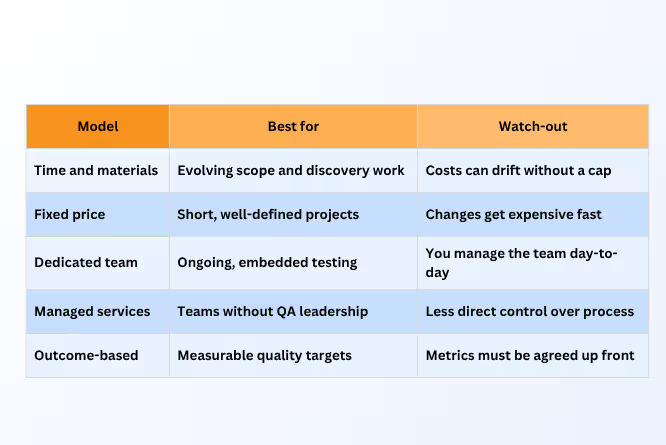
No model is best on its own. Many teams start with time and materials for a short discovery phase, then move to a dedicated or managed model once scope settles. Strong QA outsourcing services will explain which model they recommend and why.
Staff Augmentation vs. Managed QA: The Distinction That Matters
The most important split is between renting testers and hiring a team that owns the outcome. Staff augmentation gives you skilled testers who work under your direction. Managed QA gives you a vendor-led team accountable for results.
Staff augmentation fits when you already have QA leadership and just need capacity. Managed QA fits when you do not. If you want dedicated testers embedded in your sprints, IT staff augmentation services are built for that. Ask every provider of software QA services which of the two they are really selling.

Step 3: Score Vendors on a Nine-Point Scorecard
Gut feel is a poor way to compare vendors. A nine-point scorecard keeps the comparison fair. Use these criteria to evaluate any provider of software quality assurance services.
|
Criterion
|
What to ask
|
What good looks like
|
Red flag
|
|
Domain expertise
|
Which products in my industry have you tested?
|
Named case studies from your industry with measurable outcomes.
|
No relevant case studies
|
|
Certifications
|
Which standards do you meet, such as ISTQB or ISO 29119?
|
Current certifications with proof available on request.
|
Claims without proof
|
|
Technical breadth
|
Do you cover automation, API testing, integration testing, system testing, exploratory testing, performance, and mobile?
|
Documented coverage across automation, performance, API, integration, system, and exploratory testing, with named specialists for each.
|
Manual testing only
|
|
Tooling maturity
|
Do you pick tools on fit, such as Selenium, Playwright, or k6?
|
Tools chosen per project, with a clear rationale for each.
|
Locked into one proprietary tool
|
|
AI tooling and automation maturity
|
What share of your test coverage is AI-assisted, and which tools do you use?
|
A stated percentage of AI-assisted coverage, named tools, and human review of AI output.
|
No AI process, or vague “AI-powered” claims
|
|
Security
|
How do you protect test data? Do you hold SOC 2?
|
SOC 2 or equivalent, with a written test-data handling process.
|
No clear security process
|
|
Communication
|
Who is my daily contact, and what is our time-zone overlap?
|
A named daily contact, defined overlap hours, and fast replies from the first call.
|
Slow replies during the sales process, which predicts post-signature behavior
|
|
Transparent reporting
|
What will I see each week?
|
Weekly dashboards covering defects, coverage, and risks.
|
Month-end reports only
|
|
Proven results
|
Can I speak with two current clients?
|
Two reference clients available before you sign.
|
No references
|
For regulated work, ask about domain rules directly: HIPAA for healthcare and PCI-DSS for fintech.
How to Evaluate a Vendor’s AI Capability
Most legacy QA providers still sell manual tester hours. In 2026, the differentiator is AI-augmented delivery, which covers more surface area with fewer, higher-skilled engineers. Technical breadth should now include AI test generation, autonomous regression, and LLM output validation.
Ask three direct questions. What percentage of your test coverage is AI-assisted? Which AI tools do you use, such as Testim, Applitools, or Mabl? Can you validate LLM outputs for clients building AI products?
Also ask how the team handles tests automating repetitive workflows, maintains reusable test suites, and connects automated checks to ci cd pipelines. Vague answers, or “AI-powered” claims with no named tools or numbers, are a warning sign.
How to Weight and Score QA Outsourcing Services Vendors
A list of criteria is not a decision. Score each one from 1 to 5, then weight it by how much it matters to your product. Regulated work should weight security and certifications heavily. Fast release cycles should weight tooling, AI maturity, and communication.
Set minimum thresholds on the non-negotiables. A vendor that scores a 2 on security should be out, however low its price. Multiply each score by its weight, add them up, and shortlist the top two or three for a pilot. This is a practical method, not an industry standard, so adjust the weights to your situation.
Communication deserves extra weight. Testriq’s guide argues that communication, more than technical skill, is where outsourcing partnerships usually break down. For role-level checks on individual hires, see this guide to vetting remote QA engineers. Used together, the scorecard and the role checks make QA outsourcing services far easier to compare.
QA Vendors Worth Scoring First
Once you have your scorecard, you need names to run through it. These five providers are frequently cited in current buyer guides.
Ratings come from Clutch and should be verified before you rely on them. This is a starting shortlist, not a ranking. Score each one against your own weights.
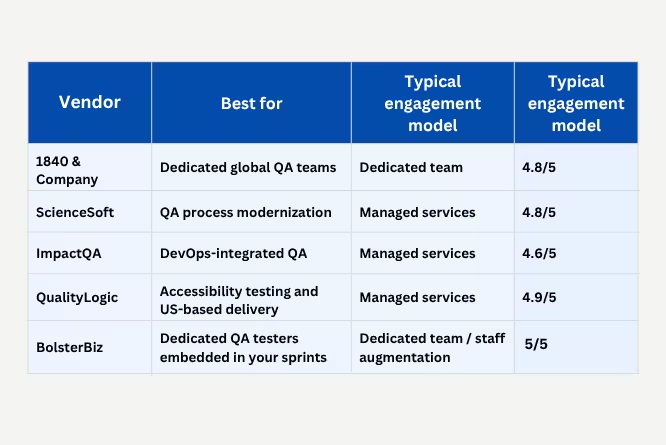
*Disclosure: BolsterBiz is the publisher of this guide. We have applied the same scorecard to ourselves and encourage you to do the same.
Step 4: Judge Cost by Total Cost, Not Hourly Rate
Hourly rates are the most quoted and least useful number in quality assurance outsourcing. QA engineer rates span roughly $8 to $140 per hour, an 18x spread, according to remote.qa, so a rate means little without seniority and scope behind it. Published rate guides also disagree with each other, because they blend countries, seniority levels, and tech stacks.
Accelerance’s 2026 Global Rates Report puts senior QA rates at 31–41/hr in Asia, 64–76/hr in Eastern Europe, and 60–75/hr in LATAM.
Team cost is easier to compare across QA outsourcing services. SoftwareTestPilot estimates a team of five costs $14,000 to $32,000 per month in India, $22,000 to $50,000 in LATAM, and $28,000 to $62,000 in Eastern Europe, against US onshore rates of $80 to $180 per hour.
That is where QA outsourcing earns its keep. SoftwareTestPilot reports typical savings of 40 to 70 percent versus an in-house US QA team, with a 55 percent median across the engagements it tracks. Testriq cites 40 to 60 percent.
Total cost also includes ramp-up time, tooling, script maintenance, and the cost of defects that escape to production. A cheaper vendor that leaks defects is rarely cheaper. The goal is to improve test coverage cost effectively without compromising product quality or release timelines. When you compare QA outsourcing services, price the whole engagement, and use staffing-style regional pricing as a cross-check; this guide to the top IT staff augmentation companies in the US shows how rates vary by region.
Step 5: Run a Time-Boxed Pilot Before You Sign
A pilot turns a sales pitch into evidence. Give the same scope to two shortlisted vendors, so the comparison is fair.
Start with clear test planning, define the scope of test executions, and agree written success criteria before work starts. Include regression checks to confirm that new releases do not affect existing functionality. Run the pilot for at least one full sprint or release cycle. That is recommended practice rather than an industry rule.
Measure four things:
- Defects found, including how serious and how well documented they are
- Framework quality, meaning how clean and maintainable the automation is
- Responsiveness, meaning how fast and clearly the team replies
- Reporting clarity, meaning whether you can see progress without asking
Track how well testers document defects and collaborate with developers on bug fixes, including whether issues are prioritized according to severity and release risk.
Watch how each vendor behaves before the pilot starts. Software Umbrella’s 2026 QA guide notes that slow responses during sales consistently predict poor communication after signing. Treat that as an early signal.
When the pilot ends, record the results in a simple scorecard so every stakeholder sees the same numbers. Then decide on the data, not gut feel. Good QA outsourcing services should welcome a pilot, and strong providers of software QA services usually offer one without being asked.
Red Flags and Contract Terms to Confirm
Some warning signs show up early. The biggest is a vendor that treats testing as headcount to rent instead of an outcome to own. Others include claiming to cover everything with no real specialization, locking you into proprietary tools, replying slowly during sales, reporting only at month-end, and offering no named QA lead.
The same warning signs apply when outsourcing other engineering work, as covered in this guide to backend development outsourcing. If a provider of QA outsourcing services shows two or more, keep looking.
Before signing, confirm these contract terms:
- Ownership of test assets and intellectual property
- Exit and transition support if you leave
- Replacement terms if a tester is not a fit
- Defect-escape tracking and reporting cadence
- Security and NDA coverage
Clear answers on all five are a good sign for any QA outsourcing relationship. Vague ones usually mean the provider’s software quality assurance services are thinner than the pitch suggests.
Conclusion
Choosing the right partner comes down to five steps: define your need, match the engagement model, score vendors, compare total cost, and run a pilot. There is no single best vendor, only the one that fits your problem and passes the pilot.
The market for QA outsourcing services is crowded, but a clear process cuts it down fast. Whether you choose staff augmentation or managed quality assurance outsourcing, ask specific questions, measure real results, and put the answers in the contract. Good QA outsourcing starts with good selection.
Ready to see how a dedicated QA team would work for you? Explore BolsterBiz QA outsourcing services and schedule a free call with our expert.
Frequently Asked Questions
1. How do I choose the best QA outsourcing company?
Define your need, match the engagement model, score vendors on a weighted scorecard, compare total cost rather than hourly rate, and run a pilot with two shortlisted vendors. The best provider is the one that fits your problem and proves it on real work.
2. How much do QA outsourcing services cost in 2026?
It depends on region and seniority. SoftwareTestPilot puts blended rates at $18 to $45 per hour in India, $28 to $70 in LATAM, and $35 to $85 in Eastern Europe. A team of five runs $14,000 to $62,000 per month across those regions for software QA services.
3. What certifications should a QA outsourcing company have?
Look for ISTQB-certified testers, ISO 29119 process compliance, and SOC 2 security certification. Regulated industries should also ask about domain rules, such as HIPAA for healthcare and PCI-DSS for fintech. Ask for proof, not just claims.
4. How long should a QA pilot run before I sign a contract?
Run it for at least one full sprint or release cycle, so the vendor faces real deadlines and real code. Give two shortlisted vendors the same scope, agree success criteria in writing, and compare defects found, framework quality, responsiveness, and reporting.
5. What is the difference between QA outsourcing and software testing outsourcing?
The terms are often used interchangeably, but they are not identical. QA is the broader discipline covering processes, standards, and defect prevention. Software testing is the execution layer, where tests are designed, run, and reported. Software testing outsourcing hands off the execution, while QA outsourcing can include the process and standards around it.
6. How do I know if a QA outsourcing company uses AI in its testing process?
Ask for specifics: what percentage of test coverage is AI-assisted, which tools they use (such as Testim, Applitools, or Mabl), and whether they can validate LLM outputs for AI products. A vendor with real AI capability will name tools, share numbers, and describe how humans review AI-generated tests. Vague “AI-powered” claims with no detail are a red flag.
-
This article is written by Sudhir Tomar. He is a content writer at BolsterBiz, covering niches like outsourcing, customer support, digital marketing, and more. He crafts content that informs, ranks, and connects with the right audience. Outside of work, Sudhir is passionate about sports, travel, and adding the perfect flavors to dishes. For any related queries reach at sudhir.tomar@bolsterbiz.com