What Is an SLA, and How Is It Different From a KPI?
These two terms get used interchangeably, but they’re not the same thing. A KPI (Key Performance Indicator) is a metric you track to understand how your customer service representatives are performing, useful for analysis and decision-making. An SLA is a contractual commitment to a minimum performance level, with financial penalties attached when your provider misses it.
The distinction matters in practice. Your KPI might be average answer rate. Your service level agreement outsourcing contract translates that into a specific commitment: 90% of calls answered within 30 seconds, with a defined penalty (often a percentage of the monthly invoice) if that threshold isn’t met. An SLA checklist without this contractual teeth is really just a KPI wishlist.


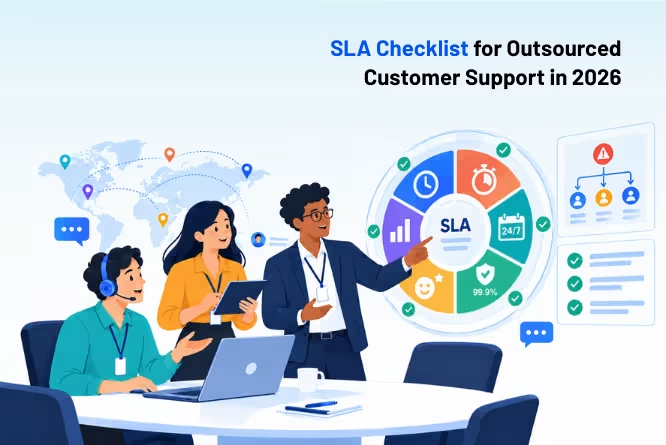
The Complete SLA Checklist for Outsourced Customer Support
Response Time Benchmarks by Channel
A blended, single response-time target across every communication channel hides where your provider is actually falling short. Break it out by channel instead:
- Phone calls: 20 to 30 second average answer time, with 80% of calls answered within that window (the standard 80/20 rule)
- Email: first response under 4 hours
- Chat: first response under 30 seconds
- Abandonment rate: under 5%, is often the direct result of excessive wait time, with anything above 8% signaling understaffing or poor forecasting on your provider’s side
This is the foundation of any real customer service SLA checklist, and everything else here builds on accurate, channel-specific response benchmarks. For a deeper breakdown of which metrics actually predict satisfaction, see BolsterBiz’s guide to metrics that define success in outsourced customer service.
Resolution and Quality Benchmarks
Speed without resolution quality just creates faster frustration. Check for:
- First Contact Resolution (FCR) above 70%
- CSAT in the 90 to 95% range, with anything below 80% treated as a serious warning signal
- A defined quality assurance scoring cadence for reviewing customer interactions, not an ad hoc or “as needed” review process
A service desk SLA that only measures speed and ignores resolution quality, especially on complex issues that need more than a scripted answer, is incomplete by design. Unity-Connect’s guide to SLAs in call centers covers channel-by-channel benchmarks in more depth.
AI and Automation SLA
By 2026, most outsourced support operations run at least some volume through AI agents or copilots that handle customer inquiries before a human ever touches the ticket, so a checklist that only covers human-staffed channels is already out of date. Confirm your contract specifies:
- AI-handled first response time, separate from human first response time (commonly sub-15 to sub-30 seconds for structured, high-volume intents like order status or password resets)
- A defined escalation trigger: the conditions under which an AI interaction must hand off to a customer service agent, and the maximum time that handoff is allowed to take
- A minimum AI resolution rate for the specific intents it’s deployed on, tracked separately from blended resolution numbers
- A re-contact rate ceiling for AI-resolved tickets, so a “resolved” AI conversation that gets reopened within 24–72 hours doesn’t quietly count as a win
Zendesk’s 2026 CX Trends research, based on surveys across 22 countries, found that a growing share of consumers now expect round-the-clock service driven by AI, which is part of why AI-handled response commitments are moving from a nice-to-have into a standard checklist item rather than a differentiator. If your provider can’t break out AI performance from human performance in reporting, that’s a gap worth flagging before you sign.
Escalation and Accountability Structure
When something goes wrong, ambiguity in service delivery is the enemy. Confirm:
- A clear escalation path defined in writing, not left to informal judgment calls
- A named accountable owner on both your side and your provider’s side
- A tiered penalty structure that distinguishes minor variance from a material SLA breach, rather than treating every miss identically
- A documented service scope definition, spelling out exactly which channels, business hours, languages, and ticket types the SLA covers, so nothing falls into an undefined gray area
This is where most customer service outsourcing SLA agreements fall apart in practice: penalties exist on paper but were never actually structured to scale with the severity of the miss. Escalation structure ties directly into service quality standards, covered in BolsterBiz’s breakdown of the 5 principles of quality customer service that your escalation process should protect.
Reporting and Governance
Your service teams can’t manage what you can’t see. Your checklist should include:
- Real-time or near-real-time performance dashboards, not monthly PDF summaries delivered after the fact
- Monthly or quarterly business reviews scheduled directly into the contract, not offered informally
- Clear data ownership and compliance terms, especially for any provider handling sensitive customer data
An SLA checklist missing this category leaves you managing the relationship reactively instead of proactively.
Scalability and Contract Flexibility
Support volume rarely stays flat as your customer base grows or contracts, and your contract should account for that:
- A defined process for scaling dedicated agents up or down as volume shifts
- A pilot period before committing to a long-term contract
- Clear opt-out or renegotiation terms, not a rigid lock-in with no exit path
- A scheduled SLA review and revision clause, setting a fixed cadence (e.g., every 6 or 12 months) to renegotiate benchmarks as volume, channels, or AI capabilities change
How SLA Tiers Affect Customer Service Outsourcing Pricing
Service level and price are directly linked, and no SLA checklist is complete without acknowledging that connection. Tighter commitments, faster response times, stricter penalty structures, and round-the-clock coverage cost more, because they require a larger customer support team, better forecasting tools, and tighter management overhead on your provider’s end.
Customer service outsourcing pricing typically scales in tiers. Standard-tier SLAs, with looser response windows and lighter penalty structures, cost less but carry more risk if things go wrong during a volume spike. Premium-tier SLAs, with sub-30-second chat responses, defined AI escalation commitments, and strict 24/7 coverage, command a meaningfully higher rate, but reduce your exposure when support volume becomes unpredictable.
The mistake most buyers make is negotiating price first and SLA terms second. It should run the other way: define the service level your business actually needs, then let that drive the customer service outsourcing pricing conversation, not the reverse. For a full breakdown of what different pricing models and SLA tiers actually cost, see BolsterBiz’s in-house vs. outsourced customer service cost comparison.
Red Flags When Reviewing an Outsourcing SLA

A few warning signs are worth catching before you sign anything.
- Watch for vague “reasonable effort” language standing in for specific numbers. “Reasonable effort” isn’t measurable, so it isn’t enforceable.
- Be cautious of contracts with no penalty structure attached to missed commitments. An SLA without consequences is just a suggestion.
- Check for a defined escalation path. Without one, you’re negotiating what “urgent” means in the middle of an actual crisis.
- Confirm benchmarks are broken out by channel rather than blended into one number. A blended average can hide serious underperformance on your highest-volume channel.
Conclusion
A real SLA checklist ties every commitment to a specific, measurable number, not aspirational language that sounds good in a sales deck but means nothing when support volume spikes. Cover response time by channel, resolution and quality standards, AI and automation commitments, escalation and accountability, reporting cadence, and scalability, and you have a contract that actually protects your business rather than one that just looks thorough on paper.
Whatever provider you choose, remember that customer service outsourcing SLA terms and pricing move together. Define the service level you need first, then negotiate cost against that baseline.
Ready to build an outsourced support relationship backed by real, enforceable SLA terms? Talk to BolsterBiz about your customer support strategy today.
Frequently Asked Questions
1. What should be included in an SLA checklist for outsourced customer support?
A complete checklist covers response time benchmarks by channel, resolution and quality standards (FCR and CSAT), AI and automation commitments, a defined escalation and accountability structure, reporting and governance cadence, and contract flexibility for scaling. Every item should have a specific number attached, not vague language.
2. What is the difference between an SLA and a KPI in customer support outsourcing?
A KPI is a metric you track to understand performance, like average answer rate. An SLA is a contractual commitment to a minimum performance level with financial penalties attached if missed, such as 90% of calls answered within 30 seconds or a penalty applies.
3. What is a good customer service response time SLA?
Strong 2026 benchmarks are 20 to 30 seconds for phone (80% of calls within that window), under 4 hours for email first response, and under 30 seconds for chat first response, with AI-handled responses often sub-15 to sub-30 seconds on structured intents. These should be tracked separately by channel and by human vs. AI handling, not blended into a single average.
4. What happens if an outsourced provider misses their SLA?
A well-structured contract includes a tiered penalty framework, often a percentage credit against the monthly invoice, scaled to the severity of the miss. Minor variance should be treated differently from a material, repeated breach, with escalating consequences for the latter.
-
This article is written by Sudhir Tomar. He is a content writer at BolsterBiz, covering niches like outsourcing, customer support, digital marketing, and more. He crafts content that informs, ranks, and connects with the right audience. Outside of work, Sudhir is passionate about sports, travel, and adding the perfect flavors to dishes. For any related queries reach at sudhir.tomar@bolsterbiz.com