Omnichannel Customer Experience vs. Multichannel vs. Cross-Channel
Three terms get mixed up. Multichannel means many channels run side by side, each with its own data and team. Cross-channel lets a customer move between channels, but only some context carries over. A true omnichannel customer experience treats every channel as one conversation.
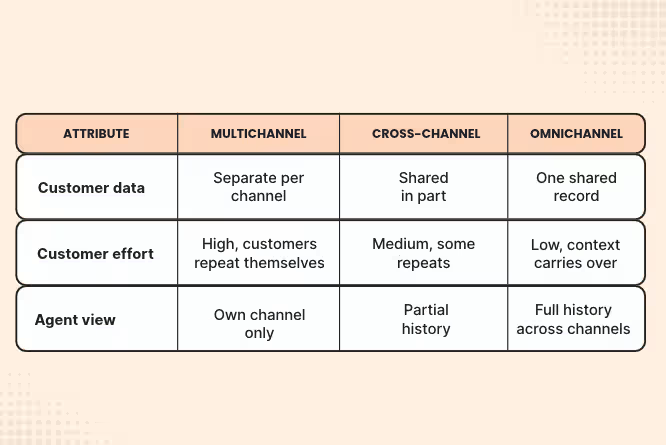
The channels involved are usually voice, plus digital channels such as chat, email, SMS, social messaging, and self service. chat, email, SMS, social messaging, and self service. Customers judge the experience by one thing: did anyone make me start over? If yes, you have multichannel, whatever your slide deck says.
What It Looks Like in Practice
A customer chats about a late refund and gets asked for her order number. The bot says an agent will email her. Two days later she makes a phone call, and the agent asks for the order number again, then the whole story. She emails once more to confirm. That is three channels, three restarts.
With a shared record, the chat agent logs the case. The phone support agent opens it, sees the order and the earlier chat, and confirms the refund date in one call. The email arrives automatically, already referencing the call. Same customer, same issue, one conversation.
Omnichannel Terms Untangled: CX, Support, Marketing, and Engagement
Vendors use these four phrases as if they mean the same thing. They do not, and the difference decides who owns what.
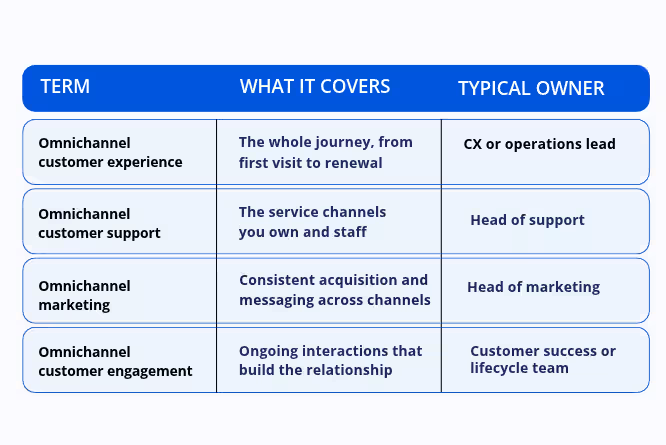
The two that cause the most confusion are support and marketing. Omnichannel customer support is the part your service teams run. Omnichannel marketing is how your brand shows up before anyone talks to you.
Marketing, including digital marketing, owns the front half of the journey and support owns the back half. A shared record starts with data you collect yourself, which is why first party data and cookieless marketing belong in the same conversation.
Why Omnichannel Customer Experience Matters: What the Data Shows
Start with the freshest sources. In the Glance Customer Experience 2026 Trends Report (company survey, 600 US consumers, October 2025), 93% said they sometimes or almost always repeat themselves when switching support channels. That breaks down to 44% almost always, 49% sometimes, and 7% rarely or never.
Speed and accuracy matter too. Zendesk’s CX Trends 2026 reports that 86% of consumers say responsiveness and accurate resolution strongly influence whether they buy.
The older research points the same way, so treat it as context, not current proof:
- Salesforce’s State of the Connected Customer (6th edition) found that 79% of customers expect consistent interactions across departments, and 56% often have to repeat or re-explain information to different representatives.
- A 2017 Harvard Business Review study of 46,000 retail shoppers found that 73% used multiple channels. They spent about 4% more in store and 10% more online, and made 23% more repeat trips within six months.
The pattern holds across every source: A connected experience lowers effort, and lower effort supports loyalty across your customer base.


How to Build an Omnichannel Customer Experience
You do not need a new platform on day one. You need a clear map, one customer record, and people who use both.
Step 1: Map the journey. List every touchpoint a customer uses, from search and website to chat, phone, and email. Mark where people make a cross channel switch and where they drop off. This map shows where your omnichannel customer experience breaks today, and it gives every later step a target.
Step 2: Connect data into one customer record. Pull orders, tickets, chats, and call notes into one profile that your CRM and help desk both read. If agents must search three tools, customers will repeat themselves. Treat that profile as your single source of truth and fix duplicates early.
Step 3: Give every agent the same view. Every support team needs the same history, whatever channel the customer used. That includes any team supplied through customer support outsourcing. Omnichannel customer support only works when one queue shows the full conversation. Test it by handing a case from chat to phone.
Step 4: Standardize quality and brand voice. A customer should hear the same tone and get the same accuracy on chat, email, and phone. Write one set of quality customer service principles, score every channel against it, and coach to the gaps. Consistency is what makes an omnichannel experience believable.
Step 5: Add automation that hands off with context. Bots and automated messages work for simple questions and status updates. The rule is the handoff: when a human takes over, the full transcript and customer record go with it. Done well, automation lifts omnichannel customer engagement instead of resetting the conversation.
Step 6: Measure, review, and adjust. Review your measures monthly and sit in on real conversations. Look for friction that repeats, such as a channel switch that always triggers a second contact. Fix one cause at a time, then check whether the numbers moved.
What Technology Do You Need?
An omnichannel customer experience platform is software that unifies customer conversations and data from every channel into one record and one agent workspace. You can buy it as a suite or assemble it from parts. Either way, you need four things:
- CRM: the system of record for who the customer is and what they bought.
- Unified help desk or agent workspace: one queue where chat, phone, email, and messaging threads sit together.
- Identity matching or a customer data platform (CDP): links the same person across email, phone number, and account ID.
- Cross channel reporting: dashboards that follow the journey, not one channel at a time.
Cost depends on platform seats, integration work, and headcount across channels and hours. Prices vary widely by vendor and volume, so get quotes before you budget.
Where AI Fits
AI helps most at the handoff. A bot can answer routine questions, but when it passes a case to a human agent, the transcript, customer record, and what the bot already tried should travel with it. Zendesk’s CX Trends 2026 names AI that carries context across channels and over time as one of its five shifts. If your AI resets the conversation, it adds a new silo instead of removing one.
How to Measure Omnichannel Customer Experience
Most dashboards report each channel alone, which hides the problem. These are recommended measures, not industry standards, built to show the full journey. For the formulas behind the basics, see these customer satisfaction KPIs. To judge omnichannel customer experience, track:
- Repeat contact rate: how often a customer contacts you again about the same issue, a direct read on channel switching friction.
- First contact resolution across channels: issues solved without a follow up, counted even when the customer changes channel.
- Journey completion rate: the share of customers who finish a task, such as a return or a booking, without giving up.
- Customer effort score across the full journey: one effort question at the end of the journey, not after each channel.
- Omnichannel NPS: one loyalty score for the whole relationship, not a separate NPS per channel.
- Cross channel conversion rates: the share of customers who buy after moving between channels.
Who Runs Your Omnichannel Experience? In-House vs. Outsourced
Technology is only half the work. CloudTechGurus puts omnichannel success at roughly 20% technology and 80% people and process. That is one firm’s view, not a measured statistic, but it matches what many teams learn the hard way.
You can build the customer service team in-house or work with a customer support outsourcing partner. Many companies blend both. In Deloitte’s Global Outsourcing Survey 2024, 80% of executives planned to maintain or increase third party outsourcing, while 70% had selectively brought some outsourced scope back in house over five years. Weigh the pros and cons of outsourcing against your volume and budget first.
Yoummday reports that top outsourced operations reach 85% to 90% CSAT and first contact resolution, and that outsourcing customer service cuts costs 60% to 70% versus building in-house. These are vendor figures, so test them against your own numbers.
Outsourced customer support only helps if the partner works inside your data. Ask any provider to show you:
- Access to your CRM and the full customer record
- One queue across channels, not a separate team per channel
- The same QA and brand standards as your own team
- Cross channel reporting you can read yourself
To compare providers, start with this list of omnichannel customer support outsourcing companies. Good outsourced customer support should look like part of your team, not a side desk.
Common Omnichannel Pitfalls
Most failures come from a few repeat mistakes:
- Channel sprawl without shared data. Adding channels before connecting them multiplies repeat contacts.
- Treating it as a software purchase. A platform helps, but nobody owns the journey after launch.
- Outsourcing one channel in isolation. Outsourced customer service cut off from your records recreates the silo.
- Measuring channels separately. Per channel scores can look healthy while the journey fails.
- No single owner. Someone has to answer for the whole omnichannel customer experience.
Are You Ready? A 5 Question Check
Answer yes or no:
- Do all your channels read from one customer record?
- Can an agent on any channel see the full history of a case?
- Do you track repeat contacts and journey completion, not just per channel scores?
- Does one named person own the whole customer journey?
- If you outsource a channel, does the partner work inside your CRM and queue?
Five yes answers means you are ready to scale. Three or four means fix the gaps first. Two or fewer means start with Step 1 and map the journey.
Conclusion
A strong omnichannel customer experience rests on four things: connected data, a shared agent view, consistent quality, and the right people to run it. Skip one and customers feel the gap first.
If you lack the people or the hours, customer service outsourcing can fill the gap, as long as the partner works inside your data and your standards. That keeps the omnichannel experience intact when volume rises. Whichever route you take, measure the whole journey, not one channel at a time.
Ready to talk it through? Talk to BolsterBiz.
Frequently Asked Questions
1. What is omnichannel customer experience?
Omnichannel customer experience is a service model that connects every channel through shared customer data. A customer can start on chat, continue by phone, and finish by email without repeating themselves. It covers the whole journey, from first visit to post purchase support.
2. What is the difference between omnichannel and multichannel customer experience?
The difference is connection. Multichannel offers several channels that run separately, each with its own data. Omnichannel links them through one customer record, so context follows the customer. The result is less repeating, fewer handoffs, and less effort.
3. How do you measure omnichannel customer experience?
Measure the whole journey, not each channel alone. Useful measures include repeat contact rate, first contact resolution across channels, journey completion rate, customer effort score, and omnichannel NPS. Review them monthly to spot where channel switching creates friction.
4. Can outsourced customer support deliver an omnichannel experience?
Yes, if the partner works inside your systems. It needs access to your CRM and customer record, one queue across channels, and the same quality standards as your team. Without those, outsourced customer support recreates the silos omnichannel is meant to remove.
It is software that pulls conversations and data from every channel into one customer record and one agent workspace. Typical parts include a CRM, a unified help desk, identity matching, and cross channel reporting. It lets any agent pick up a case without asking the customer to start over.
6. What are examples of omnichannel customer experience?
A customer chats about a late order, then calls, and the phone agent already sees the chat. A shopper starts a return in an app and finishes it in store without re-entering details. A bank customer begins a loan query online and completes it with an advisor who has the full file.
-
This article is written by Sudhir Tomar. He is a content writer at BolsterBiz, covering niches like outsourcing, customer support, digital marketing, and more. He crafts content that informs, ranks, and connects with the right audience. Outside of work, Sudhir is passionate about sports, travel, and adding the perfect flavors to dishes. For any related queries reach at sudhir.tomar@bolsterbiz.com